
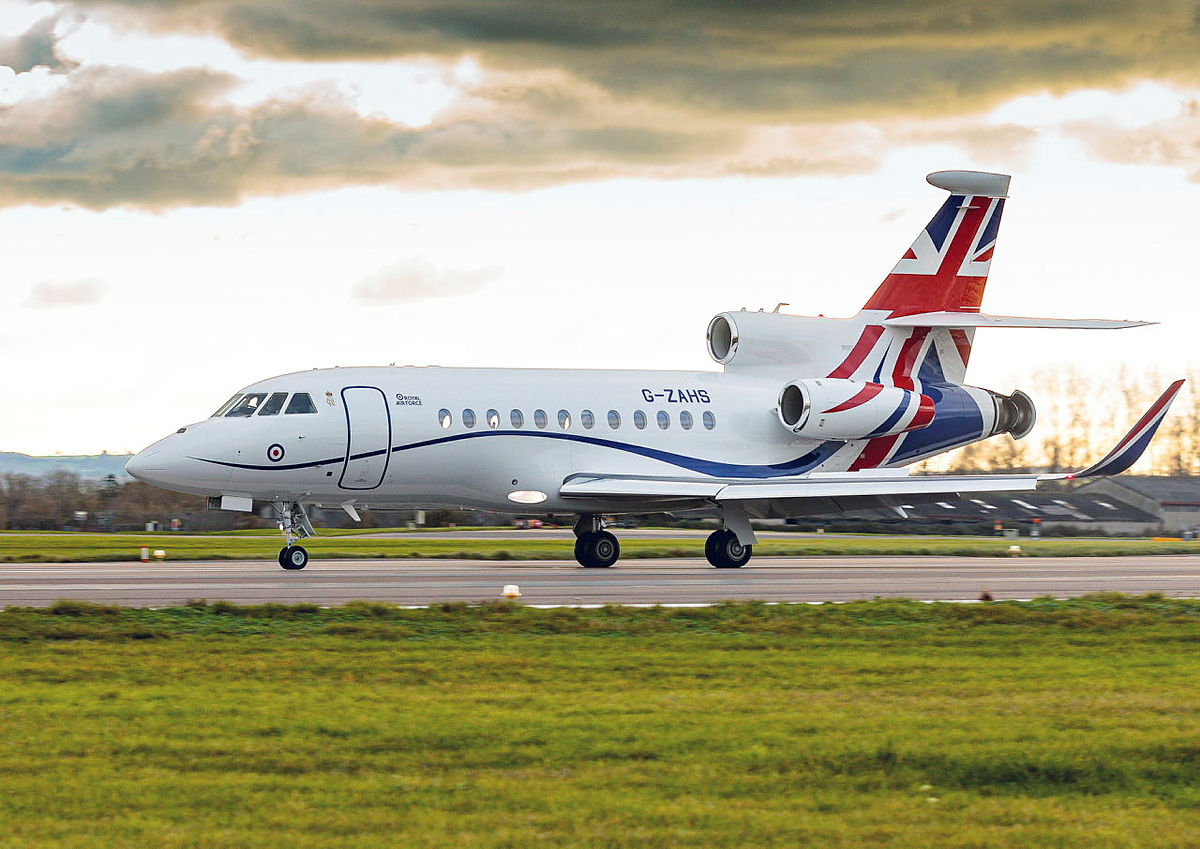
The United Kingdom’s Ministry of Defence (MOD) has announced a two-year extension of its support contract for the Royal Air Force’s (RAF) two Envoy IV business jets. This extension, costing up to £26 million, comes after a competition intended to secure longer-term support and military modifications for the aircraft failed to attract an affordable bid.
The contract modification, published on August 28, provides new context to the ongoing delay in efforts to enable the two Dassault Falcon 900LX aircraft to operate in more challenging, or “non-benign,” airspace. Work on this capability, as previously reported, currently lacks a definitive date for resumption.
Designated as Envoy IV in RAF service, the jets are presently operated from RAF Northolt. They are registered on the Civil Aircraft Register (CAR) and are flown by a combination of civilian and military pilots. Their existing Phase 1 support contract with Centreline Aviation Limited was originally set to expire on March 31, 2027.
Under the initial Command Support Air Transport (CSAT) programme, a subsequent Phase 2 was planned. This phase was designed to provide long-term in-service support, integrate military modifications, and facilitate the transfer of the aircraft from the Civil Aircraft Register to the Military Aircraft Register (MAR).
A recent procurement notice confirms that the MOD did indeed initiate a competition for this Phase 2 requirement but ultimately abandoned the process in late 2025. The department explicitly stated: “The CSAT Phase 2 requirement, for enduring in-service support and military modification under the Military Aircraft Register (MAR), was competed under Contract Notice Ref: 2023/S 000-036566. The Invitation to Negotiate was withdrawn on 14 November 2025 due to receipt of only one tender, which was deemed unaffordable.”
While the disclosure does not explicitly state that the failed competition was the direct cause for the pause in work related to non-benign airspace operations, it does establish that the broader procurement strategy to transition the Envoy IV onto a more robust military footing had faltered before ministerial confirmation of delays in the military modification programme.
In June, Conservative Member of Parliament Ben Obese-Jecty inquired with the MOD about the duration of the pause concerning Envoy IV operations in non-benign airspace. Minister for Defence Readiness and Industry, Luke Pollard, responded, confirming the pause and stating, “there is currently no definitive date for when this activity will recommence. The Department’s programme priorities are kept under regular review to ensure alignment with operational requirements and available resources.”
Minister Pollard had previously informed Parliament that various options were under consideration to enhance the future capabilities of the aircraft, including military modifications. However, he noted that this work was “currently paused whilst other activity has been prioritised.”
The military modification programme was conceived to equip the Envoy IV with capabilities essential for operations in more demanding threat environments. These enhancements included defensive aids, secure communication systems, and the necessary certification to allow the aircraft to operate under full military protocols. Instead of proceeding with the original Phase 2 procurement, the MOD will now extend the existing arrangement with Centreline Aviation Limited until March 31, 2029, while simultaneously preparing for a new competition.
The department has stated: “Due to the failure of the Phase 2 competition, the UK MOD intends to modify the existing Phase 1 Contract with Centreline Aviation Limited pursuant to Regulation 72(1)(b) of the Public Contract Regulations 2015.”
The amended contract will ensure the continued operation and in-service support for both Envoy aircraft. Additionally, it will encompass what the MOD describes as “preparatory and enabling activity associated with potential transition from the CAR to the MAR.” This interim arrangement will also maintain airworthiness management, safety case ownership, crew qualifications, and operational approvals while a longer-term solution is devised.
The specific phrasing, “preparatory and enabling activity associated with potential transition,” is notable. It indicates that the modification facilitates preliminary steps towards military registration rather than signaling the immediate resumption or completion of the full military modification programme itself.
The MOD justifies the extension by stating it requires sufficient time to conduct another competition for enduring support, which is intended to cover the aircraft’s projected out-of-service date in April 2037. This new competition process will also allow for at least six months for any new contractor to transition into government-provided facilities located at RAF Northolt. According to the notice, this measure is designed to prevent “an interruption to this essential military capability at a time of rising global tension.”
The MOD further clarified: “The modification will extend the duration of the contract for 2 years and is intended solely as an interim measure. The anticipated maximum value of the modification is £26M.” This change increases the stated value of the current contract from £80 million to £106 million, excluding Value Added Tax (VAT). The modified arrangement will also be classified as a Qualifying Defence Contract under the Defence Reform Act 2014 and Single Source Contract Regulations.
The Envoy IV aircraft were acquired to replace the RAF’s BAe 146 fleet and entered service in 2022. The original procurement strategy envisioned the Falcons initially operating under civilian registration with contractor airworthiness responsibility. This was to be followed by a subsequent military phase that would transfer them onto the Military Aircraft Register and establish their long-term support model.
For the immediate future, Centreline Aviation Limited will continue to operate and maintain the two aircraft until March 2029. During this period, the MOD will conduct a new competition for enduring support, while the separate work required to enable Envoy IV operations in non-benign airspace remains without a publicly announced restart date.
Why This Matters
The MOD’s decision to extend its current support contract for the Envoy IV business jets, coupled with the failure of a crucial procurement competition, carries significant implications for the UK’s defence capabilities and procurement strategies. The Envoy IV aircraft serve a vital role in strategic air transport, often used for VIP transport and other high-priority missions. Delays in equipping these aircraft for “non-benign airspace” mean they remain limited to less contested environments, potentially hindering their utility in evolving global security scenarios where the ability to operate safely in challenging conditions is paramount.
Financially, the £26 million extension, which pushes the total contract value to £106 million, underscores potential inefficiencies and increased costs when procurement processes encounter setbacks. The failure of the Phase 2 competition, specifically the receipt of only one unaffordable bid, highlights potential challenges within the defence industrial base, either in terms of market interest, the specificity of the MOD’s requirements, or the perceived commercial viability of the proposed solution. Such failures can lead to delays in capability delivery and necessitate costly interim measures, ultimately impacting the taxpayer.
Furthermore, the reliance on civilian registration and contractor support, even for a military asset, raises questions about the long-term strategic control and operational flexibility of these aircraft. The eventual transition to the Military Aircraft Register and the integration of military modifications are crucial for ensuring the jets can be fully integrated into military operations, exercise complete sovereign control, and be equipped with necessary defensive and communication systems for modern threats. The continued delay in this transition means a persistent gap in the RAF’s intended capabilities for these specific platforms, especially at a time when the MOD itself notes “rising global tension.” This situation reflects a broader challenge in modern defence procurement: balancing the need for advanced capabilities with realistic timelines, budgets, and market engagement.