
The Pentagon has finalized a significant new agreement to acquire guidance kits that transform standard rockets into highly effective, precision-guided weapons, primarily for countering unmanned aerial systems (UAS), commonly known as drones.
BAE Systems and the U.S. Department of Defense announced a comprehensive framework deal that could span up to seven years. This agreement stipulates the annual production of 25,000 Advanced Precision Kill Weapon System (APKWS) guidance kits specifically for the U.S. military. In addition to domestic needs, the deal makes provisions for an extra 10,000 kits to be produced each year for international customers, reflecting a growing global interest in this versatile system.
The APKWS is a laser-guidance system designed to convert existing 2.75-inch unguided rockets into precision munitions. This conversion significantly enhances the accuracy and effectiveness of these rockets, allowing them to hit specific targets with high precision. The system is currently in active service with all major branches of the U.S. military, including the Air Force, Army, Marine Corps, and Navy, as well as with several U.S. allied nations.
Over the past few years, the APKWS has emerged as the preferred method for U.S. warplanes operating in the Middle East to engage and neutralize drones launched by Iran and Iranian-backed militant groups. However, its utility extends beyond air-to-air engagements. APKWS-equipped munitions can be deployed from various platforms for a wide range of applications, including air-to-surface, surface-to-surface, and surface-to-air operations, highlighting its adaptability across different combat scenarios.
A key factor driving the Pentagon’s investment in APKWS is its cost-effectiveness. Officials estimate the cost of an APKWS kit at approximately $35,000. This relatively low cost provides the Air Force and other branches with an economical solution for neutralizing drone threats without expending significantly more expensive traditional air-to-air missiles. For comparison, an Advanced Medium-Range Air-to-Air Missile (AMRAAM) costs roughly $1 million per unit, while AIM-9 Sidewinder missiles, depending on the variant, can cost hundreds of thousands of dollars, with the most advanced AIM-9X model priced around $500,000. This substantial cost difference allows for a more sustainable and economically viable defense strategy against pervasive drone threats.
The air-to-air application of APKWS was first tested in 2019. While the U.S. Air Force did not immediately prioritize this role, interest intensified a few years later, culminating in its combat fielding in 2024. Former Air Force Chief of Staff Gen. David Allvin noted the organic nature of this adoption, stating in an interview, “We were on the wrong side of the cost curve in our munitions employment. The great thing about it is that there wasn’t a formal requirement set out for this. This was sort of organic. People started figuring it out without it being a big program of record. Good thing they did.”
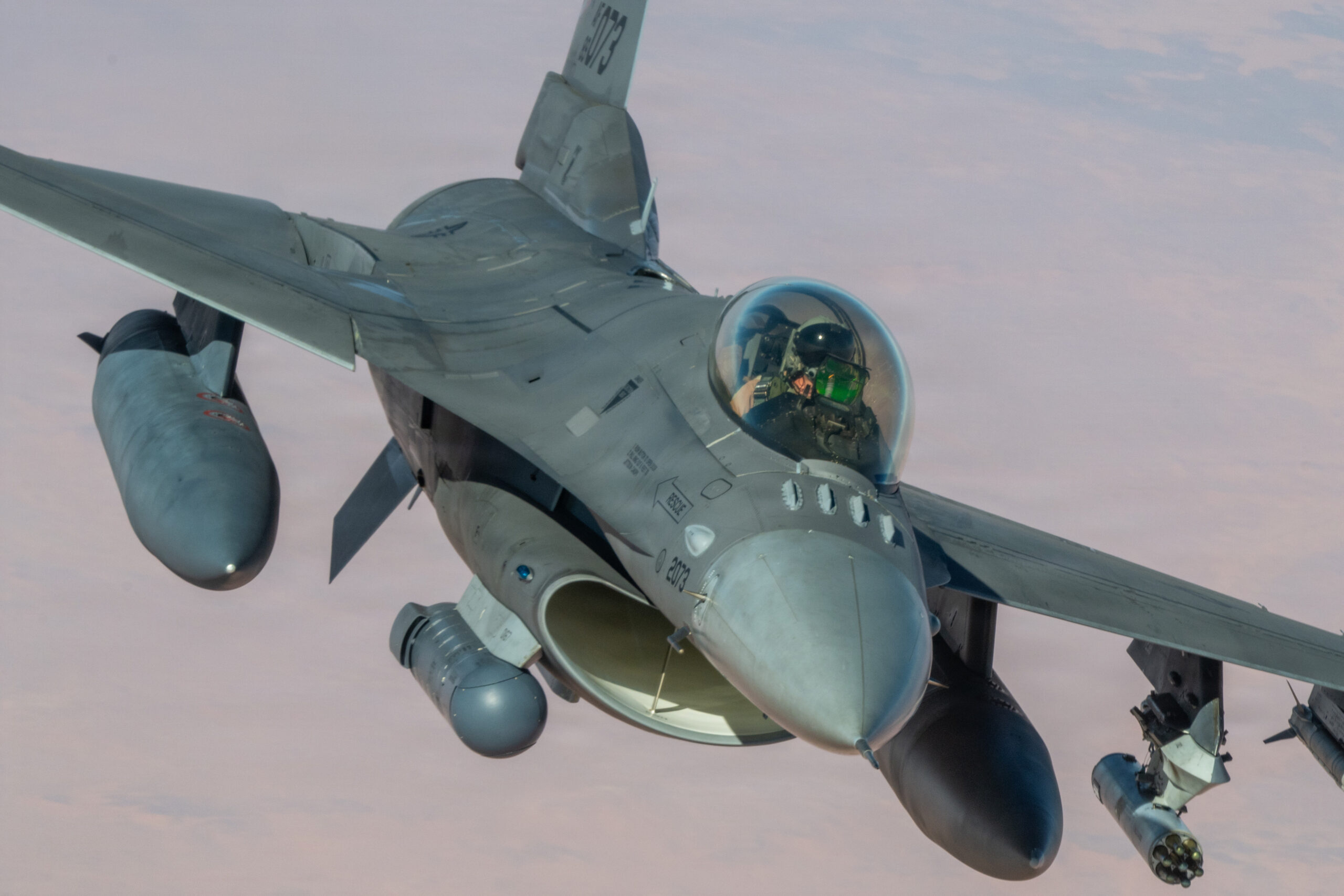
Following its successful combat debut, the Pentagon has demonstrated increased confidence in the future of APKWS. The system achieved its inaugural combat air-to-air kill in the fall of 2024 in the Middle East, executed by an F-16 from the 510th Fighter Squadron based at Aviano Air Base, Italy. Subsequently, when the 480th Fighter Squadron from Spangdahlem Air Base, Germany, deployed to the Middle East, they reported dozens more aerial kills, contributing to a total of 108 drone eliminations using various weapons during their deployment.
By the spring of 2025, the Air Force rapidly expanded the system’s deployment, commencing flight testing of APKWS on F-15E Strike Eagles and fielding the capability in the Middle East within approximately one week. Concurrently, U.S. Air Forces in Europe integrated APKWS into its air-to-air training regimens. The system has also been adapted for use on A-10 Thunderbolt II aircraft for drone interception.
The APKWS system traces its origins to the decades-old Hydra rocket system and was initially developed as a precision air-to-ground weapon, first deployed in 2012 during the Global War on Terror. Its adaptation to an air-to-air role was driven by Air Forces Central (AFCENT), then commanded by Lt. Gen. Alexus G. Grynkewich from 2022 to 2024, who sought cost-effective alternatives to expensive air-to-air missiles for countering the increasing drone threat. This effort received significant support from both U.S. Central Command (CENTCOM) and the broader Air Force leadership.
The newly announced framework agreement signals the Pentagon’s long-term procurement intentions, though specific contracts will be subject to annual congressional funding allocations. BAE Systems indicated that the agreement would facilitate the expansion of production capabilities at its facilities in Hudson, New Hampshire, and Austin, Texas.
Tom Arseneault, President and CEO of BAE Systems, emphasized the strategic importance of the deal: “This agreement highlights the importance of sustained investment in critical munitions to strengthen readiness and equip forces for evolving operational needs.” Michael Duffey, Undersecretary of Defense for Acquisition and Sustainment, added, “By securing multiyear demand, this agreement keeps production lines running at capacity, provides our forces with interceptor inventory, and flips the cost calculus in the taxpayer’s favor.”
Beyond its airborne applications, APKWS also possesses ground-to-air capabilities. The modifications required to engage aerial targets primarily involve software adjustments and the integration of a proximity fuse. It can be integrated with various anti-air systems, such as Sierra Nevada Corporation’s BRAWLR, currently deployed by the U.S. military overseas, and L3Harris’ VAMPIRE system, which is in use by Ukraine and is also being supplied to the U.S. The system has also been successfully integrated onto fighter platforms of other nations and tested on the MQ-9 Reaper drone.
Retired Lt. Gen. Derek C. France, who led Air Forces Central from April 2024 to August 2026, underscored the enduring nature of the drone challenge in a recent interview: “This drone problem is not going away. It’s accelerating in tactics, speed, advancements, and the numbers. That’s the direction that we’re going.”
Why This Matters
The Pentagon’s substantial investment in the Advanced Precision Kill Weapon System (APKWS) represents a critical adaptation to the evolving landscape of modern warfare, particularly the proliferation of inexpensive unmanned aerial systems (UAS) or drones. This agreement has several profound implications for defense strategy, military economics, and global security.
Firstly, it addresses a fundamental challenge: the unsustainable cost exchange ratio when using high-value interceptor missiles against low-cost drones. Adversaries can deploy swarms of drones, some costing only a few thousand dollars, designed to overwhelm conventional air defenses. Using missiles that cost hundreds of thousands or even a million dollars per shot to counter these drones quickly depletes expensive inventories and places a disproportionate economic burden on the defender. The APKWS, at approximately $35,000 per kit, offers a significantly more economical solution, effectively “flipping the cost calculus” in favor of the taxpayer and allowing military forces to engage threats without rapidly exhausting their most advanced and costly munitions.
Secondly, this deal enhances operational readiness and sustainability. By securing a long-term, high-volume production agreement, the Pentagon ensures a steady supply of these crucial counter-drone munitions. This is vital for ongoing operations in regions like the Middle East, where Iranian-backed militias frequently employ drones, and for potential future conflicts where drone warfare is expected to play an even larger role. A robust inventory means U.S. forces and allies can maintain defensive postures without concern for depleting essential assets.
Thirdly, the versatility of APKWS across multiple platforms and roles (air-to-air, air-to-surface, surface-to-air, and ground-based) signifies a flexible and adaptive approach to defense. Its integration onto various aircraft, including fighter jets and even drones like the MQ-9 Reaper, along with ground-based systems, demonstrates a comprehensive strategy to counter drones from diverse angles. This adaptability is crucial as drone threats themselves become more sophisticated and varied in their deployment methods.
Finally, the agreement strengthens the defense industrial base and supports international security. By guaranteeing multi-year demand, BAE Systems can maintain and expand its production capabilities, ensuring economic stability and technological advancement in this critical sector. Furthermore, the provision for international customers underscores the collaborative effort to build collective security against common threats. Equipping allies with this cost-effective counter-drone technology not only enhances their defensive capabilities but also promotes interoperability and burden-sharing in addressing global security challenges posed by the proliferation of drones.