
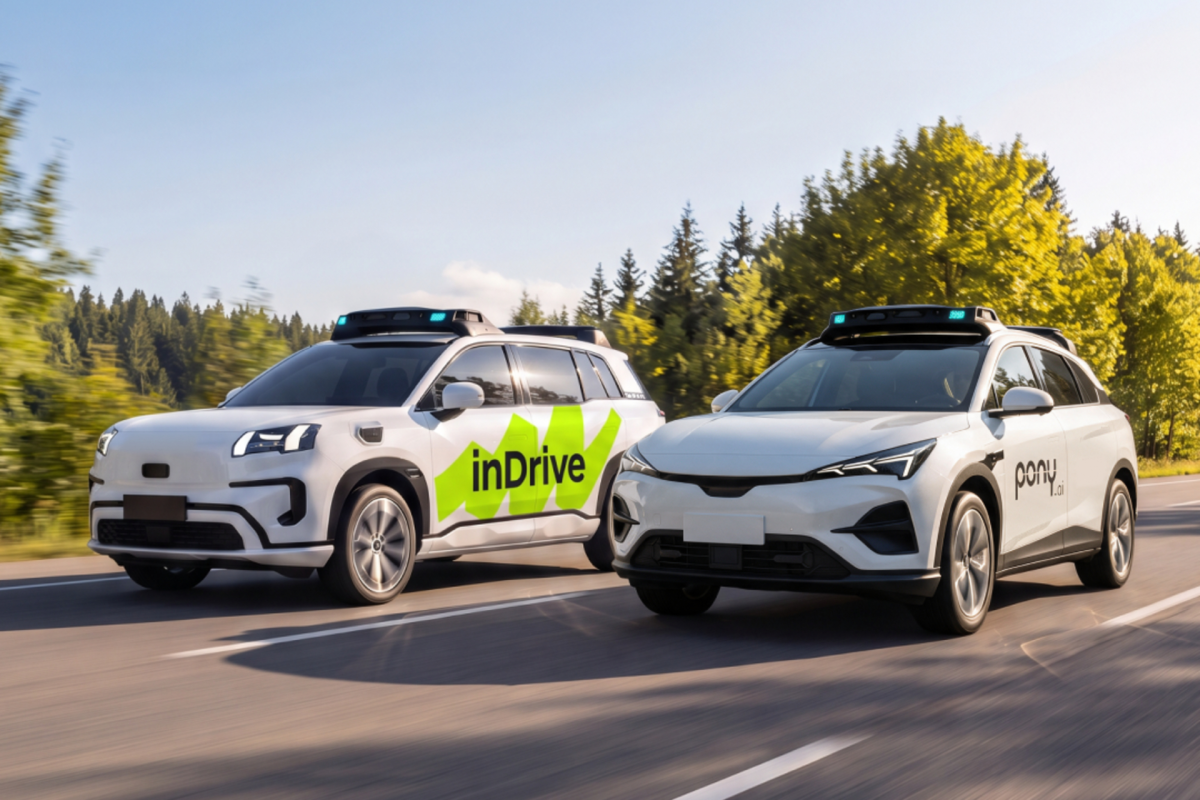
Ride-hailing company inDrive, known for letting passengers and drivers negotiate fares, is working with Chinese autonomous driving firm Pony.ai and Nvidia to begin testing robotaxis in Kazakhstan in 2027.
The companies said Friday that they had signed a memorandum of understanding to explore bringing Pony.ai’s robotaxis to inDrive’s platform — a reflection of the growing interest in self-driving technology beyond the U.S. and China.
Testing will begin in Kazakhstan’s capital, Astana, in the first half of 2027, inDrive CTO Yuri Misnik told TechCrunch. The tests will initially involve a safety operator, with fully driverless rides as the eventual goal.
Under the proposed plan, Pony.ai would provide its Gen-7 robotaxis, which inDrive would offer through its ride-hailing app and operate in Kazakhstan. Nvidia, on the other hand, would supply the AI technology, including its Hyperion platform and Halos safety system.
The move comes as ride-hailing companies expand their push into robotaxis. Earlier this month, Uber announced plans to test Pony.ai’s robotaxis in London, where it has also started offering supervised autonomous rides with British startup Wayve, an investor-backed partner. Uber is also working with multiple robotaxi companies in other markets, including the Middle East.
inDrive, which has built its business around affordable rides, is looking to bring a similar focus to autonomous ride-hailing as it explores a market where Uber and other rivals are already making moves.
“Our approach is capital-light by design,” said Misnik. “We work with a range of partners in different markets, combining their expertise with ours to deliver a better customer experience.”
Nvidia says its Hyperion platform could lower the cost of developing robotaxis by giving companies a ready-made foundation of sensors and computing technology, rather than requiring them to build and integrate everything themselves. The company also offers its Alpamayo model and tools to generate synthetic data and test autonomous driving systems across different driving scenarios.
“Those savings are particularly relevant in emerging markets, where ride-hailing is already relatively affordable and autonomous services need to compete on cost,” Ali Kani, Nvidia’s vice president of automotive, told TechCrunch.
The announcement coincides with Nvidia CEO Jensen Huang’s first visit to Kazakhstan on Friday.
The Kazakhstan proposal would also add to Pony.ai’s ongoing push beyond China. The company aims to have more than 3,500 robotaxis operating in over 20 cities worldwide by the end of 2026, up from a fleet of 1,975 vehicles at the end of June.
Last month, Kazakhstan announced plans to launch autonomous taxi services in 2027, with initial trials planned in Astana and two other cities. It has also introduced rules for autonomous vehicles to be tested on certain public roads.
Astana’s harsh winters could make it a useful testing ground for robotaxis. The city, with a population of around 1.7 million, faces months of snow and ice, posing challenges for autonomous driving systems.
“Launching here will provide an important opportunity to evaluate autonomous driving technology in challenging winter conditions,” inDrive founder and CEO Arsen Tomsky said. “Success in Astana could offer valuable insights for expanding autonomous mobility to other locations facing similar challenges.”
Kazakhstan is not the only market where inDrive is exploring robotaxis. In December, the company signed a separate agreement with Saudi Arabia’s AI Driver to explore deploying autonomous vehicles powered by Chinese self-driving firm WeRide, starting with Riyadh. The companies had targeted a pilot in the first half of 2026, though it remains unclear whether testing has begun.
“We are also looking at a number of other markets for future deployments,” said Misnik. “One of the main requisites for successful launch in our view is a favorable and collaborative regulatory environment to facilitate safe and sustainable testing on the roads.”
inDrive operates in more than 1,200 cities across 47 countries. The company has also expanded beyond ride-hailing into delivery, intercity transportation, and financial services.
When you purchase through links in our articles, we may earn a small commission. This doesn’t affect our editorial independence.
{content}
Source:{feed_title}
Key Takeaways
- **Global Robotaxi Expansion:** Ride-hailing giant inDrive, autonomous driving leader Pony.ai, and AI powerhouse Nvidia are partnering to launch robotaxi testing in Astana, Kazakhstan, by the first half of 2027, marking a significant push for AV technology into emerging markets.
- **Strategic Collaboration & Cost Efficiency:** The alliance leverages Pony.ai’s Gen-7 robotaxis, inDrive’s ride-hailing platform and ‘capital-light’ operational model focused on affordability, and Nvidia’s Hyperion platform and Halos safety system, designed to reduce AV development costs and make autonomous services viable in cost-sensitive regions.
- **Challenging Proving Ground:** Astana’s notoriously harsh winter conditions offer a unique and valuable testing environment, promising crucial data for the robust development of autonomous driving systems capable of operating reliably across diverse and extreme climates, supported by Kazakhstan’s proactive regulatory framework.
inDrive, Pony.ai, and Nvidia Forge Alliance for Robotaxi Deployment in Kazakhstan, Eyeing Global Autonomous Future
In a powerful trifecta signaling the next frontier for autonomous vehicles, global ride-hailing platform inDrive, Chinese autonomous driving trailblazer Pony.ai, and artificial intelligence titan Nvidia have announced a landmark collaboration to pilot robotaxi services in Kazakhstan. This strategic partnership, set to commence testing in Astana by the first half of 2027, underscores a burgeoning global interest in self-driving technology that extends far beyond the traditional epicenters of the U.S. and China.
The Alliance Takes Shape: Roles and Vision
The memorandum of understanding outlines a clear division of labor designed to bring Pony.ai’s advanced robotaxis to inDrive’s extensive ride-hailing network. Pony.ai will supply its state-of-the-art Gen-7 robotaxis, representing the pinnacle of its autonomous driving hardware and software stack. These vehicles will be integrated into the inDrive app, allowing passengers to access autonomous rides in Astana, with inDrive overseeing local operations.
Nvidia’s role is pivotal, supplying the foundational AI technology that powers these sophisticated machines. Its Hyperion platform, a comprehensive, production-ready architecture encompassing sensors, computing, and software, along with the Halos safety system, will be at the heart of the robotaxis. This integrated approach is critical for streamlining development and deployment, particularly in new markets.
For inDrive, a company built on the premise of affordable, negotiated fares across more than 1,200 cities in 47 countries, this venture is a natural evolution. “Our approach is capital-light by design,” explained Yuri Misnik, inDrive CTO. “We work with a range of partners in different markets, combining their expertise with ours to deliver a better customer experience.” This philosophy is key to bringing autonomous mobility to emerging economies where cost-effectiveness is paramount. Their expansion into autonomous services mirrors moves by rivals like Uber, which is also actively exploring robotaxi integrations globally, including recent tests with Pony.ai in London and partnerships in the Middle East.
Kazakhstan: A Strategic Launchpad for Harsh Realities
The choice of Astana, Kazakhstan’s capital, as the initial testing ground is particularly strategic. Beyond a favorable regulatory climate—Kazakhstan recently announced plans for autonomous taxi services by 2027 and introduced testing rules for public roads—Astana presents a unique environmental challenge: harsh winters. The city experiences months of snow and ice, conditions that rigorously test the resilience and adaptability of autonomous driving systems.
inDrive founder and CEO Arsen Tomsky highlighted this advantage, stating, “Launching here will provide an important opportunity to evaluate autonomous driving technology in challenging winter conditions. Success in Astana could offer valuable insights for expanding autonomous mobility to other locations facing similar challenges.” This real-world stress test in extreme weather is invaluable for developing robust, all-weather autonomous capabilities, a critical hurdle for widespread global adoption.
Beyond the Initial Drive: Broader Ambitions and Cost Efficiencies
This partnership aligns with each company’s broader strategic goals. Pony.ai is aggressively pushing its global footprint, aiming for a fleet of over 3,500 robotaxis operating in more than 20 cities worldwide by the end of 2026. Its collaboration with inDrive in Kazakhstan, and earlier plans with Uber in London, demonstrate a concerted effort to expand beyond its core Chinese and U.S. operations.
Nvidia’s involvement emphasizes its vision for democratizing autonomous vehicle development. Ali Kani, Nvidia’s vice president of automotive, noted that the Hyperion platform’s ability to lower development costs is “particularly relevant in emerging markets, where ride-hailing is already relatively affordable and autonomous services need to compete on cost.” By providing a ready-made foundation of sensors and computing technology, Nvidia enables companies to accelerate deployment without reinventing the wheel, a significant advantage for scaling in new territories. The announcement’s timing, coinciding with Nvidia CEO Jensen Huang’s first visit to Kazakhstan, further underscores the strategic importance of the region to the tech giant.
inDrive itself isn’t putting all its autonomous eggs in one basket. The company is exploring multiple avenues, including a separate agreement in December with Saudi Arabia’s AI Driver to deploy autonomous vehicles powered by Chinese firm WeRide in Riyadh, targeting a pilot in early 2026. This multi-partner, multi-market approach allows inDrive to diversify risk and capitalize on varying regional opportunities and regulatory environments. As Misnik affirmed, “One of the main requisites for successful launch in our view is a favorable and collaborative regulatory environment to facilitate safe and sustainable testing on the roads.”
The Road Ahead: Challenges and Opportunities
The journey to fully driverless rides, even with an initial safety operator, is complex. Integrating advanced AI with local infrastructure, navigating diverse traffic cultures, and building public trust remain significant challenges. However, the collaborative model adopted by inDrive, Pony.ai, and Nvidia—combining cutting-edge technology with local operational expertise and a focus on affordability—could be a blueprint for successful autonomous vehicle deployment in a wider array of global markets.
This partnership not only pushes the boundaries of autonomous technology but also highlights the increasing interconnectedness of the global tech ecosystem. Chinese AV developers, American AI chipmakers, and international ride-hailing platforms are converging to solve complex mobility challenges, driven by a shared vision of a more efficient and accessible transportation future.
Bottom Line
The inDrive, Pony.ai, and Nvidia collaboration to bring robotaxis to Kazakhstan by 2027 is more than just a localized pilot; it’s a powerful indicator of the next phase of autonomous vehicle evolution. By targeting an emerging market with unique environmental conditions and a proactive regulatory stance, this alliance is poised to prove the scalability and resilience of AV technology beyond established tech hubs. Success in Astana could not only unlock new opportunities for affordable autonomous mobility across a wider geographical and climatic spectrum but also solidify a collaborative, capital-efficient model for global robotaxi deployment, setting a new benchmark for the industry’s future.
Source:{feed_title}