
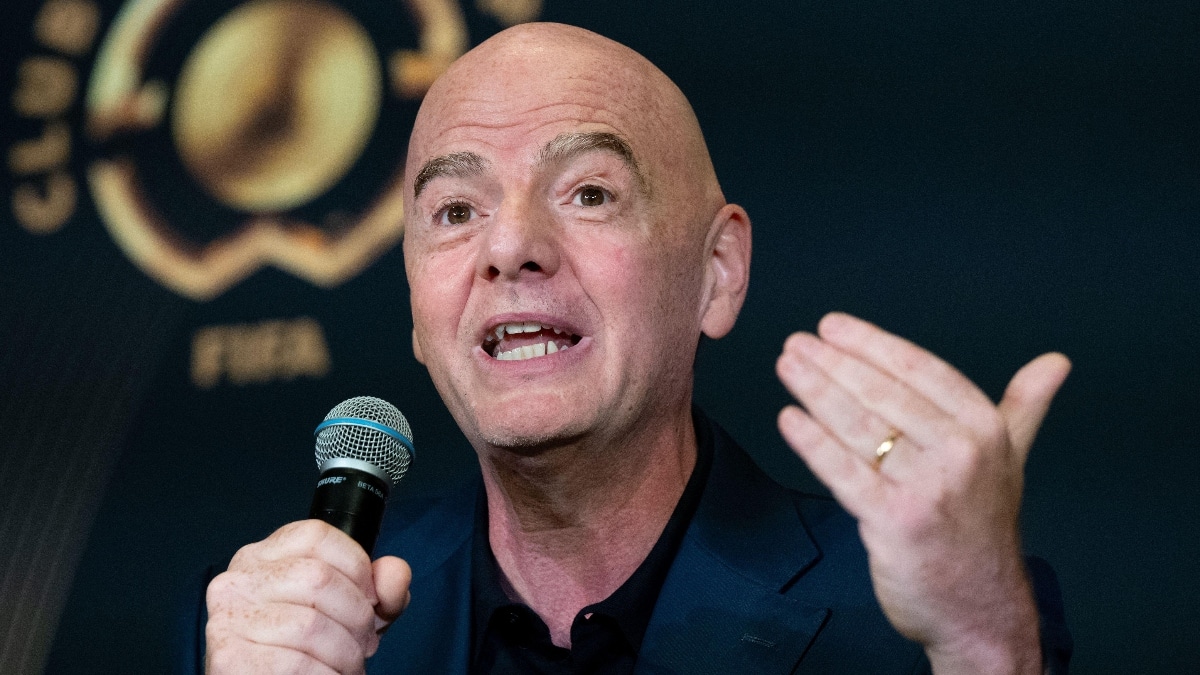
The beautiful game, often revered for its unity and passion, is currently embroiled in a no-holds-barred, heavyweight title fight in the legal arena. Forget the tactical battles on the pitch; the real power struggle is unfolding in courtrooms and behind closed doors, with global football’s two titans – FIFA and UEFA – trading blows in a blistering showdown that threatens to redefine the sport’s future governance.
At the heart of this escalating conflict is FIFA President Gianni Infantino, whose ambitious, albeit abandoned, plan to sell a significant stake in the World Cup’s commercial rights to private investors ignited a furious backlash. Now, UEFA, European football’s formidable governing body, has upped the ante, launching a full-scale legal offensive in US courts and even contemplating criminal proceedings against Infantino in Switzerland. This isn’t just a dispute; it’s a strategic war, a power play where reputations, billions of dollars, and the very soul of international football are on the line.
FIFA, under the embattled Infantino, has responded with a blistering counter-attack. In a filing to a New York court, FIFA’s legal strategists didn’t pull any punches, dismissing UEFA’s legal applications as little more than “press releases” crafted to fuel an alleged “smear campaign” against Infantino and his leadership. This isn’t merely a legal defense; it’s an accusation of political grandstanding, a charge that UEFA’s motives are less about justice and more about maintaining its iron grip on football’s financial hierarchy.
The stakes couldn’t be higher. With the FIFA presidential election looming in March, this bitter court battle is inextricably linked to Infantino’s political survival. Each legal salvo, each public accusation, serves as a volley in a wider war for the control and direction of world football, a clash that promises more fireworks than any derby match.
The Abandoned Mega-Deal: FIFA Football Enterprises
The genesis of this seismic conflict lies in the controversial FIFA Football Enterprises (FFE) proposal. This ambitious, some might say audacious, plan envisioned private investors injecting up to$4.2 billioninto a new FIFA commercial subsidiary, with the wider venture reportedly valued at a staggering$20 billion. The premise was simple: unlock vast new revenues by leveraging FIFA’s crown jewel, the World Cup, and other flagship tournaments.
However, the proposal sparked a furious global backlash, primarily from UEFA and other influential confederations. Critics feared a sell-off of football’s heritage, a dilution of FIFA’s control, and a dangerous precedent for the commercialization of the sport’s most iconic event. The opposition was so fierce that even Infantino’s senior adviser, Carlos Cordeiro, publicly denounced it as a “bad deal for football” before dramatically quitting his post. The sheer scale of the outcry eventually forced FIFA to abandon the plan, but the scars clearly run deep.
Despite the abandonment, FIFA continues to defend the FFE project vigorously. Its lawyers argue that FFE was “only a proposal,” subject to approval from FIFA’s member associations and the FIFA Council – a democratic process, they contend, that UEFA sought to bypass. They paint UEFA as a self-interested party, fiercely protective of its financial dominance. “Rather than participate in that democratic process,” FIFA claims, “UEFA issued a press release – the beginning of a weeks-long smear campaign against FIFA and its leadership.”
FIFA’s legal filing goes further, launching a direct offensive against UEFA’s alleged economic motivations. It asserts:
“UEFA’s economic motivation was to prevent smaller countries from having the financial strength to compete with the European elite.”
This is a strategic accusation, positioning FIFA as the champion of developing nations, seeking to empower them with greater financial resources. The argument is that strengthening football globally would inevitably “reduce UEFA’s market power” and create greater competition for its hugely profitable flagship tournaments, such as the Champions League. It’s a classic divide-and-conquer tactic, aiming to isolate UEFA by appealing to the broader FIFA membership.
Game Highlights: The Unfolding Power Play
This isn’t just bureaucratic wrangling; it’s a series of aggressive plays in a high-stakes chess match for football’s soul. Here’s a look at the key moments, the tactical maneuvers, and the accusations flying in this unprecedented governance battle:
- UEFA’s Opening Salvo (Legal Challenge):UEFA launched a significant legal challenge in US courts, seeking evidence related to the controversial FIFA Football Enterprises (FFE) project, signaling their intent to pursue the matter beyond public criticism.
- The Threat of Swiss Criminal Proceedings:Adding another layer of pressure, UEFA publicly announced it was considering criminal proceedings against Gianni Infantino in Switzerland, escalating the conflict to a potentially devastating personal level for the FIFA President.
- FIFA’s Blistering Counter-Punch (Smear Campaign Claim):FIFA hit back hard in US court, accusing UEFA’s legal actions of being mere “press releases” designed to further a calculated “smear campaign” against Infantino and the organization’s leadership.
- The Defense of FFE:FIFA’s lawyers maintain the FFE project was “only a proposal” that would have required democratic approval, deflecting accusations that Infantino acted unilaterally or deceptively.
- Allegations of Self-Interest:FIFA directly accused UEFA of acting purely out of financial self-interest, aiming to “prevent smaller countries from having the financial strength to compete with the European elite” and thus preserving its own market dominance.
- Internal Dissension:The controversy saw Infantino’s senior advisor, Carlos Cordeiro, resign, famously labelling the FFE deal a “bad deal for football,” an undeniable black eye for FIFA’s leadership.
- Wider Lack of Trust:The filing does not address concerns raised by other powerful confederations in Asia and North America, which have also accused Infantino of a “fundamental breach of trust,” indicating a broader crisis of confidence in his leadership.
The Road Ahead: Prediction for World Football
The final whistle on this legal and political marathon is a long way off. With the FIFA presidential election looming in March, every legal maneuver, every public statement, is a strategic play designed to influence the delegates. UEFA’s relentless pursuit of evidence and its threats of criminal action are clearly aimed at undermining Infantino’s credibility and potentially forcing his resignation or preventing his re-election. They are challenging not just a proposal, but the very legitimacy of his leadership.
However, FIFA’s equally aggressive counter-narrative – painting UEFA as a jealous, self-serving hegemon resisting global football development – is a potent political weapon. It seeks to rally support from the vast majority of smaller football nations, who often feel marginalized by Europe’s financial might. This fundamental ideological clash, between a centralized, globalist FIFA vision and a regionally powerful UEFA, will continue to define the landscape.
Prediction:While UEFA has landed some damaging blows, FIFA’s robust defense and strategic appeal to its broader membership will likely enable Gianni Infantino to weather this storm and secure re-election in March. The legal battles in US and Swiss courts will drag on, creating ongoing reputational headaches and significant legal costs for both parties. However, without a definitive legal conviction or smoking gun, the political momentum within FIFA will favor the incumbent. The true long-term impact will be a further erosion of trust between football’s governing bodies, making future collaborations and unified visions for the sport increasingly difficult. The “war” will continue, but Infantino will likely win this particular battle, albeit at the cost of deeper divisions within the global football family.