
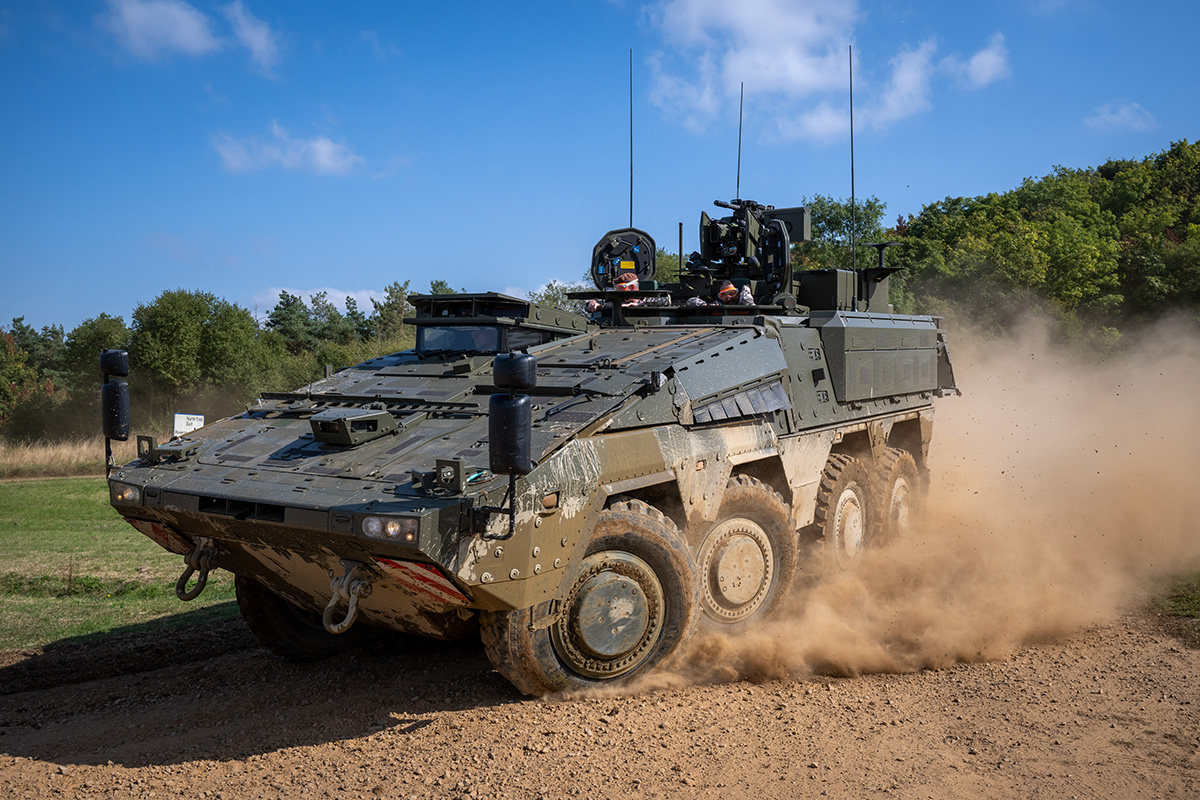
UK Parliament Debates Potential Upgrade for British Army’s Boxer Vehicle Weapon Systems
Discussions in the United Kingdom Parliament have brought to light the British Army’s ongoing assessment of potential upgrades for the Remote Weapon Station (RWS) on its new Mechanised Infantry Vehicle (MIV), the Boxer. While the Boxer was specifically designed with the capacity for future enhancements, including to its weapon systems, the Ministry of Defence has confirmed that no decision has yet been made to replace the current Kongsberg Protector RS4 RWS.
The inquiry was initiated by Ben Obese-Jecty, the Conservative Member of Parliament for Huntingdon, who formally asked the Secretary of State for Defence to outline any assessments made regarding the potential merits of upgrading from the Boxer’s existing Kongsberg RS4 RWS to the more advanced Kongsberg Protector RS6 system. This parliamentary question underscores the continuous evaluation of military capabilities and the strategic considerations involved in maintaining a modern and effective armed force.
Responding to the query, Luke Pollard, the Minister of State for Defence, affirmed the Boxer’s inherent design flexibility. “The United Kingdom Mechanised Infantry Vehicle was designed with capacity for future upgrades, including to its Remote Weapon Station,” Pollard stated. He further elaborated on the rigorous process undertaken by the military, noting, “The Army continues to assess capability, priority and affordability options across the Mechanised Infantry Vehicle Programme and wider Armoured Fighting Vehicle fleet. No decision has currently been taken to upgrade the current Remote Weapon System.” This response highlights the complex interplay of operational needs, strategic importance, and financial constraints that influence defence procurement decisions.
The Boxer Mechanised Infantry Vehicle represents a significant investment in the British Army’s modernisation efforts, playing a crucial role in the future structure of its ground forces. Acquired as part of a multi-billion-pound programme, the Boxer is a highly versatile, modular armoured vehicle intended to provide protected mobility for infantry, command and control, and specialist roles. Its modular design allows for various mission modules to be fitted to a common drive module, making it adaptable to a wide range of operational requirements and future battlefield scenarios. Its introduction is central to the Army’s “Future Soldier” initiative, aiming to create more agile and lethal combat formations.
Central to the Boxer’s immediate combat capabilities is its Remote Weapon Station. The vehicles currently in British service are equipped with the Kongsberg Protector RS4. This system is a stabilised mount, operated remotely from inside the protected confines of the vehicle, enhancing crew safety. It typically carries either a 7.62mm General Purpose Machine Gun or a 12.7mm Heavy Machine Gun, providing significant suppressive fire capabilities. The RS4 also integrates day and thermal sights, allowing for effective engagement in various lighting and environmental conditions, thereby improving situational awareness and target acquisition.
The proposed upgrade, the Kongsberg Protector RS6, belongs to the same family of highly regarded RWS systems but offers a substantial increase in firepower. The RS6 is a heavier and more robust station, designed to accommodate significantly larger weapon systems. It is rated to carry powerful armaments such as a 30mm cannon or a 40mm automatic grenade launcher. Furthermore, certain configurations of the RS6 can integrate anti-tank missiles, dramatically increasing the vehicle’s anti-armour capability. Kongsberg has marketed the RS6 as a solution for armies seeking a highly protected and potent weapon fit without incurring the substantial cost, weight, and complexity associated with a full, manned turret.
The distinction between the RS4 and RS6 is significant in terms of battlefield effectiveness. A 30mm cannon, for instance, offers far greater range, penetration, and explosive power compared to a 12.7mm machine gun. This would enable the Boxer to engage a broader spectrum of threats, including light armoured vehicles, fortified positions, and enemy personnel at greater distances, enhancing both its offensive and defensive capabilities. The ability to integrate anti-tank missiles would further transform the Boxer from primarily an infantry carrier with self-defence capabilities into a platform capable of directly engaging and neutralising heavier armoured threats.
International precedents further highlight the potential advantages of such an upgrade. Australia, for example, also selected the Boxer for its Land 400 Phase 2 programme and chose to equip its reconnaissance variants with the Kongsberg Protector RS6, specifically mounting a 30mm cannon. This decision by a close ally and fellow Boxer operator demonstrates a clear preference for enhanced firepower for specific roles. Germany, the original developer of the Boxer, has likewise fitted heavier weapon stations and turrets onto Boxer vehicles for several of its export customers, underscoring the platform’s versatility and capacity for significant armament upgrades.
The British Army’s ongoing assessment of “capability, priority, and affordability” means that while the technical feasibility and operational benefits of the RS6 are clear, the decision to upgrade is multifaceted. It involves evaluating whether the current RS4 adequately meets the Boxer’s intended roles and anticipated threats, balancing this against other pressing defence priorities, and managing the considerable financial implications of procurement, integration, training, and through-life support for a new weapon system across a significant fleet of vehicles.
Why This Matters
The discussion surrounding a potential upgrade to the Boxer’s Remote Weapon Station is significant for several key reasons, impacting the operational effectiveness of the British Army, strategic defence planning, and the broader defence industrial landscape.
Firstly, **Enhanced Firepower and Lethality** are directly tied to troop safety and mission success. Upgrading from a 12.7mm machine gun to a 30mm cannon or incorporating anti-tank missiles dramatically alters the Boxer’s role on the battlefield. It transforms the vehicle from primarily a troop carrier with self-defence capability into a platform capable of actively engaging and neutralising a wider range of threats, including light armoured vehicles and fortified positions. This increase in organic firepower for infantry formations means British soldiers would be better equipped to deter and defeat adversaries, reducing their direct exposure to danger and potentially influencing the outcome of engagements.
Secondly, this decision speaks to the **Future-Proofing and Adaptability** of the British Army’s equipment. The Boxer’s modular design is a core tenet of its acquisition, allowing it to evolve with changing threats and technological advancements. The ability to upgrade the RWS without having to procure entirely new vehicles demonstrates a smart approach to long-term defence planning, ensuring that the Boxer fleet remains relevant and effective for decades to come, thereby maximising the return on a substantial defence investment.
Thirdly, it highlights the **Strategic Priorities and Resource Allocation** within the Ministry of Defence. The Army’s assessment of “capability, priority, and affordability” reflects the constant balancing act between operational needs, strategic imperatives, and budgetary constraints. A decision to upgrade would signal a prioritisation of increased ground force lethality, potentially at the expense of other defence programmes. Conversely, a decision to maintain the current system would indicate that existing capabilities are deemed sufficient for the Boxer’s intended role, or that other areas of defence spending are considered more critical at this juncture. This process is a microcosm of larger national security decisions in an increasingly complex global environment.
Finally, the **Interoperability with Allies** is a subtle but important factor. Observing allies like Australia choosing the more heavily armed RS6 for their Boxers raises questions about potential divergences in operational doctrine or threat perception. While not necessarily a barrier to cooperation, differing weapon fits can affect joint training, logistics, and the seamless integration of forces in multinational operations. This parliamentary discussion therefore provides insight into the UK’s specific defence posture and how it aligns with, or differs from, its international partners in equipping its modern armoured fleet.