
Unlock the White House Watch newsletter for free
Your guide to what Trump’s second term means for Washington, business and the world
Key Takeaways
- Escalating tensions in the Strait of Hormuz have injected a significant geopolitical risk premium into global oil markets, pushing Brent crude above $90/barrel and reigniting fears of supply-side shocks and broader inflation.
- The direct targeting of Iranian oil tankers by the US underscores the tangible threat to crucial maritime trade routes, potentially disrupting global energy supplies, impacting shipping insurance costs, and elevating freight rates across various industries.
- Sustained higher oil prices pose a renewed inflationary challenge to the global economy, complicating central banks’ monetary policy decisions, potentially impacting consumer spending, corporate earnings, and the trajectory of economic growth ahead of key US elections.
The geopolitical chessboard of the Middle East has once again sent tremors through global financial markets, as the United States military confirmed strikes against three Iranian crude oil tankers. This retaliatory action followed Iran’s launch of missiles against two US Navy warships, marking a significant escalation in the ongoing battle for control of the strategically vital Strait of Hormuz between Washington and Tehran. The incident immediately amplified the geopolitical risk premium in energy markets, sending crude oil prices surging and casting a long shadow over the delicate balance of global economic recovery.
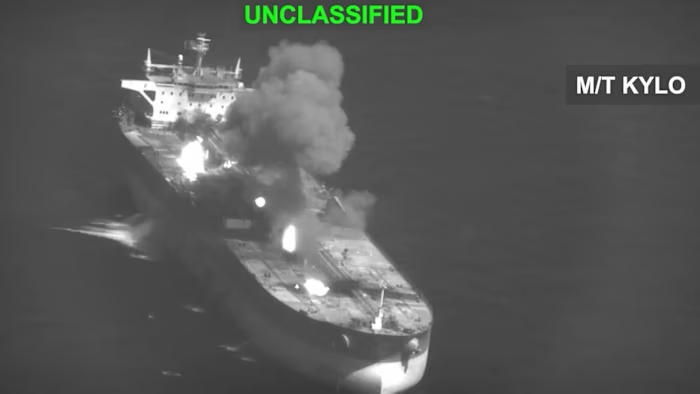
US Central Command (Centcom), overseeing American military operations in the Middle East, reported on Saturday that a US aircraft carrier and a guided-missile destroyer had successfully “evaded” an attack by the Islamic Revolutionary Guard Corps (IRGC), with no American personnel harmed. The swift and decisive US response saw the “permanent disablement” of the M/T Downy crude oil carrier off Kharg Island and the M/T Stark crude oil carrier near Jask, along Iran’s eastern coast on the Strait. Additionally, an unladen tanker in the Gulf of Oman was struck, signaling a broader intent to cripple Iran’s maritime oil infrastructure and disrupt its ability to export crude, even through clandestine channels.
“Let the message to the IRGC be clear: if you shoot at two of our ships, we will impose an even higher economic cost — taking out three of yours,” Admiral Brad Cooper, Centcom commander, stated unequivocally. “We will not hesitate to defend American forces and, if necessary, destroy Iran’s limited and exposed oil fleet.” This rhetoric, coupled with direct military action against commercial vessels, serves as a stark reminder to markets of the immediate and tangible threats to global oil supply routes and the potential for a wider conflict to spill over into the broader energy complex.
This latest exchange of fire follows Washington’s renewed campaign of military strikes against Iranian targets over the past week, breaking a month of relative quiet in the six-month-old conflict. The direct targeting of oil tankers, even those described as part of Iran’s “limited and exposed oil fleet,” is a critical development for market watchers. The Strait of Hormuz, a narrow chokepoint between the Persian Gulf and the open sea, is one of the world’s most critical maritime passages. An estimated one-fifth of the world’s total petroleum consumption and one-third of the world’s liquefied natural gas (LNG) passes through this strait daily. Any significant disruption here has immediate and profound implications for global energy prices and, by extension, the global economy, impacting everything from manufacturing costs to consumer spending power.
As a direct consequence of these tit-for-tat strikes, the price of Brent crude oil has surged above $90 per barrel for the first time since May. This spike is not merely a reflection of current supply-demand dynamics but incorporates a substantial “geopolitical risk premium,” as traders factor in the increased probability of future supply disruptions, heightened shipping risks, and potential retaliatory measures. For global consumers and businesses, this translates to higher fuel costs, increased shipping expenses, and potentially higher prices for a vast array of goods. The re-emergence of $90+ oil casts a new, dark cloud on the global economy, which is already grappling with persistent inflationary pressures, slowing growth in major economies, and the lingering threat of recession.
While former President Donald Trump on Friday dismissed the Iran conflict as “small potatoes,” its extended duration and potent impact on inflation have emerged as significant political vulnerabilities for the Republican party ahead of the US midterm elections in November. For the incumbent administration, rising energy prices directly impact consumer sentiment and purchasing power, potentially swaying undecided voters and complicating efforts to tout economic stability. The specter of “stagflation” – a combination of high inflation and stagnant economic growth – looms larger with every barrel added to the oil price, posing a serious challenge to central banks attempting to navigate a soft landing.
Iran, for its part, has increasingly targeted a small fleet of vessels engaged in risky shuttle runs, ferrying oil from Gulf ports to more risk-averse vessels waiting outside the Strait of Hormuz. These tactics highlight Iran’s strategy to leverage its geographic position to exert economic pressure and complicate international sanctions. There have been at least four confirmed attacks on tankers by the IRGC since August 30, when the most recent round of direct strikes between the two sides resumed. Furthermore, Iran has issued a list of more than 50 tankers it warns could be susceptible to attack or seizure for their perceived role in exporting Gulf countries’ oil via the strait. Many of these vessels are owned by prominent Gulf national oil and shipping companies, such as the UAE’s Adnoc and Saudi Arabia’s Bahri, signaling a direct challenge to regional energy producers and their supply chains, potentially affecting their export capacities and market share.
The heightened risk has dramatically impacted maritime traffic. According to maritime analytics firm Windward, traffic through Hormuz has fallen to near all-time lows. Shipping companies and insurers are reassessing their risk exposure, leading to significantly higher insurance premiums for vessels traversing the area, and in some cases, prompting re-routing decisions that add significant time and cost. This directly impacts global supply chains, potentially causing delays and increasing costs for goods ranging from consumer electronics to industrial raw materials, ultimately contributing to broader inflationary pressures.
The US has responded by tightening its blockade of Iranian ports and vessels, and taking more aggressive action against so-called “dark fleet” ships that transport Iranian crude in an attempt to circumvent international sanctions. This “dark fleet” operates outside traditional maritime tracking and insurance frameworks, adding another layer of complexity and risk to the global oil market. Efforts to disrupt this network, while aimed at curbing Iran’s revenue, also carry the risk of further tightening global oil supplies if legitimate alternatives are not readily available or perceived as too risky, potentially exacerbating the current price rally and making sanctions enforcement a double-edged sword for global energy consumers.
In a move that underscores the high-stakes political rhetoric surrounding the conflict, Trump proposed renaming the strategic waterway the “Trump Strait” in a social media post. “Now that we have it under U.S.A. control, should we change the name Hormuz Strait to TRUMP STRAIT??? Like America itself, it would be “hotter” than ever before!” he said. While largely symbolic, such statements contribute to the perception of instability and unpredictability, factors that financial markets inherently dislike and often price into risk premiums, adding another layer of uncertainty to an already volatile situation.
Market Impact
The immediate market impact is unequivocally bearish for global economic growth prospects, while bullish for crude oil prices and specific sectors. Energy stocks, particularly those of major oil and gas producers and refiners, are likely to see upward momentum on the back of higher commodity prices and expanded profit margins. Shipping and logistics firms operating outside the immediate risk zone might benefit from increased demand for alternative routes or higher freight rates, though those directly exposed to the Persian Gulf face elevated operational costs and prohibitive insurance premiums. Conversely, sectors heavily reliant on stable energy prices and efficient global supply chains, such as manufacturing, airlines, transportation, and consumer discretionary goods, will likely face margin compression, reduced consumer demand, and potentially revised earnings forecasts. Bond markets will closely watch inflation expectations, with potential for yields to rise as central banks face renewed pressure to maintain a hawkish stance to curb price increases. Safe-haven assets like gold and the US dollar could see increased demand as investors seek refuge from escalating geopolitical uncertainty, signaling a broader risk-off sentiment in equity markets and a flight to quality across asset classes.