
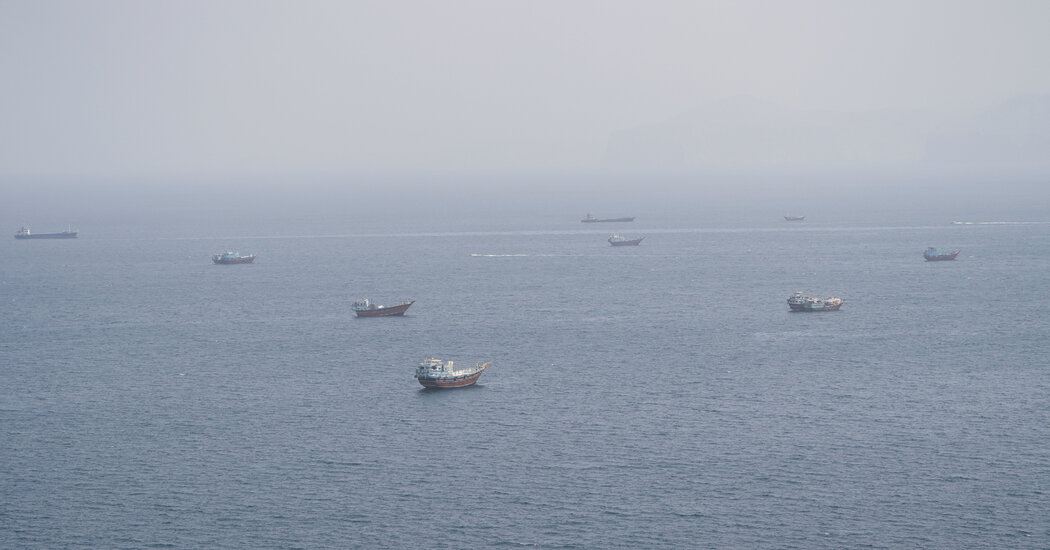
Recent weeks have seen a significant escalation in maritime tensions and attacks within the Strait of Hormuz, a critical global waterway. Despite ongoing efforts by the United States military to safeguard commercial shipping, vessels transporting oil from the Persian Gulf continue to face attacks, leading to casualties and disruptions in global energy supplies. The situation is characterized by a persistent stalemate, with Iran demonstrating its capacity to impede navigation while the U.S. endeavors to ensure passage.
A notable incident occurred last week when a Saudi-flagged vessel was struck near the coast of Oman while attempting to transit the strait. The attack resulted in the deaths of two crew members aboard the ship, identified as the Sidr, owned by the Saudi state shipping company Bahri. This incident follows two other fatalities in similar attacks in August, making it the deadliest period for merchant seamen in the strait since March. Over July and August, at least 23 ships were reportedly hit within the waterway. In response to what it described as unprovoked attempts by Iran to attack U.S. warships, the United States military conducted strikes on three Iranian oil tankers on Saturday.
After more than six months of sustained conflict in the region, analysts describe the situation in the Strait of Hormuz as a “lethal stalemate.” Eugene Gholz, an associate professor of political science at the University of Notre Dame and an expert on regional conflicts, explains this dynamic: “The strait is neither fully closed nor fully opened. Iran can’t close it completely, and the U.S. can’t open it completely.”
The U.S. military’s operation to protect tankers, initiated in mid-May, involves measures such as intercepting Iranian drones and missiles before they can impact commercial vessels. This protection effort has facilitated the transit of millions of barrels of oil out of the Persian Gulf daily, offering a degree of stability to international oil markets. According to Captain Tim Hawkins, a spokesman for U.S. Central Command, which oversees the operation, approximately 1,600 commercial vessels and 800 million barrels of oil have successfully transited the strait under U.S. guidance. Captain Hawkins stated that “Commercial traffic flow continues through the strait despite Iranian aggression, and momentum is clearly building.” He did not provide comment on the specific number of Iranian attacks in July and August.
Despite these protective measures, Iranian attacks have persisted, deterring many private shipping companies from operating in the strait. Records analyzed by The New York Times indicate that Iran struck 12 ships in August, a slight increase from 11 in July. This continued aggression has kept the volume of oil transiting the waterway significantly below pre-conflict levels. TankerTrackers.com, a maritime analysis firm, reported that in the seven days leading up to last Thursday, an average of 6.7 million barrels of oil transited the strait daily. This figure represents nearly a 60 percent reduction compared to the daily average before the conflict began at the end of February, which was approximately 16.75 million barrels per day.
Iran appears to be leveraging its ability to disrupt shipping and restrict oil supply as a strategic tool against the United States. Furthermore, Iran has expressed an interest in formalizing its influence over the waterway by imposing fees on ships using the strait, a proposal that the United States has publicly opposed. The persistent threat has led many private shipping companies to avoid the Gulf region entirely, even with the presence of U.S. military protection.
Industry executives have cited several reasons for this reluctance, including the unacceptable risk to the lives of their crews, the potential for vessels to be put out of service for weeks due to damage requiring repairs, and the exorbitant costs of maritime insurance. While Iranian attacks typically do not result in the total destruction of tankers, they frequently inflict sufficient damage to render ships inoperable for extended periods. Insurance premiums, which must cover the vessel, its crew, and the cargo onboard, are particularly high in conflict zones.
In contrast, Gulf countries, whose economies are heavily reliant on oil exports, appear to be more willing to accept these heightened risks. They often utilize government-owned tankers for their energy exports and employ tactics such as switching off ship transponders to evade detection while traversing the strait. This practice also complicates efforts by independent ship trackers to accurately count all vessels passing through the area. The recently struck Saudi vessel, the Sidr, belongs to Bahri, the state shipping company, and was reportedly carrying approximately two million barrels of oil when it was attacked during nighttime transit. Samir Madani, a co-founder of TankerTrackers.com, noted that while Iran could attempt to halt oil flow from the Gulf, “that won’t stop the Arab nations from exporting.” Bahri confirmed the deaths of two Filipino sailors in a social media post, stating, “The safety and well-being of Bahri’s people remain its highest priority, and the company remains committed to operating in accordance with the highest standards of safety, security and environmental protection.”
Other Gulf nations have also experienced attacks on their tankers. The United Arab Emirates has sent tankers through the strait, several of which have been hit. A spokesman for ADNOC, the UAE’s state oil company, declined to comment on these incidents. Similarly, two Kuwaiti tankers were struck in late August, though the Kuwait Petroleum Company did not respond to requests for comment. To mitigate risks, Saudi Arabia and the Emirates are increasingly utilizing pipelines that bypass the Strait of Hormuz. Goldman Sachs analysts estimate that the combined volume of oil transported via pipelines and tankers now accounts for approximately two-thirds of the Gulf’s pre-conflict oil exports.
Despite these bypass efforts, global oil prices remain elevated. On Friday, Brent crude, the international benchmark, was priced at $95.50 a barrel, representing an increase of over 30 percent compared to its value before the conflict began. The conflict has also contributed to faster price increases for refined fuels, with diesel reaching a new high of $5.85 a gallon in the United States on Friday, alongside rising gasoline prices. A shipping executive, who requested anonymity due to fears of becoming an Iranian target, stated that his company had been operating in the Persian Gulf in recent months but was suspending operations due to the escalating danger. The executive also noted that Iran appeared to be specifically targeting the engine rooms of ships, increasing the risk of vessels becoming stranded.
The U.S. military’s tanker protection operation, which began in mid-May, directs ships through routes closer to Oman. While effective in guiding numerous vessels, analysts suggest that maintaining such an operation could prove challenging and expensive over an extended period. Resupplying U.S. warships in the Middle East has become more difficult since the U.S. Navy’s base in Manama, Bahrain, was reportedly rendered largely inoperable by Iranian attacks that commenced on the first day of the conflict. Professor Gholz highlighted the significant costs associated with the operation, including fuel consumption, combat pay for personnel, and the persistent risk of accidents or further Iranian attacks.
The tanker protection effort is one component of a two-pronged U.S. strategy aimed at curtailing Iran’s influence in the strait. The other is a U.S. Navy blockade targeting ships bound for Iranian ports. This blockade has substantially restricted Iranian oil exports from the Gulf, thereby limiting Tehran’s oil revenue.
For tanker companies, navigating the Strait of Hormuz incurs significantly higher costs, even as they charge customers increased rates. Insurance premiums for ships, crew, and cargo remain exceptionally high during the conflict, despite the U.S. military’s protective presence, and these rates can fluctuate hourly. David Smith, an executive at McGill and Partners, an insurance broker, reported that insuring a tanker to transit the strait has recently cost an additional 4 to 7 percent of the combined value of the ship and its oil. The total war insurance cost for a single tanker could exceed $10 million, although shipping companies may receive rebates for incident-free voyages. Smith noted that during quieter periods of the conflict, such as immediately following a cease-fire agreement in mid-June, these costs temporarily dropped to between 1 and 2 percent of the ship and cargo value. He described the current situation as “certainly, in my 40 years, it remains the most dynamic shipping insurance market I’ve seen.”
Analysts anticipate that Iran is likely to continue its campaign against tankers in the Strait of Hormuz. Noam Raydan, a senior fellow at the Washington Institute for Near East Policy, explained Iran’s motivation: “Iran wants to show, once again, that even if regional countries try to think of ways in order to bypass the Iranians in the Strait of Hormuz, they will hit back.” Raydan stated that Iran’s overarching objective is to secure lasting leverage over the strait, which it believes will strengthen its hand in future negotiations. “This is why I do not see them letting go,” she concluded.
Why This Matters
The ongoing conflict and instability in the Strait of Hormuz have profound global implications across several critical areas. First and foremost, it directly impacts **global energy security**. As the choke point for approximately one-fifth of the world’s oil supply, disruptions or threats to navigation in the Strait can trigger significant volatility in oil markets, leading to higher prices for crude oil, gasoline, and diesel. This translates to increased costs for consumers and businesses worldwide, fueling inflation and potentially hindering economic growth in energy-dependent nations. The sustained higher oil prices and reduced transit volumes underscore the fragility of global supply chains when a key maritime route is contested.
Secondly, the situation carries substantial **geopolitical and regional stability risks**. The Strait of Hormuz is a focal point of tension between Iran and its regional adversaries, particularly Saudi Arabia and the United Arab Emirates, as well as the United States. The series of attacks, retaliatory strikes, and the deployment of naval assets elevate the risk of a wider regional conflict. Such an escalation could draw in more international actors, destabilize the Middle East further, and potentially disrupt other critical trade routes. Iran’s stated aim to formalize its influence and potentially levy fees on passing ships directly challenges the principle of freedom of navigation, a cornerstone of international maritime law.
Finally, there are significant **humanitarian and economic consequences for the shipping industry**. The direct targeting of commercial vessels, leading to the deaths of innocent merchant seamen, highlights the human cost of this conflict. The extreme costs of war risk insurance—reaching tens of millions of dollars per voyage—deter private shipping companies from operating in the region. This not only makes goods more expensive to transport but also creates uncertainty and financial strain for an industry vital to global trade. The logistical challenges for naval operations, such as the damage to the U.S. Navy’s Bahrain base, also underscore the ongoing costs and difficulties faced by forces attempting to maintain stability.