
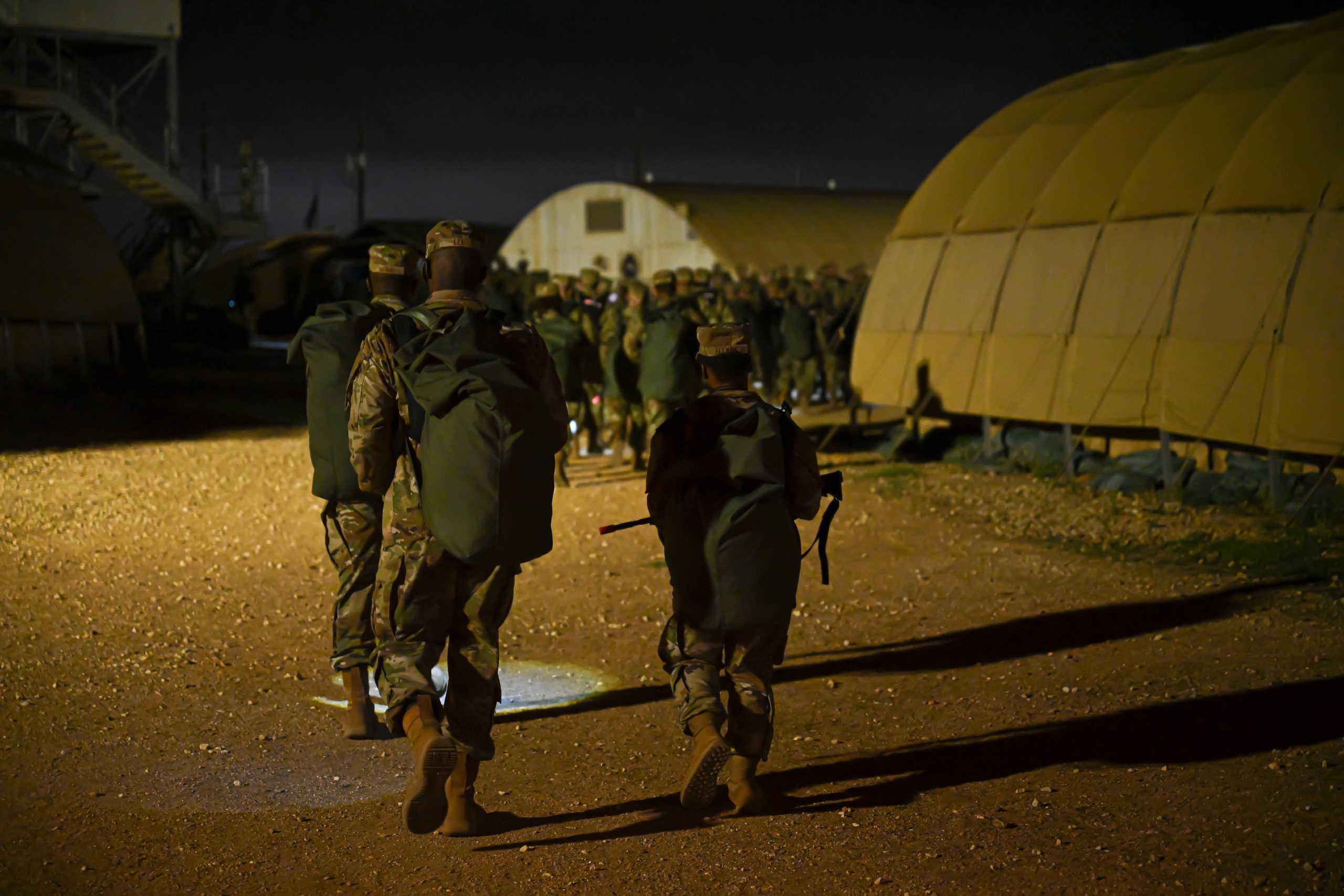
JOINT BASE SAN ANTONIO-LACKLAND, Texas—The U.S. Air Force has initiated significant revisions to its Basic Military Training (BMT) program, introducing heightened levels of physical and psychological stress, including increased sleep deprivation. These changes are designed to better equip future Airmen for the rigorous demands and unpredictable environments of modern combat operations.
Traditionally, the 7.5-week BMT program has challenged recruits with constant scrutiny, demanding training schedules, and interrupted sleep due to responsibilities like guard duty. However, in late August, officials at Joint Base San Antonio-Lackland began implementing modifications aimed at deliberately pushing trainees further.
Colonel Kellie Courtland, commander of the 37th Training Wing, which oversees BMT, informed Air & Space Forces Magazine that the initial phase involves increasing nocturnal training to induce additional sleep deprivation. In the coming weeks, the program will incorporate “stress inoculation,” a technique designed not only to intensify training stress but also to teach recruits practical methods for maintaining effectiveness under extreme pressure.
These comprehensive changes stem from a directive issued by Chief of Staff of the Air Force General Kenneth S. Wilsbach. The decision followed observations from recent operational deployments—including those referred to internally as “Epic Fury” and an “air campaign against Iran”—which revealed that some younger Airmen struggled to perform optimally amidst the accelerated pace and high-stress conditions of modern combat environments, according to Colonel Courtland.
“The Air Force is realizing that there are people that are not responding to being able to perform well when they’re sleep deprived, or there’s a lot of stress, or hard events happen; they’re having a hard time recovering from that,” Colonel Courtland explained. “The idea is to practice that a little bit more and get used to that level of stress and sleep deprivation because it’s going to happen at different points throughout your career but definitely when you’re out in those wartime environments.”
This initiative represents the latest evolution within a broader effort to transform BMT. The overarching goal is to cultivate a universal “airmindedness” among all Airmen, ensuring they possess the skills and mindset to operate effectively in small, agile teams, capable of defending, operating, generating, and sustaining airpower in diverse operational settings.
Enhanced Sleep Deprivation Protocols
The initial week of BMT will retain its current structure, as new recruits typically experience a form of sleep deprivation naturally induced by the profound cultural and environmental shock of military life, Colonel Courtland stated. The deliberate increase in sleep deprivation begins in week two.
Starting from the second week, Military Training Instructors (MTIs) will intensify the frequency of nighttime entry-control procedures, commonly known as guard duty. Previously, these shifts spanned two hours. Under the new protocols, shifts are reduced to one hour, necessitating that a greater number of trainees are awake and active each night. “Before, you would only have four to eight people basically getting woken up during the night that would do their entry control procedures,” Courtland noted. “Now you’ve got 21 trainees that have to get up, spend an hour doing entry control procedures.”
Further nocturnal training activities are integrated into weeks four and five, serving as preparation for PACER FORGE, the culminating field training exercise renowned for its intense, 57-hour duration and minimal sleep opportunities.
In the fourth week, “we will do different exercises, like maybe an accountability exercise,” explained 37th Training Wing Command Chief Master Sgt. Caleb Vaden. These exercises involve all trainees exiting their dormitories for a headcount, a process that typically lasts about an hour before they return to their sleeping areas. Vaden emphasized that “everything we do here is tied to a training objective.”
The fifth week will see an escalation in nighttime training events as trainees gear up for PACER FORGE. “We are working on an exercise where they would fall out, work on that F-16, fall under attack, have to go to a bunker, and then they’re going to go forward to their forward site,” Vaden elaborated. This scenario is designed to induce “additional sleep deprivation before they even get to the PACER FORGE site. We’re getting them up early, keeping them up, not letting them sleep very much… it just keeps amping up as you get closer and closer to PACER FORGE.”
Introducing Stress Inoculation
While the specific methodologies for stress inoculation are still under review, Colonel Courtland outlined the core concept: to not only expose trainees to heightened stress during exercises but also to equip them with techniques for recognizing and managing intense pressure effectively. The aim is for the new stress portion of training to be approved by the end of September.
“It’s more understanding how you work through stress when you are stressed out,” Colonel Courtland stated. “The idea is they get stressed out more here. It’s intense. They get that stress, but then we are walking them through it— ‘hey, you probably felt really stressed in that moment, here’s something you could have done, or here’s something that may have helped.'”
For instance, trainees may be taught techniques such as box breathing, a method involving equal counts for inhaling, holding breath, exhaling, and pausing, which is known to help calm the nervous system. Colonel Courtland declined to specify the full list of techniques under consideration but affirmed that “at the same time that we’re teaching them how to deal with stress, we are going to be turning up the stress and turning up the intensity.”
Military Training Instructors will conduct regular after-action reviews following training events to ensure trainees comprehend how increased stress affects their performance. “I will more than likely see degradation in teamwork. I’ll see degradation in leadership. I’ll see degradation in situational awareness; I’ll see degradation in a lot of things,” Chief Vaden commented, indicating that these observable performance metrics will be crucial for assessment.
Colonel Courtland underscored that the ultimate measure of success for this initiative will be observing whether trainees can effectively apply the newly learned stress management tools under escalating pressure. “The goal is to teach them the tools, stress the hell out of them, and see if they know how to use the tools correctly,” she concluded.
In conjunction with these programmatic adjustments, BMT officials have also made progress on other infrastructure enhancements. A portion of the new air base training range has been completed, featuring a non-flying F-16 Fighting Falcon. Trainees are now utilizing this asset to practice re-arming procedures with mock AIM-9 Sidewinder missiles and other training munitions, including simulated Advanced Precision Kill Weapon System rockets. The new training range is also slated to incorporate two retired C-130 Hercules aircraft, which arrived at the base in August, further expanding realistic training scenarios.
Why This Matters
The U.S. Air Force’s decision to intensify stress and sleep deprivation in Basic Military Training reflects a critical adaptation to the evolving nature of global conflict and the demands placed upon service members. This shift holds significant implications for individual Airmen, the broader Air Force, and national security.
For Individual Airmen:These changes aim to forge a more resilient and adaptable fighting force. By exposing trainees to controlled, high-stress, and sleep-deprived environments, the Air Force hopes to “stress inoculate” recruits, teaching them how to perform effectively when faced with the real psychological and physical pressures of combat. This proactive approach could reduce the likelihood of performance degradation in theatre, potentially saving lives and improving mission success. Furthermore, by teaching coping mechanisms like box breathing, the program acknowledges the importance of mental health and psychological resilience, equipping Airmen with lifelong tools for managing stress, both in and out of uniform. This could lead to a more mentally robust force capable of recovering from traumatic experiences more effectively.
For the Air Force:The revisions are a direct response to lessons learned from recent operational engagements, highlighting a commitment to continuous improvement and responsiveness to real-world challenges. In an era where “Agile Combat Employment” (ACE) concepts emphasize small, distributed teams operating in contested environments, Airmen must be prepared to function under austere conditions with limited resources and intermittent rest. This updated BMT program directly supports the Air Force’s readiness goals, ensuring that every Airman, regardless of their specialty, possesses a foundational “airmindedness” and the resilience required for modern, decentralized warfare. A more prepared force can translate into higher operational effectiveness, reduced errors, and a stronger ability to project airpower globally. It also addresses potential retention issues by creating a force better equipped to handle the psychological tolls of service.
For National Security:A military trained to thrive under extreme duress is a more formidable and credible force on the global stage. In an increasingly complex geopolitical landscape, the ability of the U.S. Air Force to conduct sustained operations under adverse conditions is paramount for deterrence and power projection. This enhanced training sends a clear message to potential adversaries about the caliber and readiness of American service members. By cultivating highly adaptable and psychologically robust Airmen, the United States strengthens its capacity to respond to a spectrum of threats, from conventional warfare to hybrid conflicts, thereby safeguarding national interests and supporting allied operations worldwide. The investment in realistic training and psychological preparedness contributes directly to the overall strength and reliability of the nation’s defense apparatus.