
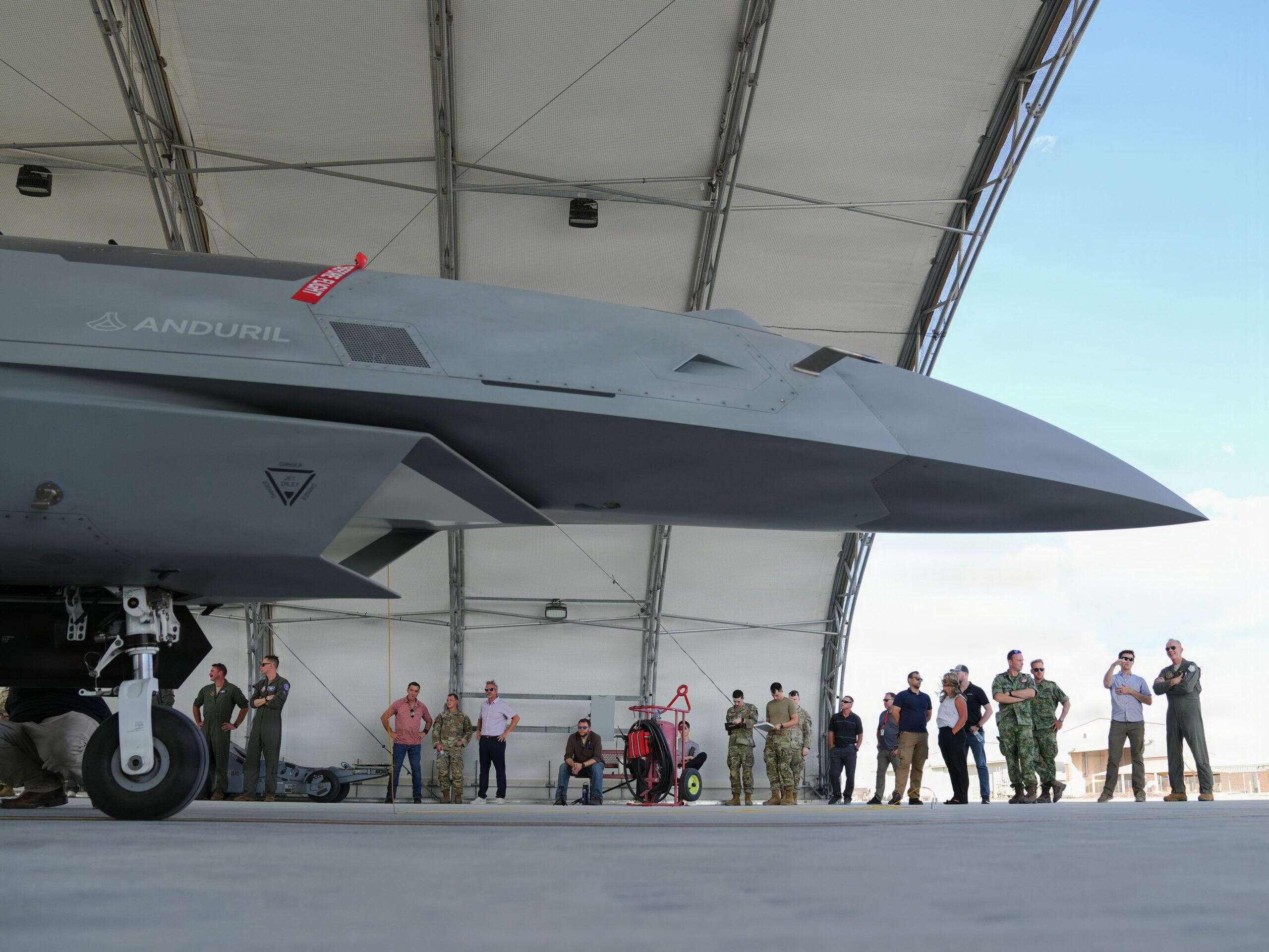
NATIONAL HARBOR, Md.—The United States Air Force is set to conduct its inaugural large-scale exercise involving Collaborative Combat Aircraft (CCAs), semi-autonomous drone fighters, in December. This significant step marks the first major integration of these uncrewed systems into a comprehensive combat simulation, according to Lt. Col. Lyndon Bartlett, commander of the drones’ Experimental Operations Unit, speaking on Sept. 15 at AFA’s Air, Space & Cyber conference.
The exercise, dubbed Emerald Flag, will take place at Eglin Air Force Base in Florida. Lt. Col. Bartlett described it as the CCAs’ “first dip of the toe in an actual force integration,” designed to lay the groundwork for their eventual deployment in real-world operations.
“That will, in my mind, be the first time that we will ever do some CCA end-to-end kill chain live,” Bartlett stated, emphasizing the importance of this initial integration. He added that it would represent the first instance of CCAs being integrated into a combined offensive counter-air (OCA) push involving both fourth and fifth-generation crewed fighters. Though initially small in scale, these “building blocks” are crucial for fostering trust in the CCA technology among Air Force personnel.
Collaborative Combat Aircraft are sophisticated, semi-autonomous drones designed to fly alongside and support crewed fighter jets, such as the F-35 or the forthcoming F-47. Pilots in the manned aircraft will direct these drones through a tablet interface, leveraging their capabilities in various combat scenarios. The Air Force has ambitious plans for its CCA fleet, aiming for at least 500 by 2032 and projecting a total fleet of 1,000 or more in the long term. Currently, the service has committed to acquiring two specific CCA models: General Atomics’ FQ-42A Vengeance and Anduril Industries’ FQ-44A Fury, with additional models expected to follow.
The Experimental Operations Unit (EOU), established at Creech Air Force Base, Nevada, in June 2023, has been at the forefront of this integration effort. Since its inception, the EOU has been actively flying and experimenting with CCAs to understand how Airmen can most effectively utilize them in combat environments.
During this experimental phase, Bartlett noted that the EOU has been “pleasantly surprised” by the ease of maintaining CCAs and their minimal operational footprint. Recent Agile Combat Employment (ACE) exercises, which simulate operations from smaller, dispersed, and potentially austere bases, demonstrated a “one-to-one maintainer-to-airplane ratio,” a remarkably low requirement for aircraft upkeep.
This operational simplicity suggests that CCAs could enable “cross-functional” Airmen—personnel from various career fields—to contribute to generating CCA sorties and loading weapons, even if these tasks fall outside their conventional duties. “Because [CCAs are] a little bit simpler, because their role is so focused, what we found … any [Air Force Specialty Code] can be trained to generate sorties, to load weapons,” Bartlett explained. He indicated that such cross-training has already occurred and more extensive experimentation is planned for the coming years.
Brig. Gen. Timothy Helfrich, the portfolio acquisition executive for fighters and advanced aircraft, further confirmed the EOU’s rapid pace of operations, stating that CCA aircraft are being flown “multiple times a week.”
Jason Levin, Anduril’s senior vice president of engineering, reported that the company delivered its FQ-44 Fury drone to the EOU in August. He highlighted significant progress in streamlining Fury’s operation, reducing it to a “single operator flying a Fury from a laptop.” These advancements have allowed for disaggregated operations, with operators flying from multiple locations, and rapid “hot reloads” of the Fury, cutting turnaround times from hours to “single-digit minutes.” Levin also mentioned that Air Force operators have successfully flown Fury with mission autonomy multiple times a day, integrated into airspace with crewed fifth-generation fighters and other CCAs, fostering crucial trust in the system.
David Alexander, president of General Atomics Aeronautical Systems, echoed the sentiment that building a foundation of autonomous CCA use and operator comfort is paramount. Once this is achieved, he believes the program can fully concentrate on Agile Combat Employment operations, transitioning from an experimental phase to an “everyday event.”
Levin stressed the critical role of ACE exercises in identifying software shortcomings. He warned that if these issues are not swiftly addressed, Airmen in the field will not develop the necessary trust in CCA systems. “When we go out to those ACE exercises and they don’t like something, if we don’t fix it by the next ACE, they’re not going to trust the system,” Levin cautioned.
Significant milestones for the CCA program include Anduril’s Fury firing its first weapon, an AIM-120 Advanced Medium-Range Air-to-Air Missile, in July. General Atomics’ Vengeance is scheduled to conduct its first live-fire test later this year.
Despite the progress, Bartlett identified mission autonomy programming as the most significant remaining challenge. He described it as the “secret sauce” that will ultimately determine the decisiveness of CCAs, a capability that will be thoroughly evaluated over the next few years.
Another critical hurdle involves developing new operational doctrine for CCAs. While the Air Force possesses decades of established guidelines for crewed aircraft, the framework for uncrewed systems is still being written. Bartlett emphasized the need for tailor-made policies that enable rapid integration and effective use of CCAs, rather than merely adapting existing regulations.
Beyond the Air Force, the broader nation will also need to adapt to the regular presence of uncrewed aircraft in U.S. airspace. Bartlett highlighted the policy implications this presents for the Federal Aviation Administration (FAA), which will need to develop systems and regulations to integrate pilotless aircraft that operate autonomously and do not adhere to traditional air traffic control protocols. “Our system is not set up for that,” Bartlett stated, underscoring the necessity for the U.S. government to establish policies that prepare the entire country to “internalize an autonomous fighter that does not have a pilot, that is running on a mission autonomy agent, that doesn’t listen to” air traffic control.
Why This Matters
The rapid advancement and integration of Collaborative Combat Aircraft (CCAs) represent a pivotal shift in modern military strategy and technological development, with profound implications across various sectors. This program is not merely about adding new aircraft; it’s about fundamentally rethinking air combat, force projection, and national defense.
Reshaping Military Strategy:CCAs promise to revolutionize warfare by offering a combination of mass, lethality, and affordability. By flying alongside crewed fighters, they can act as loyal wingmen, scouts, decoys, or even weapons platforms, significantly expanding the capabilities of a single human pilot. This approach aims to provide numerical superiority in contested environments, reduce risk to human pilots by performing dangerous missions, and potentially lower the overall cost of airpower compared to exclusively procuring high-end manned aircraft. The ability to disperse operations through Agile Combat Employment further enhances survivability and responsiveness in future conflicts, especially against peer adversaries.
Technological Frontier:The CCA program is a crucible for cutting-edge technologies, particularly in artificial intelligence, machine learning, and autonomous systems. The success of CCAs hinges on their “mission autonomy” – their ability to make complex decisions and execute tasks without constant human intervention. This push drives innovation not only in aerospace but also in software development, human-machine teaming interfaces, and secure communication networks. Learnings from this program could have ripple effects in civilian applications of AI and robotics, from logistics to disaster response.
Economic and Industrial Impact:The development and procurement of a projected fleet of 1,000 or more CCAs represent a substantial investment in the defense industrial base. This fuels research and development, manufacturing, and creates specialized jobs. It also positions the United States at the forefront of defense innovation, maintaining a competitive edge in a rapidly evolving global security landscape. Companies like General Atomics and Anduril Industries are key players, driving innovation and potentially setting new standards for defense contracting.
Geopolitical Ramifications:As nations worldwide observe and potentially develop their own autonomous combat systems, the U.S. CCA program has significant geopolitical implications. It influences the balance of power, deterring potential adversaries and reinforcing alliances. The successful deployment of CCAs could force other militaries to re-evaluate their own defense spending and strategic priorities, potentially sparking a new arms race in autonomous weapons technology. This also raises questions about international norms and regulations concerning the use of AI in warfare.
Societal and Ethical Considerations:Perhaps one of the most significant long-term impacts will be the societal adjustment to autonomous combat aircraft. The integration of pilotless fighters into national airspace, as highlighted by Lt. Col. Bartlett, necessitates new policies from regulatory bodies like the FAA. More broadly, it sparks public debate about the ethics of autonomous weapons, accountability in combat, and the implications of delegating decision-making power to machines in life-or-death situations. Building public trust and establishing robust ethical frameworks will be crucial for the long-term acceptance and success of the CCA program.