
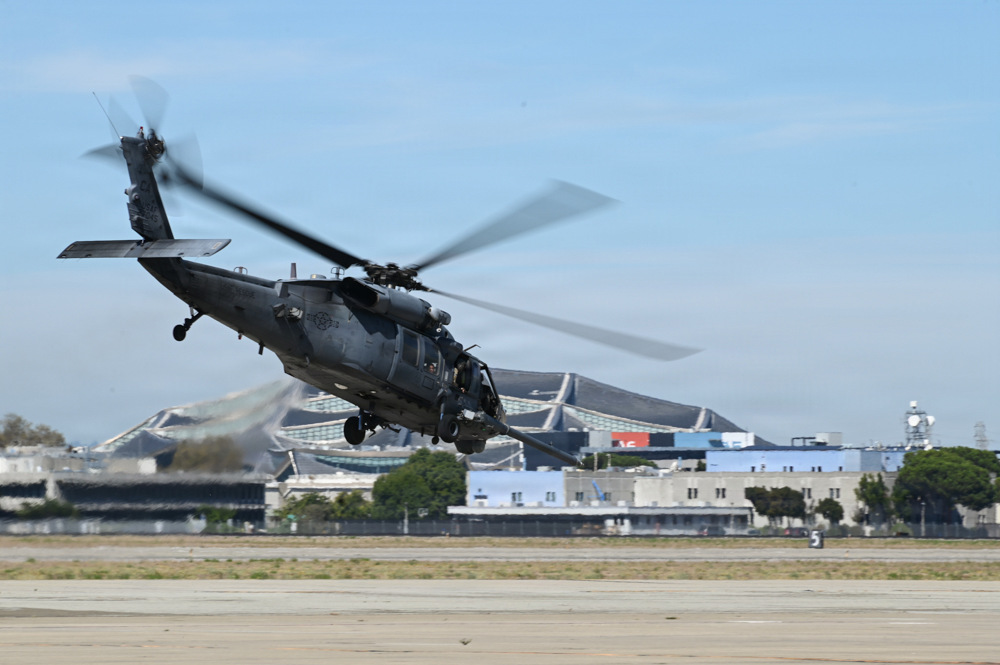
Moffett Air National Guard Base, Calif.– The U.S. Air Force has officially retired its last operational HH-60G Pave Hawk helicopter, marking the end of an era for an aircraft that served as the service’s primary combat search and rescue (CSAR) platform for over four decades. The 129th Rescue Wing conducted the Pave Hawk’s final flight and held a retirement ceremony for tail number 27045 on September 10, 2026, at Moffett Air National Guard Base, California.
While a few remaining G-models were still in the inventory for administrative processing, the flight by the 129th Rescue Wing represented the last active operational mission for the venerable helicopter. These remaining aircraft were slated to be fully processed out by September 30, 2026, coinciding with the end of the fiscal year. The HH-60G is being systematically replaced across Air Force units by its modernized successor, the HH-60W Jolly Green II.
Often referred to as the “Golf,” the HH-60G entered service in 1982. It quickly established itself as a critical asset, performing a wide array of missions beyond its primary role of combat search and rescue. These included disaster relief operations, humanitarian aid missions, and crucial casualty and medical evacuations in diverse and often hostile environments. As a variant of the ubiquitous UH-60 Black Hawk, the Pave Hawk was engineered for ruggedness and versatility.
Its capabilities were instrumental in its long service life. The Pave Hawk could carry eight or more passengers, operate at speeds up to 180 miles per hour, and boast a range of 580 miles. A key feature for its CSAR mission was its aerial refueling capability, allowing for extended loitering times and long-distance deployments without needing to land. For self-defense and mission support, it was equipped with two guns. Its cargo hook could lift up to 8,000 pounds, making it invaluable for external load transport, while its folding rotor blades enabled it to be transported aboard large cargo aircraft like the C-5M Galaxy, extending its global reach.
Throughout its operational history, the Pave Hawk played a significant role in numerous high-profile military and humanitarian operations. Domestically, it was critical in the military’s humanitarian response to Hurricane Katrina in 2005, extracting stranded citizens from floodwaters and delivering vital supplies. Internationally, the Pave Hawk was a constant presence during operations in the Global War on Terror in Iraq and Afghanistan, where its crews frequently flew into dangerous zones to rescue downed pilots and injured personnel, often under fire.
One of its most challenging and lauded deployments came during the noncombatant evacuation operation out of Afghanistan in 2021. Pave Hawk crews faced intense pressure and direct threats, including small arms fire from the ground, as they evacuated scores of people ahead of the advancing Taliban forces. For their extraordinary actions during this perilous period, Airmen operating the HH-60G were decorated with Distinguished Flying Crosses and Presidential Unit Citations, underscoring the helicopter’s reliability and the unwavering bravery of its crews in extreme circumstances.
The profound connection between the aircraft and its operators was often articulated by those who flew it. Lt. Col. Benjamin Buchta, an HH-60 pilot and commander of the 129th Rescue Squadron, remarked in a statement, “When you’re flying the [Pave Hawk], you kind of become one with that machine. The Golf feels like home when I sit in it.” This sentiment is widely shared among the thousands of Airmen who depended on the Pave Hawk over the decades.
At its operational peak, the Air Force maintained an inventory of over 100 HH-60G aircraft, distributed among Active Duty, Air National Guard, and Air Force Reserve units globally. The process of phasing out the Pave Hawk was a systematic, multi-year endeavor. Units worldwide began saying their final farewells to the “Golf” years prior, with Kadena Air Base in Japan retiring its last in August 2024, followed by Gabreski Air National Guard Base, New York, in October 2024. Kirtland Air Force Base, New Mexico, and Aviano Air Base, Italy, both completed their transitions in December 2024. The Air Force Reserve’s final HH-60Gs departed Patrick Space Force Base, Florida, in September 2025. The Air Force’s fiscal 2026 budget specifically funded the final 11 Pave Hawk divestments, leading to the Alaska Air National Guard retiring its last HH-60G in July 2026, and ultimately, the California Air National Guard’s final ceremony in September 2026, just before the new fiscal year.
Tributes from rescue units across the Air Force have consistently credited the HH-60G with directly contributing to the saving of thousands of lives over its more than 40 years of service, solidifying its legacy as a true workhorse of military aviation.
Its replacement, the HH-60W Jolly Green II, represents a significant leap forward in technology and capability. The “Whiskey” models feature fully digital glass cockpits, offering vastly improved situational awareness for pilots and crew. They boast enhanced hot weather and high-altitude performance, crucial for operations in challenging global environments. Crucially, the HH-60W incorporates advanced on-board self-defenses, designed to counter higher-end threats, significantly improving survivability. Other improvements include larger cabins for increased capacity and double the internal fuel capacity of the G-models, extending their endurance and range. The Air Force has requested over $200 million in its 2027 budget proposal for further Whiskey upgrades, including enhanced self-protection against shoulder-fired rockets and conversions for new missions, such as transporting VIPs around Washington D.C.
The service plans to field a total of 102 HH-60W Jolly Green II aircraft, which includes 11 test and developmental airframes. The final delivery of these next-generation rescue helicopters is anticipated in January 2030, ensuring the U.S. Air Force maintains a state-of-the-art combat search and rescue capability for decades to come.
Why This Matters
The retirement of the HH-60G Pave Hawk is more than just the decommissioning of an aircraft; it signifies a critical juncture in U.S. military aviation and global humanitarian capabilities. This event holds profound significance across several dimensions:
Strategic Readiness and Personnel Morale:The Pave Hawk’s primary mission of Combat Search and Rescue (CSAR) is indispensable. Knowing that a dedicated, capable rescue force exists to retrieve them if downed in hostile territory is a tremendous morale booster for combat aircrews. The transition to the HH-60W Jolly Green II ensures that this vital safety net remains robust and technologically advanced, capable of operating in increasingly contested environments. This directly impacts the willingness of personnel to undertake high-risk missions, underpinning strategic military operations globally.
Technological Modernization:The shift from the analog-era HH-60G to the digitally integrated HH-60W exemplifies the continuous evolution of military technology. The new aircraft’s enhanced features—from digital cockpits and improved performance to advanced self-protection systems—are crucial for maintaining an edge against sophisticated adversaries. This modernization is not merely about incremental upgrades; it’s about adapting to contemporary and future threats, ensuring U.S. forces can operate effectively and safely anywhere in the world.
Humanitarian and Global Impact:Beyond combat, the Pave Hawk was a cornerstone of humanitarian and disaster relief efforts, both domestically and internationally. Its involvement in events like Hurricane Katrina and numerous other crises underscored its dual-use capability. The HH-60W is poised to continue this legacy, providing critical aerial support for disaster response, medical evacuations, and aid delivery, thereby impacting civilian populations and reinforcing the U.S.’s role in global humanitarian assistance.
Economic Investment and Defense Industry:The procurement and ongoing upgrades for the HH-60W represent a substantial investment in the defense industrial base. This commitment supports high-tech manufacturing, research and development, and creates jobs, reinforcing the symbiotic relationship between national defense and economic activity. The allocation of over $200 million for future upgrades in the 2027 budget highlights a sustained investment in next-generation capabilities.
Historical Legacy and Institutional Knowledge:The retirement prompts reflection on over 40 years of service, courage, and innovation. The HH-60G’s legacy is intertwined with pivotal moments in recent history, from the Global War on Terror to critical evacuations. Preserving the institutional knowledge and experiences gained from operating the Pave Hawk is vital for training future generations of rescue personnel and informing the development of even more advanced systems. It honors the sacrifices and achievements of the Airmen who flew and maintained this iconic aircraft, and serves as a testament to the enduring commitment of the U.S. Air Force to its core mission.