
Unlock the White House Watch newsletter for free
Your guide to what Trump’s second term means for Washington, business and the world
**Key Takeaways**
* **Fragile Stability Amidst Geopolitical Volatility:** Despite calls for “no conflict” and “healthy competition,” the summit underscored persistent strategic friction between the US and China, particularly on trade, technology, and regional security, maintaining a cautious undertone for global markets.
* **Trade Truce Offers Temporary Respite, Long-term Uncertainty:** The short, two-month extension of the trade war truce provides immediate relief for supply chains and investor sentiment but highlights the deep divisions and the high probability of renewed tensions post-January 10, impacting sectors from manufacturing to agriculture.
* **AI Dialogue Signals Critical Tech Battleground:** The agreement to establish an “AI dialogue” acknowledges the transformative yet fraught nature of artificial intelligence, setting the stage for future regulatory frameworks, export controls, and a fierce competition for global tech leadership, with significant implications for semiconductor firms and tech giants.
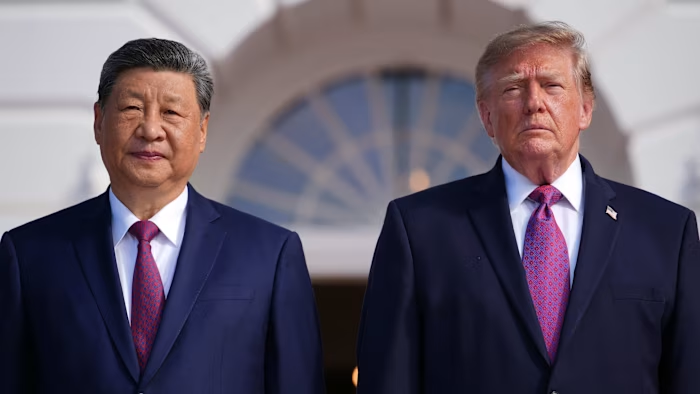
In a closely watched diplomatic encounter with profound implications for global markets and supply chains, Chinese President Xi Jinping emphasized the critical need for the US and China to avoid being drawn into a “conflict,” delivering his remarks at the White House alongside US President Donald Trump. This high-stakes visit marked Xi’s first trip to Washington in over a decade, arriving as investors worldwide keenly assess the trajectory of the world’s two largest economies.
Speaking during the White House arrival ceremony, Xi called for the nations to “coexist in peace,” a sentiment designed to assuage fears of escalating geopolitical tensions. His comments came as he prepared for extensive discussions with Trump, which were widely anticipated to delve into contentious issues, including US and Chinese policy towards Taiwan – a perennial flashpoint with the potential to trigger significant market instability.
“China and the United States . . . stand to gain from co-operation and will both lose in confrontation,” Xi stated, articulating Beijing’s preferred framework for engagement. He further elaborated, “Our competition should be a healthy one, and should be kept within bounds. It should be a race of catching up with one another, not a wrestle in which one either wins or loses.” This messaging, emphasizing “healthy competition” over direct confrontation, aimed to reassure global investors that Beijing is committed to preventing an all-out economic war, a scenario that would wreak havoc on multinational corporate earnings and global trade flows. Xi reinforced this by insisting the two superpowers must “hold the line of no conflict and no confrontation between us,” a phrase offering a degree of stability to nervous equity and commodity markets.
The timing of the trip is crucial, occurring as both nations navigate a complex landscape to maintain what they term “strategic stability.” This stability is constantly tested by difficult issues on which they remain fundamentally divergent, including entrenched trade imbalances, the accelerating technological rivalry, and China’s increasingly assertive military posture in the South China Sea. Each of these areas represents a potential source of market volatility, influencing everything from shipping costs and energy prices to the valuation of technology stocks dependent on global supply chains.
Welcoming Xi four months after his own visit to Beijing, President Trump struck a more optimistic tone, declaring that the two leaders had “made tremendous strides” in their collaborative efforts, including striving to forge a “more balanced trading relationship.” While the phrase “balanced trading relationship” often signals continued pressure from the US for greater market access and intellectual property protections, Trump’s overall positive framing offered a glimmer of hope for a de-escalation of trade hostilities, providing a temporary uplift to investor sentiment.
A critical outcome for markets emerged on Wednesday when US Treasury Secretary Scott Bessent announced that the countries had agreed to extend the trade war truce – initially brokered in Busan, South Korea, last year – by a mere two months, pushing the deadline to January 10. The brevity of this extension, coupled with the US stance that it refused a longer period due to China not “living up to the deal,” immediately sent a cautious signal across global trading floors. While the extension averts an immediate re-escalation of tariffs, the short timeframe and US skepticism imply that markets will remain in a “wait and see” mode, pricing in renewed uncertainty and the potential for further trade friction early next year. This impacts corporate investment decisions, particularly for companies with significant exposure to US-China trade across manufacturing, agriculture, and high-tech sectors.
Trump indicated that the leaders’ agenda would encompass security, technology, and his newly coined term, “super intelligence” – referring to artificial intelligence. Following an initial discussion between the two presidents, a wider meeting was planned with senior members of their respective delegations, underscoring the comprehensive nature of the discussions. For investors, the focus on technology, particularly AI, is paramount given its transformative economic potential and the intense US-China competition for dominance in this field.

As the leaders delved into policy, first lady Melania Trump was slated to escort Xi’s wife Peng Liyuan to the Smithsonian National Museum of Asian Art, a soft-power diplomatic gesture that often runs parallel to harder political negotiations.
This summit marks the third meeting between the two leaders since Trump returned to the White House in January 2025. Expectations are now firm that the US president will attend the Asia-Pacific Economic Cooperation forum in Shenzhen in November, followed by Xi’s presence at the G20 in Miami in December. This unprecedented frequency of high-level engagement – the first time either a US or Chinese president has paid two visits to the other country in a single year – suggests a heightened diplomatic effort to manage relations, potentially signaling a floor under the relationship’s deterioration, even if significant disagreements persist.
Treasury Secretary Bessent, speaking to the FT on Sunday, revealed that the leaders would establish an “AI dialogue” to address the security risks posed by new models of artificial intelligence. Xi acknowledged both countries as “leading nations” in the technology, yet struck a more cautious tone regarding AI risks than Trump, who had earlier expressed a desire “to leave it exactly where it is.” Xi’s nuanced approach – stating, “We have both the capability and responsibility to develop and manage AI for good and ensure that the development of AI is always under human control and serves the wellbeing of the people” – underscores the divergent philosophies that will shape global AI governance. For tech investors, this dialogue is crucial; it could lead to cooperative standards or, conversely, to a fragmented regulatory landscape impacting semiconductor manufacturers, software developers, and cloud service providers globally.
In a symbolic gesture recalling an earlier era of “panda diplomacy,” Xi announced that China would send two giant pandas to the Atlanta zoo. While seemingly trivial, such moves are often interpreted as signals of a willingness to engage positively, helping to thaw diplomatic frost and indirectly boosting broader market sentiment by reducing geopolitical friction.
Following their remarks, the two leaders proceeded to the Rose Garden for a military review. As they observed, a B-2 Spirit bomber – the aircraft that struck Iranian nuclear facilities last year – along with four F-22 fighter jets, executed a flyover. This visible display of US military might, even amidst a summit focused on cooperation, served as a stark reminder of the underlying strategic competition and power dynamics at play, a factor always considered by defense sector investors and those assessing regional stability risks.
Xi and Peng returned to the White House on Thursday evening for a lavish state dinner, a key event for networking and showcasing commercial ties. The guest list underscored the immense corporate stakes in US-China relations, featuring a formidable array of American business leaders: Apple’s Tim Cook, Citi’s Jane Fraser, SpaceX’s Elon Musk, Nvidia’s Jensen Huang, and Jamie Dimon from JPMorgan. Their presence signifies the continued importance of the Chinese market for these global behemoths and their desire for predictable, stable trade relations. US cabinet secretaries also attended, alongside Supreme Court Chief Justice John Roberts and General Dan Caine, chairman of the US Joint Chiefs of Staff, highlighting the whole-of-government approach to the relationship.
The Chinese delegation included prominent figures such as Wang Yi, the top foreign policy official, and vice-premier He Lifeng, who has been leading negotiations with Treasury Secretary Bessent. Notably, and in stark contrast to when Trump visited Beijing, there were no Chinese chief executives present at the state dinner. This absence is a telling detail, potentially signaling a more government-centric approach from Beijing to this iteration of diplomacy, or a cautious stance from Chinese firms amid ongoing US regulatory scrutiny and strategic competition. This could be interpreted by markets as a subtle cooling of direct business-to-business engagement, shifting the emphasis towards state-level agreements rather than immediate commercial deals.
During the dinner, Trump presented Xi with a statue of a bald eagle, a powerful symbol of American sovereignty, expressing his hope that it would find a “nice place” in Beijing – another layer of symbolic diplomacy in a relationship that continues to shape the global economic order.
**Market Impact**
The outcome of this high-profile summit offers a mixed bag for financial markets. The rhetoric of “no conflict” and “healthy competition” provides a crucial psychological anchor, mitigating immediate tail risks of an all-out economic war and offering a degree of stability to global equity indices and commodity prices. However, the short, two-month trade truce extension is a clear signal that underlying structural issues remain unresolved, leaving corporations and investors wary of renewed tariff threats post-January 10. This looming uncertainty will likely keep a lid on long-term capital expenditure and foster a cautious stance among multinational corporations heavily invested in US-China trade. Furthermore, the agreement to establish an “AI dialogue” underscores the escalating technology rivalry, pointing to a future where regulatory frameworks, export controls, and intellectual property protections will be fiercely contested, directly impacting the valuations and supply chains of key semiconductor, software, and advanced manufacturing firms. While symbolic gestures like panda diplomacy and frequent high-level meetings suggest a desire to manage tensions, the fundamental divergences, particularly on trade and technology, ensure that US-China relations will remain a dominant and unpredictable driver of global market sentiment for the foreseeable future, demanding constant vigilance from investors.