
Key Takeaways:
- Nexterity, founded by former ExxonMobil engineer Lindsey Elliott, is revolutionizing industrial pipefitting with a remote-controlled robot designed to automate the physically demanding task of bolting flange joints.
- The innovation directly addresses critical industry challenges including prevalent worker injuries, notoriously low productivity in pipefitting, and a severe labor shortage across essential infrastructure sectors.
- By offering a portable, battery-powered robotic solution that can be rented like construction equipment, Nexterity aims to make blue-collar jobs safer, more efficient, and appealing to a new generation of “torque dorks” keen on automation.
Unbolting the Future: Nexterity’s Robot Revolutionizes Industrial Maintenance
Lindsey Elliott is not your typical tech founder. While many gravitate towards apps or AI platforms, Elliott has found her calling in the often-overlooked world of industrial fasteners. At last year’s Bolting Symposium — the 13th annual gathering of what she affectionately calls “torque dorks” — her highlight wasn’t a keynote, but a spirited round of Bolting Bingo. This playful engagement, however, masks a serious mission: to fundamentally transform a critical yet arduous aspect of global infrastructure.
A seasoned engineer and planner forged at ExxonMobil, Elliott spent years immersed in the intricate systems that transport oil, gas, and petrochemicals. Her focus narrowed to a seemingly small component with monumental impact: the bolts securing “bolted flange joints” in pipelines. These ubiquitous connections, essential to every fluid-carrying system from oil rigs to water treatment plants, demand immense physical effort to loosen and tighten. It’s a task ripe for automation, and the core of Nexterity’s groundbreaking solution.
The Unseen Challenge: Bolting’s Heavy Toll on Industry and Workers
The physical strain associated with manually manipulating these heavy-duty bolts is immense. Pipefitters, the skilled craftspeople responsible for this work, frequently suffer from musculoskeletal injuries, strains, and fatigue. “Those people get really tired when they’re asked to work 12 hours a day for three months in a row,” Elliott told TechCrunch. Beyond individual well-being, this physically demanding work contributes to a broader crisis: a pervasive labor shortage across vital trade industries. New recruits are scarce, and experienced workers are aging out, leaving a widening skills gap. Compounding this, Elliott notes, is a pervasive inefficiency: “I’ve talked to pipefitters across the U.S., across Canada, and just repeatedly have been told North American pipefitting productivity is notoriously low.” This trifecta of safety concerns, labor scarcity, and productivity drains not only impacts individual companies but also the resilience and cost-effectiveness of critical infrastructure globally.
Nexterity’s Robotic Ingenuity: A Smarter Approach to Torque
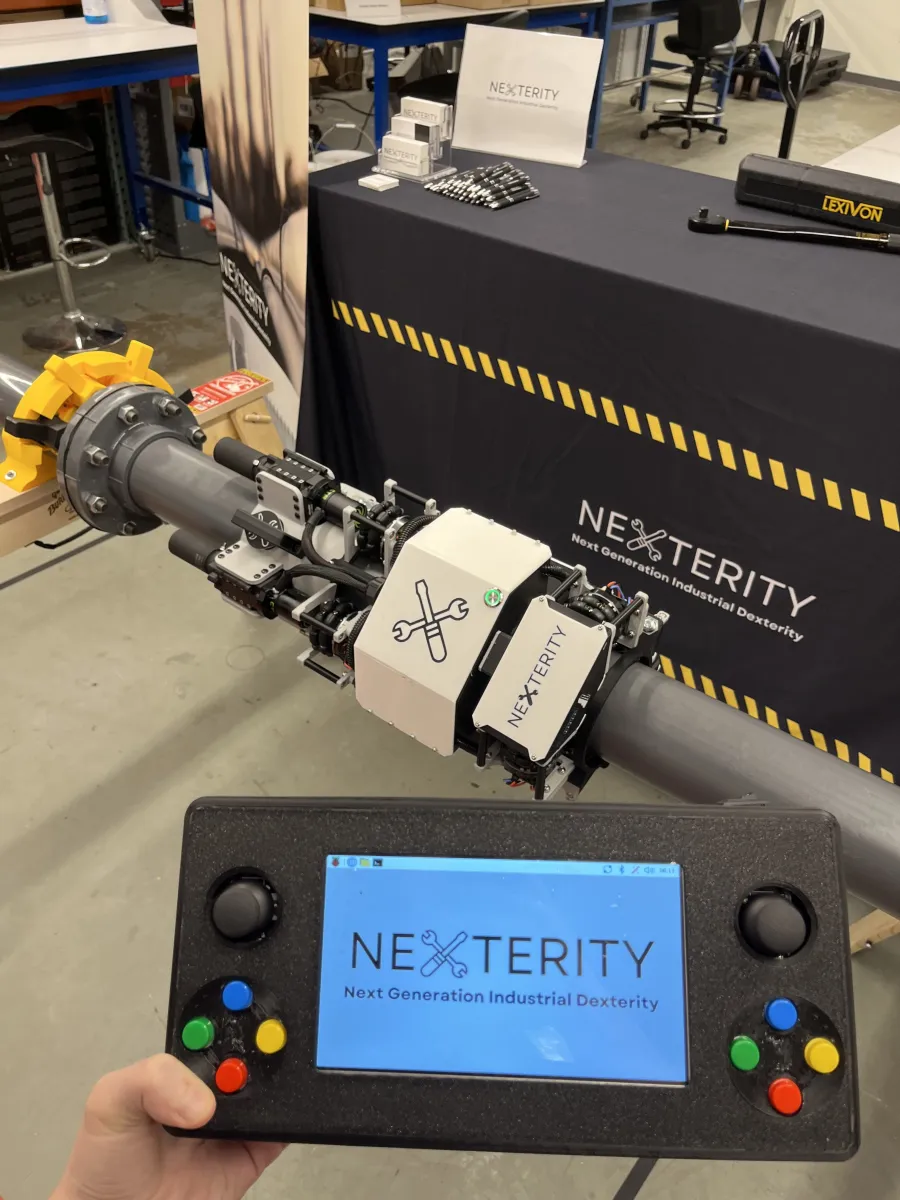
Elliott’s answer to this industrial dilemma, brought to life through her startup Nexterity (and showcased as one of the Startup Battlefield 200 at TechCrunch Disrupt), is a remote-controlled robot specifically engineered to handle the laborious task of bolt management. This ingenious device promises to fundamentally alter this blue-collar job, shifting the paradigm from brute force to precision automation. The company’s tagline, “More dork, less torque,” perfectly encapsulates this vision for a safer, smarter, and ultimately more productive workforce.
The robot itself is a marvel of practical engineering. It comprises two main pieces designed to clamp securely around a pipe. Powered by robust batteries, the unit can effortlessly slide along the pipeline, positioning itself to rapidly loosen or tighten up to four bolts simultaneously. Nexterity has developed several configurations to accommodate the most common standard pipe sizes, specifically targeting the NPS2 to NPS8 range. Despite its industrial capabilities, the robot prioritizes portability and ease of deployment. Each unit is compact enough to fit snugly into a standard Pelican case, allowing a single worker to transport and set it up at new sites with minimal effort. This flexibility is crucial to Nexterity’s innovative business model, which treats the robot as rental construction equipment, making it accessible to a wide array of clients without requiring significant upfront capital investment.
From Engineer to Innovator: Lindsey Elliott’s Vision for Automation
Elliott’s journey from a corporate engineering role at ExxonMobil to spearheading an industrial robotics startup is a testament to her keen observational skills and dedication to practical problem-solving. Her design philosophy wasn’t born in a vacuum; it evolved from years of direct engagement with the very people her technology aims to empower. She meticulously gathered insights not only from the quirky community at the Bolting Symposium but also from rigorous discussions with members of the American Society of Mechanical Engineers’ Pressure Vessels & Piping Division. “What I learned from the people, the torque dorks per se,” she explained, “is that 80% of our pipes are between two to eight inches in diameter, or what they call NPS2 to NPS8. And so when you have that much repeatability, you have a fantastic candidate for automation.” This deep understanding of industry needs and pain points allowed her to zero in on a highly repeatable process, making it an ideal target for Nexterity’s automated solution.
A Market Ripe for Automation: Beyond Oil & Gas
The simplicity of Nexterity’s idea belies its immense market potential. Elliott emphasizes just how pervasive the need for efficient bolting is. “I think it would shock a lot of people just how big this market is,” she asserts. While the original focus might have been on the oil, gas, and petrochemical sectors where Elliott gained her experience, the application extends far beyond. Consider the vast networks of water and wastewater treatment facilities, the meticulous hygiene demands of the food and beverage industry, the heavy machinery in mining operations, the precise requirements of nuclear power plants, and the rapidly expanding infrastructure for green and sustainable manufacturing. All these sectors rely heavily on the same types of bolted flange joints that Nexterity’s robot is designed to manage. This universality, coupled with the high volume of standard pipe sizes, positions Nexterity to address a truly global and diverse industrial demand.
Transforming the Workforce: The “Dork, Not Torque” Paradigm
Nexterity isn’t just offering a new tool; it’s proposing an evolution in how critical industrial maintenance is performed. By automating the most arduous and injury-prone aspects of bolting, the company not only enhances worker safety but also boosts productivity exponentially. Imagine pipefitters, freed from hours of strenuous manual labor, now supervising multiple robotic units, analyzing data, and focusing on higher-value tasks that require human judgment and skill. This shift could make these essential blue-collar jobs more attractive to a new generation, drawing in individuals who are adept with technology and interested in optimizing industrial processes rather than simply enduring physically taxing work. It’s about empowering the “torque dorks” to become tech wizards, leveraging their industry knowledge with cutting-edge robotics to build a more efficient and sustainable future for industrial infrastructure.
The Bottom Line
Nexterity’s remote-controlled bolting robot represents a significant leap forward in industrial maintenance, offering a pragmatic solution to long-standing challenges of safety, labor shortages, and productivity. By focusing on a universal yet underserved problem, Lindsey Elliott and her team are not just building a product; they are laying the groundwork for a safer, more efficient, and technologically advanced future for essential blue-collar work across every industry that relies on a bolted connection. Their vision to transform “torque dorks” into tech-savvy operators could redefine the very nature of industrial craftsmanship, proving that sometimes, the biggest innovations come in small, powerful packages designed for the humble bolt.
When you purchase through links in our articles, we may earn a small commission. This doesn’t affect our editorial independence.
{content}
Source:{feed_title}