
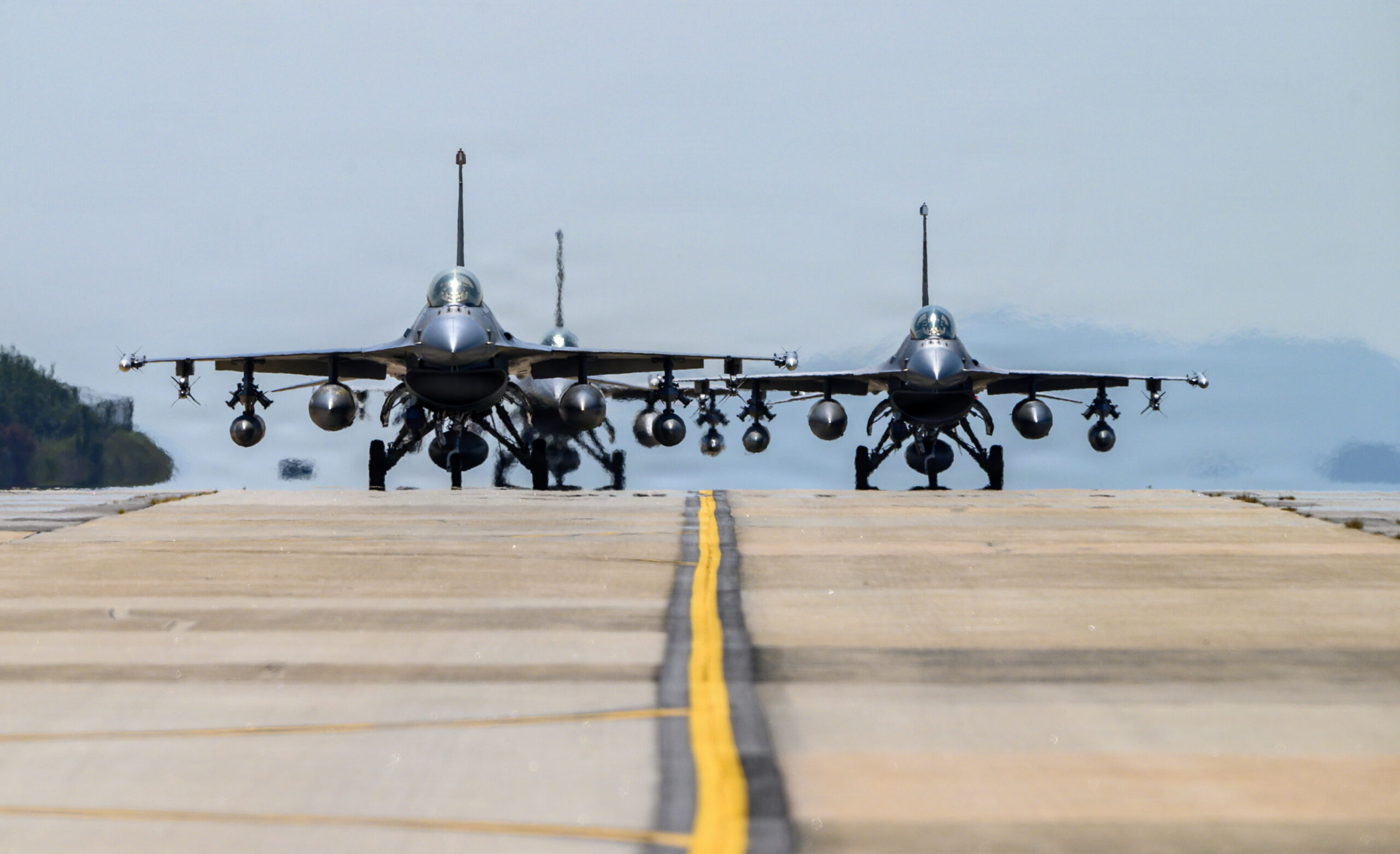
After a two-year operational trial, the U.S. Air Force is repositioning F-16 fighter jets across its bases in South Korea, concluding its “Super Squadron” experiment. The move sees F-16s returning to Kunsan Air Base, establishing a revised force posture on the peninsula aimed at enhancing strategic flexibility.
The 7th Air Force, which oversees U.S. Air Force forces in Korea, officially announced the phased return of F-16s to Kunsan Air Base on September 28. However, captions accompanying images released by the 7th Air Force indicate that some of these aircraft transfers commenced earlier, in May and August of the current year.
Upon the completion of this realignment, the U.S. Air Force presence will consist of two F-16 fighter squadrons at Kunsan Air Base and one at Osan Air Base. Geographically, Kunsan is situated approximately 150 miles south of the Demilitarized Zone (DMZ) that separates North and South Korea, while Osan Air Base lies closer to the border, about 50 miles from the DMZ.
Won Hee Kim, a spokesperson for the 7th Air Force, provided an official statement via email to Air & Space Forces Magazine. Kim noted, “The decision to return the F-16s on the Korean Peninsula to a three-squadron structure leverages the strategic advantages of both Osan and Kunsan Air Bases while increasing operational flexibility.”
The “Super Squadron” experiment was initiated in the early 2020s. This period coincided with Osan Air Base’s divestiture of its A-10 Warthog ground-attack aircraft, a change that would have left Osan with only a single F-16 squadron. The experiment involved shifting F-16s and their associated personnel from the 8th Fighter Wing at Kunsan to the 51st Fighter Wing at Osan.
The trial was structured into two phases, each designed to create larger, “jumbo” squadrons. These experimental squadrons comprised 31 jets, an increase from the conventional 24 aircraft typically assigned to a fighter squadron. The experiment had been slated to continue its evaluations through October 2026.
However, Gen. Kevin Schneider, commander of Pacific Air Forces, announced in April of the current year that the test had been “successfully completed,” and the involved forces would undergo a “reset” to their respective bases. At the time of this announcement, officials did not provide specific details regarding the reasons for the experiment’s conclusion ahead of its initially scheduled timeframe.
Super Squadron Background and Current Configuration
Under the newly re-established three-squadron structure, the 7th Air Force maintains the 36th Fighter Squadron and the 80th Fighter Squadron at Kunsan Air Base, alongside the 35th Fighter Squadron at Osan Air Base. This arrangement accounts for an estimated total of 72 F-16s distributed between the two strategic locations on the Korean Peninsula. It is important to note that F-16s from Misawa Air Base in Japan have also been separately transferring to Osan, contributing to the broader regional U.S. air power.
The 72 F-16 Fighting Falcons stationed in South Korea represent a significant component of the U.S. Air Force’s overall fighter fleet. This number constitutes nearly 9 percent of the approximately 826 F-16s currently in service with the U.S. Air Force.
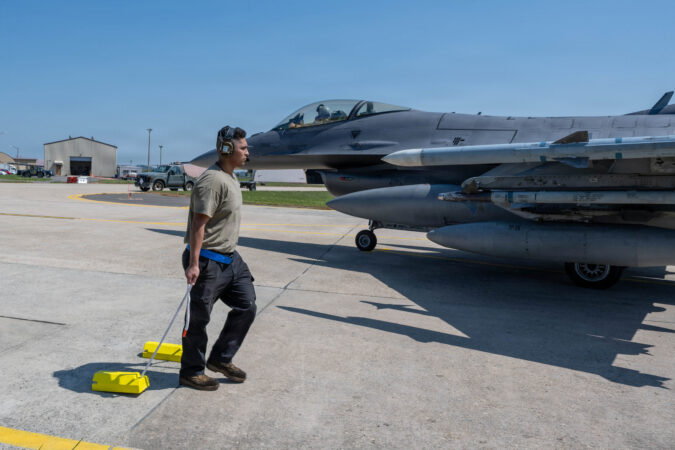
The fighter wings operating at both Kunsan and Osan primarily utilize F-16C and F-16D variants, specifically Block 40 Vipers. These aircraft are distinguished by their modernized features, which include advanced capabilities for Suppression of Enemy Air Defense (SEAD), night operations, and precision strike missions. This makes them versatile assets crucial for maintaining air superiority and providing close air support in the region.
The primary objective of the “Super Squadron” experiment was to gather data and measure potential efficiencies in aircraft maintenance and combat generation, according to commanders at the time of its launch. Lt. Col. Karl Wiest, then-spokesperson for Chief of Staff Gen. David W. Allvin, stated in an earlier announcement that the initiative sought to improve readiness and training while concurrently “reducing manpower and logistical support requirements.” General Allvin had also articulated a broader Air Force goal of reducing excess infrastructure and overall logistical demands.
While detailed findings from the experiment have not been publicly disseminated, an official release in April affirmed that “The Super Squadron test provided valuable data and critical insights for F-16 operations across the U.S. Air Force.” Neither the 7th Air Force nor the 8th Fighter Wing has provided more specific information regarding the lessons learned from the two-year trial.
Kim, the 7th Air Force spokesperson, underscored the human element in the experiment’s execution. Kim noted that the Airmen involved in this effort “demonstrated a culture of adaptability, innovation, and complemented the Agile Combat Employment model by enhancing flexibility within the force,” indicating a successful adaptation to altered operational structures.
The repositioning of U.S. Air Force F-16s on the Korean Peninsula, following the conclusion of the “Super Squadron” experiment, carries significant implications for regional stability, U.S. military strategy, and alliance dynamics.
Regional Deterrence and Stability:The distribution of U.S. fighter aircraft in South Korea is a critical component of the deterrence strategy against potential aggression from North Korea. A robust and strategically dispersed fighter presence reinforces the U.S. commitment to the defense of South Korea and contributes to overall regional security. By leveraging the “strategic advantages of both Osan and Kunsan Air Bases,” as stated by the 7th Air Force, the U.S. aims to enhance the survivability and operational reach of its air assets in a potential conflict scenario. This strategic spread makes U.S. forces less vulnerable to a concentrated attack and increases their ability to respond effectively across the peninsula.
Operational Flexibility and Modern Doctrine:The decision to revert to a three-squadron structure across two distinct bases, rather than maintaining a concentrated “Super Squadron” at a single location, highlights a strategic emphasis on operational flexibility and dispersed operations. This aligns with modern military doctrines such as Agile Combat Employment (ACE), which prioritizes the ability to rapidly deploy, disperse, and recover forces from multiple, often austere, locations. Such flexibility is crucial in a contested environment, as it minimizes the footprint of forces, reduces their vulnerability, and allows for quicker response times and greater adaptability to evolving threats. The “Super Squadron” experiment likely provided valuable insights into the practical challenges and benefits of concentration versus dispersal in a high-threat region.
U.S. Force Structure and Efficiency:The “Super Squadron” experiment itself served as a real-world test case for optimizing resource allocation, manpower utilization, aircraft maintenance procedures, and logistical support within the U.S. Air Force. While specific detailed outcomes remain largely internal to the Air Force, the conclusion of the experiment and the subsequent “reset” indicate that lessons learned are being integrated into broader force structure planning. This continuous evaluation of how best to organize, equip, and employ air power has direct implications for the efficiency and effectiveness of the U.S. military presence not only in the Indo-Pacific but potentially for global deployments and operations. It reflects an ongoing effort to adapt to budgetary constraints and evolving operational requirements.
Alliance Dynamics and Strategic Messaging:The U.S. military posture in South Korea forms the bedrock of the long-standing U.S.-Republic of Korea alliance. Adjustments to U.S. force structure and deployment, even if primarily internal tactical decisions, are closely observed by allies and potential adversaries alike. These changes communicate the U.S.’s ongoing efforts to refine its defensive capabilities and ensure interoperability with South Korean forces, thereby bolstering the alliance’s collective strength and strategic messaging in a volatile region. The long-term implications of these tactical and organizational adjustments are vital for maintaining peace and stability in Northeast Asia and underscore the U.S.’s enduring commitment to its regional partners.