
Independent Women Vice President of economic policy Patrice Onwuka speaks to Fox News Digital after receiving backlash over an opinion piece where she argued that socialist policies are threatening her family’s American dream.
Key Takeaways:
- **Ideological Divide Deepens Amid Economic Strain:** As persistent inflation and elevated interest rates squeeze household budgets, the fundamental debate between free-market capitalism and democratic socialism intensifies, with proponents of each offering vastly different solutions to economic inequality and affordability crises.
- **Rent Control Faces Market Scrutiny:** Democratic socialist proposals for universal rent control are being challenged for their potential to distort housing markets, disincentivize property maintenance and development, ultimately reducing housing supply and exacerbating affordability issues rather than solving them.
- **Fiscal Sustainability and Investor Confidence at Risk:** Critiques of democratic socialist platforms highlight immense projected federal spending, raising concerns about national debt, inflationary pressures, and the potential for these policies to deter private investment and stifle economic growth.
As persistent inflation, elevated interest rates, and squeezed household budgets leave millions of Americans feeling financially stretched, democratic socialist leaders are pitching rent controls and greater government involvement in the economy as an equalizer. This ideological battle is not merely political rhetoric; it has profound implications for market dynamics, investor sentiment, and the long-term economic trajectory of the United States.
Patrice Onwuka, vice president for economic policy at Independent Women, is pushing back after her defense of capitalism and the American dream drew criticism online, warning Americans not to be swayed by what she calls the socialist “pipe dream.” Her arguments resonate deeply within free-market circles, emphasizing individual agency, property rights, and the power of entrepreneurial spirit—concepts critical to capital formation and economic expansion.
On Aug. 26, Onwuka wrote an opinion piece for The Washington Post criticizing the socialist movement for challenging “the very ethos of what drew [her family] here.” Her family immigrated legally from Montserrat in the Caribbean more than 40 years ago, arriving in Boston with just suitcases and living in a drug-ridden neighborhood before building wealth through ownership of a multifamily “fixer-upper” home. This narrative is a classic testament to upward mobility within a capitalist framework, where hard work, saving, and strategic investment in real assets like property can lead to significant wealth accumulation and intergenerational prosperity.
Online commenters dismissed her defense of capitalism as “billionaire propaganda … so tone-deaf”; “Everything you described happened under today’s capitalist system”; “Capitalism already destroyed the American dream”; and “You’re talking about 30 years ago … it’s not like this anymore, who are you kidding?” These criticisms reflect a growing disillusionment among some segments of the population who feel excluded from the benefits of the current economic system, often pointing to stagnant wages, rising costs of living, and widening wealth disparities as evidence of capitalism’s failures.
“Those people who called my work ‘billionaire propaganda,’ well, I’m not a billionaire, so that’s not what I’m talking about. And if they actually read beyond just the headline, which I doubt most did, then they would actually realize I started with my family’s story of coming to this country with just a few suitcases of clothes and living in the ghetto in the 1980s,” she told Fox News Digital. This personal rebuttal underscores the free-market belief that opportunity is not solely the domain of the ultra-rich but is accessible to those willing to pursue it, even starting from humble beginnings.
“Nothing was handed to us, and that’s what my parents taught us, like so many people’s families, instilled values about personal responsibility, about putting money aside, saving for what you want to build towards, self-denial, really working towards a goal and achieving it, and recognizing that opportunity does get dressed up as hard work,” Onwuka said. “But, when you’re willing to put the time and effort in, there is so much that you can do and so much you can achieve, frankly, that you can’t achieve in other countries.” From a market perspective, this highlights the role of individual capital formation, deferred gratification, and labor force participation as drivers of personal economic growth and overall GDP.
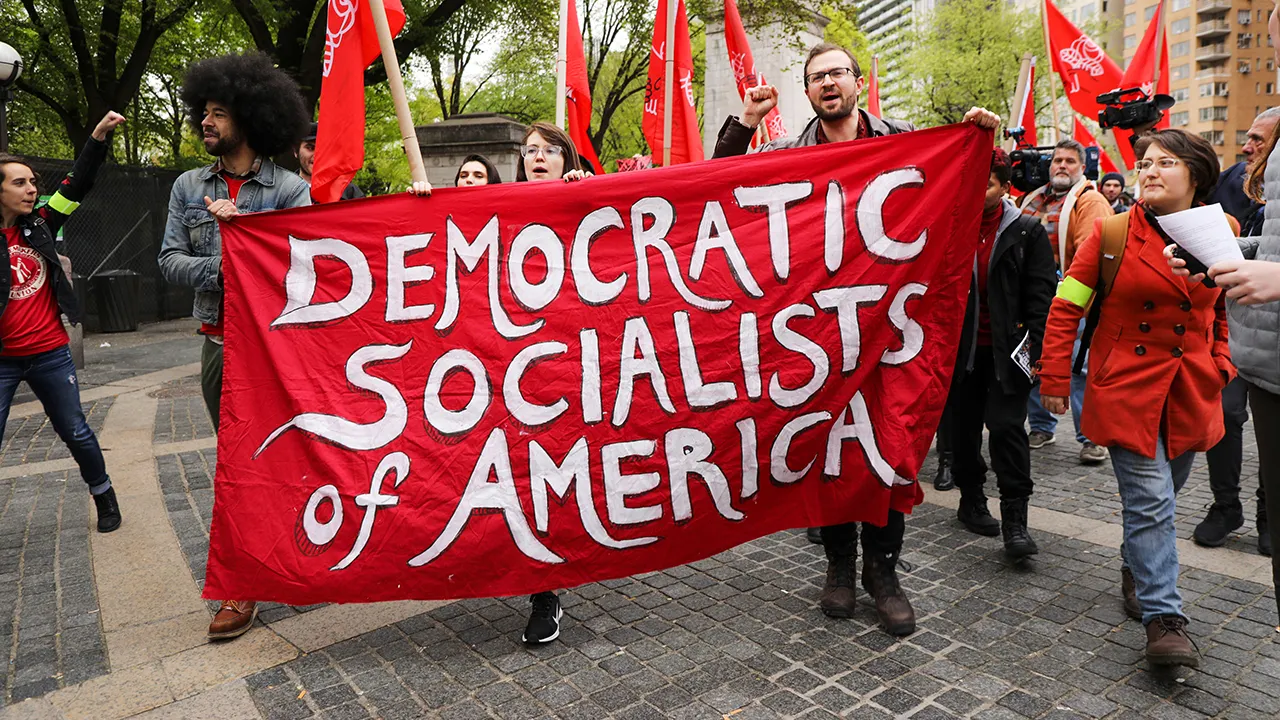
Members of the Democratic Socialists of America gather outside a Trump-owned building on May 1, 2019.(Getty Images)
Onwuka said Americans feeling squeezed by inflation and household expenses should be wary of political promises that government intervention will deliver greater economic equality. The current inflationary environment, marked by CPI hovering well above the Federal Reserve’s 2% target and persistent supply chain issues, makes the appeal of government-led solutions to perceived market failures particularly strong. However, economists often caution that large-scale government intervention can exacerbate inflationary pressures and create new market distortions.
“Don’t be fooled. They are going to sell you a pipe dream and play off emotions of how people are feeling about their financial positions,” Onwuka said. “I get it, folks, when you hear the Census data come out that we had record-low poverty in 2025, record-high median incomes, which is really great news, but then you look at your own family budgets and feel like you don’t have that extra cushion because of high gas prices and inflation not coming down to where it was prior to the pandemic — don’t latch on to a new shiny object saying, ‘Oh, I can make things better and everything will be equal.'”
“In their eyes, equal looks like everyone living like Jeff Bezos. Equal looks like everybody living like Elon Musk. But we all understand that there’s certainly not enough money for the government to confiscate to make everyone a billionaire on day one,” she continued. This directly addresses the often-misunderstood concept of wealth redistribution, highlighting the practical limitations and the immense capital flight and disincentive to innovation that would follow such drastic measures.
Onwuka’s family moved from the Caribbean island of Montserrat, just south of St. Kitts & Nevis and Antigua.| FOXBusiness
“What equal ends up looking like is what it’s looked like in other countries where this failed democratic socialist experiment has failed. Equal looks like bread lines. Equal looks like store shelves where you have maybe one or two items, not the plethora and variety that we have in our store shelves at very low cost. Equal looks like inflation in the thousands of percent rather than in the 3 to 5% range that we have right now.” This is a stark warning, drawing parallels to historical economic collapses and hyperinflationary environments seen in command economies, which stand in sharp contrast to the consumer choice and price stability generally provided by competitive markets.
Onwuka specifically called out the Democratic Socialists of America (DSA) platform’s support for universal rent control and tighter regulation of investment properties. In New York City, DSA-backed Mayor Zohran Mamdani campaigned on freezing rents for rent-stabilized tenants, and the city’s Rent Guidelines Board later approved zero-percent increases for one- and two-year leases for rent-stabilized units. The debate over rent control is particularly acute in tight housing markets like NYC, where demand far outstrips supply, leading to rapidly escalating rental costs.
“When you look historically at what has happened when rent control is implemented, well, the cost for providing that home — the mortgage payments, the maintenance fees, fixing pipes, fixing issues that come up — those costs continue to rise. The rent is capped, and so the amount that a landlord has to be able to keep that property in a very livable, comfortable space for their tenants, that money diminishes until it becomes nothing,” Onwuka explained. From a market perspective, rent control acts as a price ceiling, distorting the natural supply-demand equilibrium. Landlords face reduced profitability, which disincentivizes investment in property upkeep, renovation, and new construction. This inevitably leads to a reduction in the quality and quantity of available rental units over time, paradoxically worsening the housing crisis it aims to solve.
‘Varney & Co.’ host Stuart Varney examines a court setback for Mayor Zohran Mamdani’s second-home tax rollout and the broader fight over his ‘tax the rich’ agenda in New York City.
“And when it goes into the negative, then there is absolutely no reason for a landlord to continue to rent their property out. And so what you tend to have is you have a lot of vacant properties sitting unused. Because it’s too expensive to fix them up and to keep a tenant in there since the rent that they can charge is artificially capped,” she continued. “That is dangerous.” This phenomenon, where properties are withdrawn from the rental market or fall into disrepair, directly impacts housing supply, property values for investors, and the overall health of the urban real estate market.
She further argued that rent controls can lead to property dilapidation, which she said could give the state a pretext to seize private property – a concern that touches upon fundamental property rights, a cornerstone of market economies and investor confidence. The Democratic Socialists of America did not respond to Fox News Digital’s request for comment.
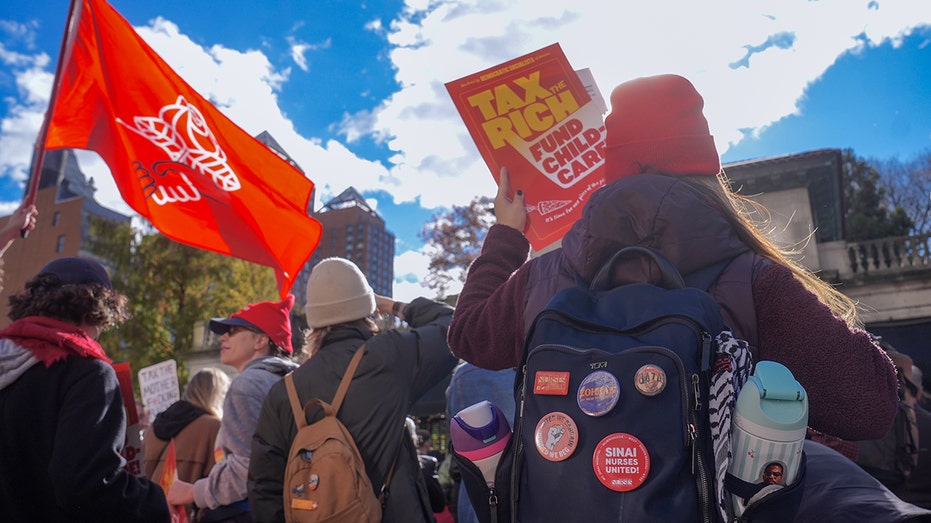
New York City Democratic Socialists (NYC-DSA) held a rally in Union Square marking the start of a campaign to tax the rich and win universal childcare on November 16, 2025.(Getty Images)
An August analysis from the libertarian Cato Institute estimated that the DSA platform would cost between $71 trillion and $212 trillion in new federal spending between 2027 and 2036, equivalent to 18% to 53% of U.S. GDP. The analysis also estimated that confiscating 100% of the total net worth of America’s 400 richest individuals — $6.6 trillion — would cover only 3% to 9% of the plan’s estimated 10-year cost. This fiscal gap highlights the profound challenge of funding such ambitious programs, inevitably pointing towards massive tax increases on corporations and individuals, significant government borrowing, or rampant money printing – all of which have severe implications for market stability, inflation, and national debt.
“You start to see why their solutions actually do not work, but turn us into pretty much indentured servants to the federal government or the state government,” Onwuka said.
The core capitalist argument is that government plays a critical but limited role in fostering a robust market economy. “Government plays a role in terms of reducing the barriers that people have and the hurdles that people have to pursue opportunities,” she added. “Whether you want to be a nurse or you want to be a firefighter, or you want to have your own small business, or you want to be a YouTube sensation — the government’s role is not to tell you where to go. Government’s role isn’t even to make it harder for you to get into any of those occupations.”
“The government should be looking for ways to ensure that the barriers are lowered so that you can compete, that you can pursue the education you want and that you go as far as you desire to go … the Democratic Socialists of America, they don’t have that to offer. They want to tell you what to do, what to become and limit your opportunities. And I don’t want that for you, for me or for my children, or anyone’s children.” This perspective emphasizes regulatory efficiency, educational access, and a stable legal framework that protects contracts and property – conditions essential for a thriving, competitive, and innovative market economy.
Market Impact:
The ongoing ideological battle between free-market principles and democratic socialist proposals carries significant implications for various sectors of the U.S. economy and global markets. Should policies like universal rent control gain broader traction, the real estate market, particularly in urban centers, could face reduced investment in rental properties, a decline in property values for landlords, and a potential exodus of institutional capital from residential real estate. Developers would likely scale back new projects, further tightening housing supply. On a broader macroeconomic level, the fiscal implications of trillion-dollar spending plans, as outlined by the Cato Institute, could lead to increased government borrowing, potentially driving up interest rates and crowding out private investment. Concerns over higher corporate and individual taxation, coupled with increased regulatory burdens, could dampen investor confidence, slow capital formation, and potentially trigger capital flight, impacting stock market valuations and the overall growth trajectory of the U.S. economy. The uncertainty surrounding such fundamental shifts in economic policy would likely introduce volatility across asset classes, challenging long-term investment strategies and potentially altering the perceived risk profile of the U.S. as a global investment destination.