
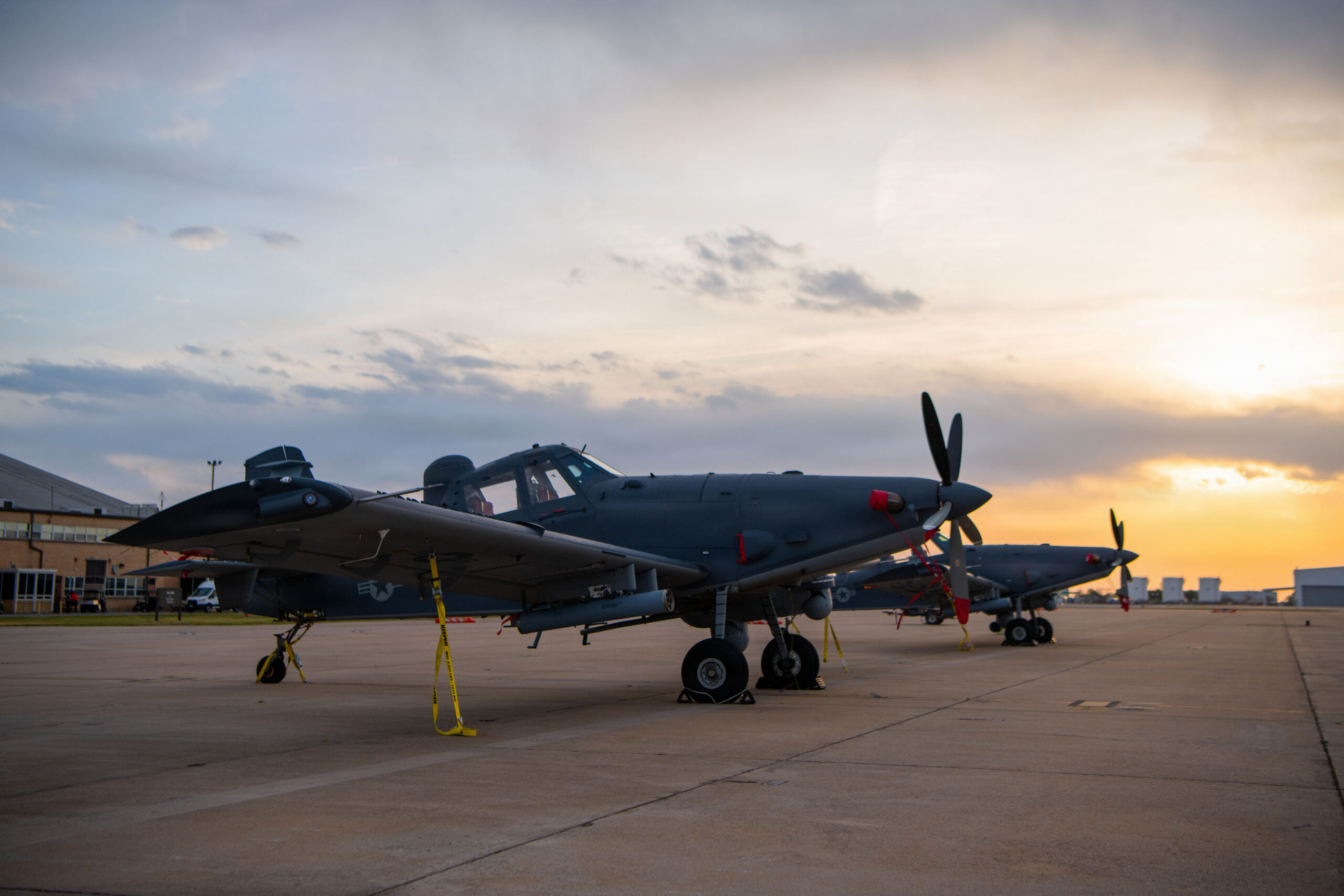
An OA-1K Skyraider II aircraft, operated by Air Force Special Operations Command (AFSOC), was involved in a runway excursion incident on October 5 at Sundance Airport, a small general aviation facility near Oklahoma City. The aircraft departed the runway while landing, coming to rest in the adjacent grass. Officials confirmed that both crew members on board were safe and uninjured following the incident, which occurred during a training sortie.
The incident was initially reported by local media outlets in Oklahoma City. The OA-1K had taken off from Will Rogers Air National Guard Base, located approximately 20 miles from Sundance Airport, earlier that day for its training mission.
A spokesperson for the 492nd Special Operations Wing, to which the aircraft is assigned, confirmed the safety of the two crew members. The spokesperson declined to specify whether one of the individuals on board was a student pilot, given the timing of the incident.
This event occurred just days after the 492nd Special Operations Wing announced on social media the commencement of its formal training unit (FTU) for the OA-1K. The FTU had begun training its inaugural class of new pilots, marking a significant milestone in the aircraft’s integration into AFSOC operations.
The OA-1K Skyraider II is a specialized “combat scout” aircraft, adapted from a commercial cropduster airframe. Its design and operational profile are tailored for light attack, intelligence, surveillance, and reconnaissance (ISR) missions, particularly in less contested airspaces. This platform is intended to support counterinsurgency operations, providing a cost-effective and versatile asset for special operations forces. The first OA-1K airframe arrived at Will Rogers Air National Guard Base in June 2025, with test and instructor pilots dedicating the past year to developing the training curriculum and preparing the “schoolhouse” to train future special operations aviators.
Flight tracking data indicates that the OA-1K involved in the incident took off from Will Rogers in the mid-afternoon of October 5. It subsequently conducted several hours of flight patterns before attempting to land at Sundance Airport. The data suggests that approximately midway down the runway, the aircraft veered sharply to its left, ultimately coming to a halt in the grassy area adjacent to the airstrip.
The 492nd Special Operations Wing issued a statement regarding the occurrence: “The 492nd Special Operations Wing is tracking an incident involving one of its OA-1K Skyraider II aircraft at Sundance Airport, Oklahoma City. Both crew members are safe and the cause of the incident is under investigation. Further details will follow as the investigation develops.”
Local media reports provided additional visual details and preliminary observations. Oklahoma City’s News 9, citing the Oklahoma City Fire Department, reported that the aircraft appeared to have “nose-dived” during landing, resulting in damage to its propeller. KOCO News 5, another local television station, released video footage captured after the incident. This video visibly depicted bent propeller blades and distinct skid marks in the grass trailing behind the aircraft, corroborating the description of a runway excursion and physical damage.
As of the morning of October 6, the aircraft remained at Sundance Airport. The 492nd spokesperson stated, “Our team is currently working courses of action to remove the aircraft off the airfield. Safety-trained personnel are on scene documenting and collecting all evidence while developing a plan to remove the aircraft as soon as safety-investigative procedures allow.” This indicates a methodical approach to securing the scene, gathering information, and planning the safe retrieval of the damaged aircraft.
This incident represents the second safety-related event involving the OA-1K Skyraider II since its introduction to Oklahoma. In October 2025, an experienced special operations aviator, who was transitioning to the OA-1K, inadvertently shut off the aircraft’s fuel supply during a training sortie. This previous incident resulted in the aircraft flying at an extremely low altitude over a local road before ultimately crashing in a field. While the circumstances differ, both events underscore the inherent risks associated with flight training, particularly with new aircraft types and their operational integration.
Why This Matters
The incident involving the OA-1K Skyraider II at Sundance Airport carries significance for several reasons, impacting military aviation safety, pilot training, and the broader strategic development of Air Force Special Operations Command’s capabilities.
Firstly, it highlights the inherent challenges and risks associated with introducing new aircraft platforms and establishing formal training programs. The OA-1K’s formal training unit had just commenced its first class of new pilots. While it’s unconfirmed if a student pilot was involved, any incident during this critical phase can impact the pace and confidence in the training curriculum. Military aviation training, by its nature, involves complex maneuvers and operational scenarios, demanding rigorous safety protocols. Investigations into such events are crucial for identifying potential procedural gaps, equipment issues, or training deficiencies that could prevent future occurrences and ensure the safety of both pilots and the aircraft itself.
Secondly, the OA-1K Skyraider II represents a key component of AFSOC’s strategy for operating in specific environments. Its role as a “combat scout” for light attack and ISR missions in less contested airspace is designed to fill a niche that traditional high-performance fighter jets or larger surveillance aircraft may not efficiently or cost-effectively address. These missions are particularly relevant for counterinsurgency operations, where a flexible, durable, and relatively low-cost platform is highly valuable. An incident that damages one of these relatively new and limited-production aircraft can cause delays in its operational deployment and potentially impact the availability of these assets for critical missions. The financial cost of repairs, investigation, and potential operational downtime also represents a drain on defense resources.
Thirdly, this marks the second safety incident for the OA-1K platform since its arrival in Oklahoma. While the previous incident in October 2025 involved an experienced pilot inadvertently shutting off the fuel, the recurrence of safety events, even if unrelated in cause, warrants careful scrutiny. AFSOC and the Air Force will meticulously analyze both incidents to ensure that there are no underlying systemic issues related to the aircraft’s design, maintenance, or the comprehensive training syllabus. Maintaining a strong safety record is paramount for military aviation programs, not only for the well-being of personnel but also for maintaining public trust and confidence in the capabilities and responsible operation of military assets.
Finally, the transparency and thoroughness of the ongoing investigation are important. The statement from the 492nd Special Operations Wing indicates a commitment to understanding the cause and developing a plan for recovery. The findings of this investigation will inform future training methodologies, operational procedures, and potentially modifications to the aircraft or its systems. As AFSOC continues to integrate this unique platform into its force structure, every incident serves as a critical learning opportunity to refine its operational readiness and ensure the long-term success of the OA-1K program in supporting special operations missions globally.