
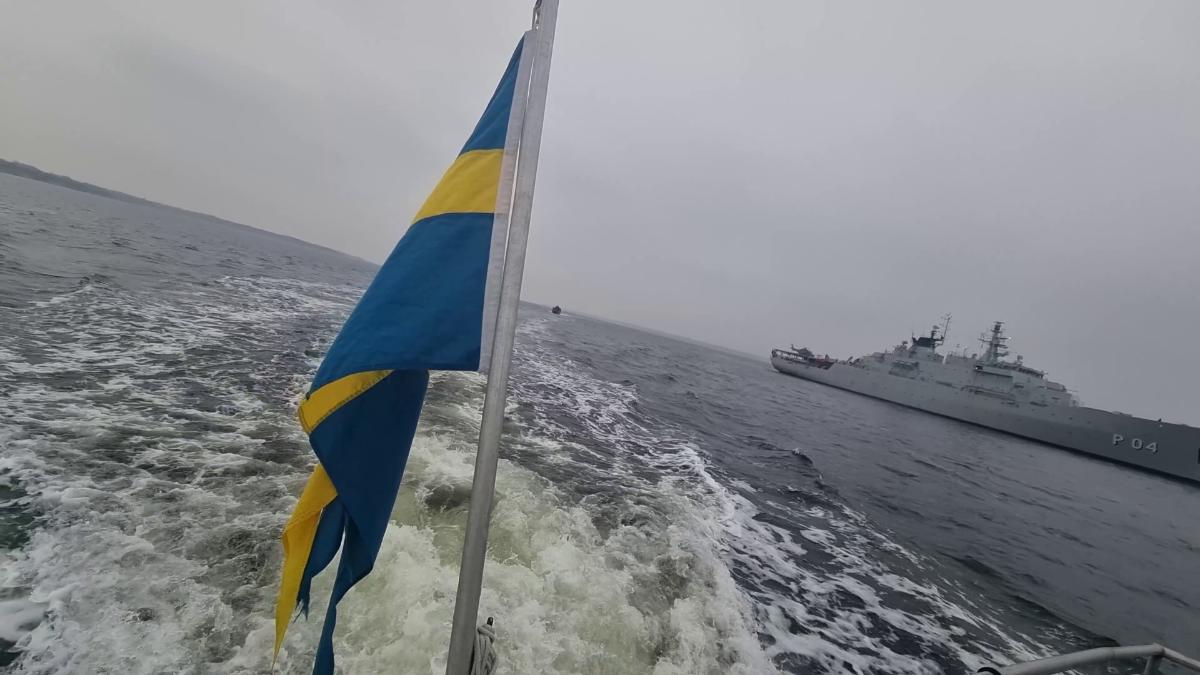
Swedish Navy Leverages Baltic Sea’s Unique Underwater Environment for Strategic Advantage, Informs NATO Strategy
London, UK– The distinctive and challenging underwater topography of the Baltic Sea, which often renders conventional sonar systems unreliable, paradoxically provides a strategic advantage for a navy intimately familiar with its complexities, according to Captain Anna Jonsson, commander of the Royal Swedish Navy’s 4th Naval Warfare Flotilla. Speaking at the Apex Europe conference in London on Wednesday, Captain Jonsson detailed how Sweden has honed its naval platforms, sensors, weapons, and tactics over generations to exploit this environment for cover, concealment, and freedom of maneuver.
Captain Jonsson, whose flotilla is responsible for operations in the intricate waters surrounding Stockholm, opened a panel discussion on countering undersea threats by describing the operational conditions faced by her crews. She emphasized the profound impact of the region’s geography on naval operations. “Sweden and my unit operate in a complex underwater environment,” Captain Jonsson stated. “Our archipelago consists of tens of thousands of islands, narrow passages, shallow waters, and highly variable seabed conditions. Below the surface, rocks, wrecks, and diverse seabed formations create an inherently challenging environment for our sensors.”
The inherent variability of the water itself further complicates these conditions. Captain Jonsson highlighted that beyond the physical seabed, fluctuations in depth, temperature, and salinity significantly impact acoustic propagation. “Add variations of depth, temperature and salinity to that, and the performance of the sonar and underwater systems can change significantly from one area to another,” she explained. This dynamic environment can cause sound waves to refract, reflect, and scatter unpredictably, creating acoustic shadows and confusing signals that confound traditional anti-submarine warfare (ASW) techniques.
However, Captain Jonsson argued that these complexities, rather than being solely a hindrance, can be transformed into a decisive advantage for a force that possesses an in-depth understanding of the battlespace. “Complexity is not necessarily a disadvantage always. For the force that understands the environment, it can provide cover, concealment and freedom of manoeuvre,” she asserted. This philosophy has profoundly influenced Swedish naval doctrine and procurement for decades, shaping a force uniquely adapted to its home waters.
This environmental mastery is evident in the specific design and capabilities of the Swedish Navy’s fleet. Unlike many “blue-water” navies designed for open ocean operations, Sweden’s focus has been on developing platforms optimized for the shallow, confined, and acoustically challenging Baltic Sea. This includes highly maneuverable, shallow-water submarines, such as the Gotland-class, renowned for their Air Independent Propulsion (AIP) systems, allowing them to remain submerged for extended periods. Additionally, specialized mine countermeasures vessels and corvettes like the Visby-class, built with stealth technology and a shallow draft, are integral to operating effectively within the archipelago’s narrow passages and coastal zones. The tactics employed by these vessels have been refined over decades, allowing them to effectively navigate and exploit the very conditions that would incapacitate a less specialized force.
For Sweden, a nation with comparatively smaller defense resources, this specialized expertise is a crucial force multiplier. “Sweden is in some way a small state,” Captain Jonsson observed. “I have limited resources within my flotilla, but we still need to achieve combat effectiveness. It’s important for us to understand the underwater terrain better than our adversary.” This emphasis on asymmetric advantage through environmental knowledge underscores a strategic imperative for smaller navies operating in critical, contested regions.
The unique ASW challenges of the Baltic Sea resonate with a broader understanding within NATO. The panel chair noted that the Baltic effectively condenses problems that other navies encounter in a more diluted form elsewhere, with the Black Sea offering the closest comparison in terms of its complex operating environment. Consequently, anti-submarine warfare in the Baltic demands a fundamentally different approach than in the deeper, more open waters where many NATO navies typically operate.
Commodore David Burton, who leads NATO’s efforts in developing an allied underwater battlespace network, affirmed that understanding the operating environment is a foundational principle of the alliance’s experimentation strategy. Allied Command Transformation (ACT), NATO’s strategic command for future warfare development, is systematically conducting demonstrations region by region to build this crucial environmental intelligence. The Baltic Sea has already been a key focus, followed by exercises in the Mediterranean, with the High North slated for the next phase of these critical environmental data-gathering and tactical refinement initiatives.
Sweden’s recent accession to NATO in March 2024 has brought this invaluable, generations-deep expertise and specialized capability directly into the alliance. This integration significantly strengthens NATO’s collective defense, particularly on its eastern flank, by providing an enhanced understanding of the complex Baltic Sea environment and proven strategies for effective undersea warfare within it.
Why This Matters
The insights shared by Captain Anna Jonsson underscore several critical aspects of contemporary naval warfare and regional security. Firstly, the Baltic Sea is a strategically vital waterway, serving as a critical access point to the North Atlantic and bordering several NATO and EU member states, as well as Russia. Its unique geography, as highlighted by Captain Jonsson, transforms it into a complex arena where traditional naval superiority does not automatically translate into operational dominance. Understanding and exploiting this environment is paramount for effective defense and deterrence.
Secondly, the discussion emphasizes the growing importance of undersea warfare and anti-submarine capabilities. With advancements in quiet submarine technology and the increasing potential for sub-surface conflict, the ability to detect, track, and counter undersea threats is a cornerstone of modern naval power. Sweden’s specialized approach demonstrates that adapting tactics and technology to specific environmental conditions can create a significant asymmetric advantage, allowing a smaller force to effectively challenge a larger, less adapted adversary.
Thirdly, Sweden’s recent integration into NATO is profoundly significant. By joining the alliance, Sweden brings not only its highly capable military forces but also unparalleled expertise in operating within the challenging Baltic Sea environment. This deep knowledge of the local underwater terrain, developed over generations, directly enhances NATO’s collective defense capabilities on its eastern flank. It provides the alliance with refined tactics, specialized platforms, and a strategic understanding that is vital for projecting power, maintaining regional stability, and deterring potential aggression in this critical theater. This specialized understanding complements broader NATO efforts, such as those led by Allied Command Transformation, to build a comprehensive underwater battlespace network across various operational environments.
Finally, this discussion highlights a fundamental principle of military strategy: the importance of knowing your battlespace better than your adversary. In an era of advanced technology, environmental intelligence remains a non-negotiable factor in achieving combat effectiveness. For nations like Sweden, with limited resources, this mastery of the local environment is not just an advantage; it is a strategic imperative that ensures combat readiness and contributes significantly to regional security and the broader framework of NATO’s collective defense.