

The U.S. Air Force’s B-52 Stratofortress bomber is poised to significantly enhance its maritime strike capabilities, with plans underway to equip the aircraft to carry up to 20 stealthy Long-Range Anti-Ship Missiles (LRASM). This development would enable the B-52 to effectively engage moving targets at sea, a critical capability in potential conflicts, particularly in the Indo-Pacific region.
On October 7, Naval Air Systems Command (NAVAIR) issued a notice indicating its intention to award a contract to Lockheed Martin for the integration of its Long-Range Anti-Ship Missile (LRASM), officially designated as the AGM-158C, onto the B-52 platform. This contract is expected to encompass crucial efforts such as missile software updates, comprehensive testing, repair of test assets, and the establishment of failure review boards to ensure seamless integration and operational reliability.
The B-52 bomber already possesses the capacity to carry up to 20 Joint Air-to-Surface Standoff Missiles (JASSM), upon which the LRASM is based. Both missiles share similar dimensions, simplifying the integration process. While the concept of arming the B-52 with LRASMs has been discussed since at least 2019, according to reports by Naval News, the initiative had not progressed significantly until recently. However, the current push underscores its growing strategic importance.
Retired Air Force Col. Mark Gunzinger, a former B-52 pilot and now director of future concepts and capability assessments for the Mitchell Institute of Aerospace Studies, emphasized the profound implications of this integration. He stated that in a large-scale conflict, “A handful of B-52s will be able to deliver more weapons on maritime targets and do so over much longer ranges than the Navy’s carrier-based aircraft per day.” This highlights the potential for the B-52 to become a highly potent and flexible maritime strike platform.
Spokespeople for NAVAIR and the Air Force Life Cycle Management Center did not immediately respond to requests for comment regarding the impending contract. Lockheed Martin spokesperson Scott Swofford declined to provide further specific details on the integration effort, deferring to the Pentagon for official statements. However, Swofford underscored LRASM’s strategic value, describing it as “a precise, stealthy and survivable cruise missile” that offers “multiservice, multiplatform, and multimission capabilities for offensive anti-surface warfare.” He added that LRASM provides “low-risk and long-term, flexible capabilities to the warfighters’ anti-surface warfare environment that no other inventory weapon provides.”
Expanding Maritime Strike Capabilities
The October 7 notice aligns with a broader strategic push by the U.S. military to integrate the LRASM across its bomber fleet. In June, the Air Force publicly acknowledged for the first time that a B-2A Spirit stealth bomber had successfully employed a LRASM to strike a decommissioned amphibious transport vessel during an exercise in the Pacific. This demonstrated the B-2’s enhanced capability in maritime engagement.
Colonel Gunzinger reiterated the significance of this trend, asserting that “The Air Force’s bomber force will be our military’s predominant maritime strike force, considering the number of anti-ship cruise missiles they can carry per sortie and deliver over intercontinental ranges, if necessary.” He further explained that LRASMs would provide the bomber force with “the ability to strike moving targets at sea with unprecedented accuracy,” offering commanders expanded options to engage maritime targets from airbases located in less contested regions, thereby reducing the need to place high-value assets like aircraft carriers at immediate risk.
LRASM Development Timeline
- 2009: DARPA (Defense Advanced Research Projects Agency) and the U.S. Navy initiate the program to develop advanced anti-ship strike capabilities.
- 2012: DARPA cancels the supersonic LRASM-B variant, focusing exclusively on the subsonic, stealthy LRASM-A (now AGM-158C) based on the JASSM-ER.
- 2013: Lockheed Martin completes the first successful air-launch flight test of the missile from a USAF B-1B bomber.
- 2015: The Pentagon officially designates the stealthy anti-ship missile as the AGM-158C.
- 2017: Lockheed Martin receives the first low-rate initial production contract.
- 2018: The U.S. Air Force achieves Early Operational Capability with the AGM-158C on the B-1B Lancer.
- 2019: The U.S. Navy achieves Early Operational Capability, integrating the missile onto F/A-18E/F Super Hornets.
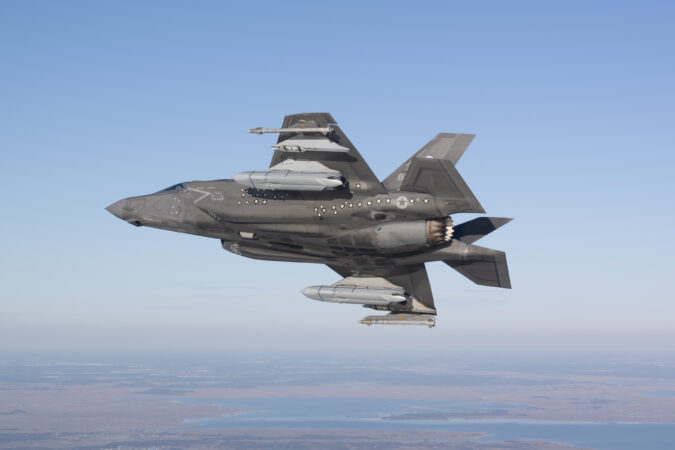
- 2024: The U.S. Navy completes four-missile salvo testing and begins flight testing the round on the F-35C.
- 2025: Initial flight testing expands to the F-35B short-takeoff/vertical-landing variant.
- 2026: Lockheed Martin expands factory capacity and contract modifications to boost annual production.
Sources: Lockheed Martin, Air & Space Forces Magazine, USNI
LRASM, JASSM, and Production Efforts
Lockheed Martin is the manufacturer of both the AGM-158 JASSM (Joint Air-to-Surface Standoff Missile) and the AGM-158C LRASM. An extended-range variant, the AGM-158 JASSM-ER, is capable of engaging targets up to 500 miles away. The baseline LRASM’s range is approximately 200 miles, similar to the standard JASSM variant.
The JASSM is currently integrated on a wide array of U.S. Air Force aircraft, including the B-1B Lancer, B-2A Spirit, B-52H Stratofortress, various F-15 and F-16 variants, and the C-130 Hercules transport aircraft. Integration efforts are also underway for the F-35A Lightning II and the next-generation B-21 Raider bomber.
Recent Pentagon acquisition reports released in July highlighted ongoing progress in JASSM and LRASM production. As of April, the U.S. Navy and Air Force were reportedly expanding their production plans for these shared munitions. Lockheed Martin had delivered a total of 5,348 JASSMs to both services. The company’s current production capacity stands at 600 JASSMs annually, with short-term objectives to increase this to 860 missiles per year. This increased production is crucial, particularly in light of reports such as one from the Center for a New American Security, which estimated that a significant portion of the Air Force’s JASSM inventory was expended during recent operations, identified as “Operation Epic Fury.”
In a move to further innovate and adapt to evolving threats, Lockheed Martin announced a new AGM-158 JASSM-FLEX variant in September at the AFA Air, Space & Cyber conference. This new variant offers users the flexibility to interchange the nose and launch options, accommodating various payloads and configuration needs. A Lockheed Martin spokesperson explained that “The AGM-158 FLEX airframe concept was driven by a strategic need to keep pace with rapidly evolving threats, insert emerging technologies quickly, manage obsolescence, and provide, at scale, a cost-effective missile family that can be repurposed for a wide range of missions while delivering timely, relevant capability to the warfighter.” This modular design could potentially include an LRASM-like option.
To bolster the supply chain and production resilience, the Air Force has allocated $200 million in fiscal year 2025 for a second-source engine for both the LRASM and JASSM-ER. Concurrently, Lockheed Martin plans to invest between $8 million and $9 million through 2030 to enhance production capacity on its existing manufacturing lines.
Why This Matters
The integration of the Long-Range Anti-Ship Missile (LRASM) onto the B-52 bomber represents a significant strategic enhancement for the United States military, with far-reaching implications for global security and military strategy. This development directly addresses several key challenges and priorities:
Geopolitical Significance and Deterrence:In an era of renewed great power competition, particularly with China and Russia, the ability to project long-range, precision anti-ship strike capabilities is paramount. The Indo-Pacific region, with its vast maritime expanses and rising tensions over territorial claims, is a primary area of focus. By enabling the B-52 to carry a large payload of LRASMs, the U.S. significantly boosts its capacity to deter potential adversaries and respond effectively to aggression against naval assets. This capability enhances the credibility of U.S. power projection and its commitment to regional allies.
Evolving Military Strategy:This move aligns with a broader shift in U.S. military doctrine towards distributed maritime operations and long-range, stand-off strike capabilities. Rather than relying solely on aircraft carriers or forward-deployed fighter jets, which may be vulnerable in high-threat environments, the B-52 offers the advantage of launching precision munitions from extremely long distances, potentially from bases located thousands of miles away. This reduces risk to personnel and high-value platforms, while expanding the geographic scope and flexibility of military operations. It diversifies options for commanders, allowing them to engage enemy fleets without placing more vulnerable assets within contested zones.
Technological Advancement and Modernization:The LRASM is a sophisticated, stealthy cruise missile designed to operate autonomously in complex electromagnetic environments. Its integration onto the B-52, a platform dating back to the 1950s, showcases the U.S. military’s commitment to modernizing its legacy systems with advanced technologies. This capability ensures that even older, highly reliable platforms remain relevant and formidable in contemporary warfare, extending their operational lifespan and cost-effectiveness. The continuous development and integration of new variants like JASSM-FLEX also highlight an agile approach to adapting to rapidly evolving threats.
Industrial Base and Economic Impact:The ongoing contracts with Lockheed Martin, coupled with investments in expanding production capacity and securing second-source engines, underscore the significant economic activity tied to national defense. These efforts support the defense industrial base, foster innovation, and create highly skilled jobs. They also aim to ensure the resilience of the supply chain, a crucial factor for sustained military readiness, particularly when facing scenarios that could rapidly deplete missile inventories.
In essence, equipping the B-52 with LRASMs is more than just an upgrade; it is a strategic recalibration that enhances the U.S. military’s ability to maintain maritime superiority, deter aggression, and respond effectively to conflicts in critical global theaters, all while leveraging existing assets and advanced technology to meet future challenges.