
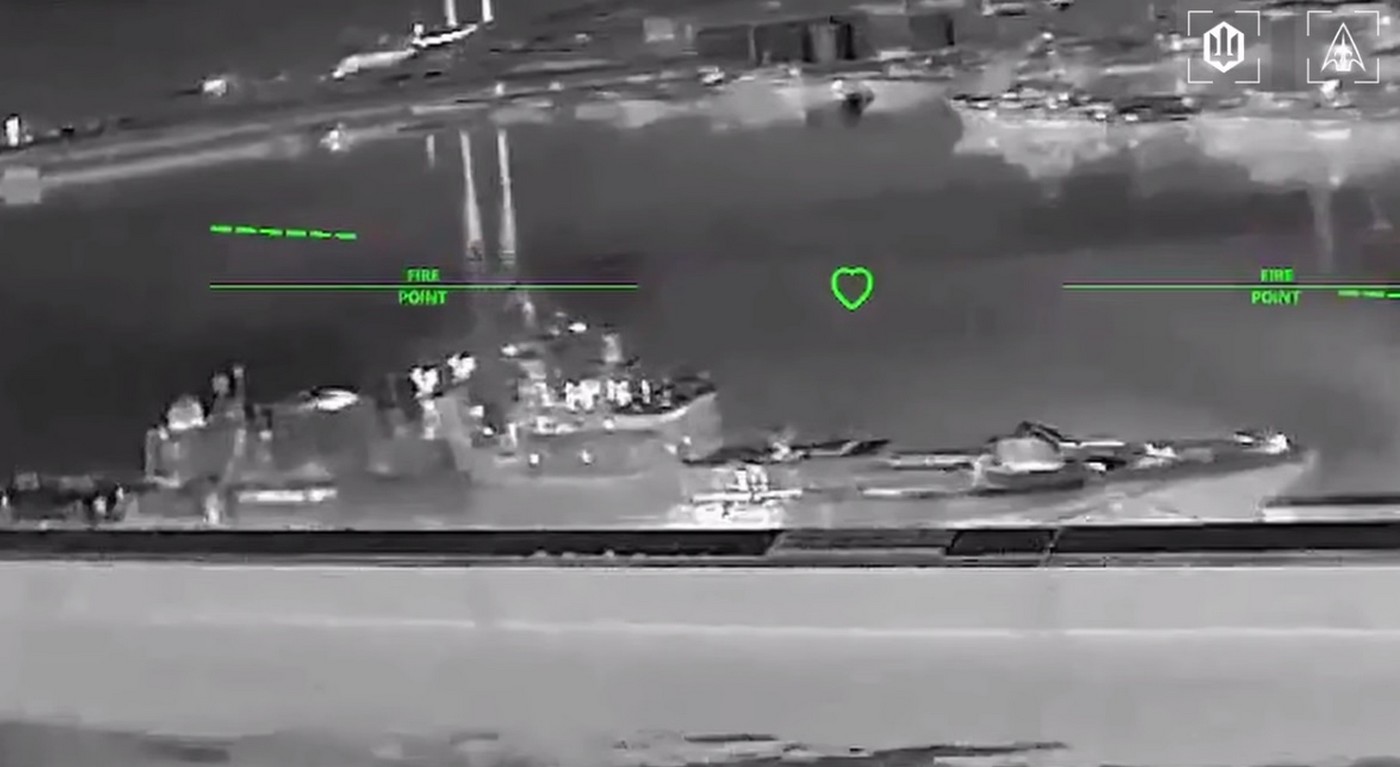
Ukrainian Drone Attack Reportedly Degrades Russian Black Sea Fleet’s Missile Capability
A recent Ukrainian drone attack on the Russian Novorossiysk Naval Facility and Commercial Port has significantly impacted the land-attack cruise missile (LACM) capability of Russia’s Black Sea Fleet, according to a Defence Intelligence update published by the UK Ministry of Defence. The assessment indicates that the strike accounted for forty percent of the fleet’s Kalibr-capable surface ships.
In its update on Thursday, Defence Intelligence reported on two substantial uncrewed aerial system (UAS) attacks targeting the Russian Novorossiysk facilities within a two-month period. Specifically, the update stated:“The 08-09 September 2026 attack led to successful strikes against a GRIGOROVICH class frigate and a SVIYAZHSK light-frigate.”
The intelligence assessment further elaborated on the damage sustained by these vessels:“Both vessels have likely sustained sufficient damage to prevent them taking part in KALIBR Land-attack Cruise Missile (LACM) firings into Ukraine, likely for the short-medium term. This single attack has significantly degraded the LACM strike capabilities of the Black Sea Fleet, representing 40% of the KALIBR-capable surface fleet.”
This assessment highlights a notable reduction in Russia’s strike capacity, given that the incapacitation of two vessels constitutes two-fifths of its Kalibr-capable surface fleet. This figure not only underscores the effectiveness of the Ukrainian strike but also provides insight into the relatively limited number of such vessels remaining within the Black Sea Fleet. Since the onset of the full-scale invasion, Russia has utilized Kalibr missiles, launched from various Black Sea platforms, to target Ukrainian cities and critical infrastructure. The surface ships designed to carry these missiles have not been numerous.
The targeted vessels are key assets within the Black Sea Fleet. The Admiral Grigorovich class frigates, designated as Project 11356R, represent some of the newest conventional surface combatants in the fleet. Each frigate is equipped with a vertical launch system (VLS) capable of firing Kalibr missiles. The second vessel, described by Defence Intelligence as a Sviyazhsk light-frigate, is a smaller surface combatant also armed with Kalibr missiles.
The attack on Novorossiysk follows a strategic shift by the Russian Black Sea Fleet. Over the course of 2023 and 2024, persistent Ukrainian strikes compelled Russian warships to relocate from their primary base in Sevastopol, Crimea. The port of Novorossiysk, situated in Krasnodar Krai on Russia’s mainland, subsequently became the main operating base for the remaining elements of the fleet. This eastward displacement was intended to position the fleet beyond what was considered easy reach of Ukrainian forces, thereby enhancing its security and operational continuity.
The UK Defence Intelligence utilizes a specific methodology for its probability assessments. The term “likely” in its reports indicates a confidence level between 55 and 75 percent. Therefore, the judgment that both vessels are incapacitated for Kalibr firings is presented as a confident assessment, though not an absolute certainty. Similarly, the phrase “short to medium term” regarding the duration of incapacitation does not have a precise, fixed definition. However, repairs to complex systems such as a vertical launch system and its surrounding structural components on a frigate typically involve significant time and resources, particularly when conducted in a port that may itself be subject to periodic attacks or threats.
The full guidance on the probabilistic language used by UK Defence Intelligence is publicly available for reference. This incident underscores the ongoing challenges faced by the Russian Black Sea Fleet in maintaining its operational capabilities amid sustained Ukrainian efforts to degrade its naval assets and control over the northwestern Black Sea.
Why This Matters
This reported drone attack on the Novorossiysk Naval Facility carries several significant implications for the ongoing conflict in Ukraine and the broader security landscape of the Black Sea:
- Degradation of Russian Offensive Capability:The most immediate impact is the reported 40% reduction in the Black Sea Fleet’s Kalibr-capable surface vessels. Kalibr missiles have been a primary tool for Russia to strike Ukrainian cities and infrastructure, causing widespread damage and civilian casualties. A reduction in this capability could translate into fewer missile strikes on Ukraine, potentially easing pressure on Ukrainian air defenses and civilian populations.
- Challenge to Russian Naval Dominance:Russia has historically sought to assert dominance in the Black Sea. By effectively striking key naval assets in Novorossiysk – a port considered a safer haven after the withdrawal from Sevastopol – Ukraine demonstrates its continued ability to project power and threaten Russian naval operations even in supposedly secure areas. This further challenges Russia’s operational freedom and control over significant parts of the Black Sea.
- Strategic Shift and Logistical Strain:The forced relocation of the Black Sea Fleet from Sevastopol to Novorossiysk was a strategic move to mitigate threats. This latest attack indicates that even these deeper-lying bases are not impervious. This creates significant logistical challenges for Russia, requiring more extensive protective measures, dispersing assets, and potentially forcing further withdrawals, which in turn impacts operational efficiency and response times. Repairs to damaged vessels will also place additional strain on limited naval repair facilities, particularly those operating under potential threat.
- Validation of Ukrainian Asymmetric Warfare:Ukraine, lacking a traditional large navy, has successfully employed asymmetric tactics, primarily through the use of drones (aerial and naval), to target superior Russian naval forces. This incident further validates this strategy, showcasing its effectiveness in neutralizing high-value assets and influencing the naval theater of war. It also underscores the evolving nature of modern naval warfare.
- Impact on Black Sea Security and Shipping:The ongoing threat to naval assets in the Black Sea has broader implications for maritime security, including commercial shipping and the potential for disruption of critical supply routes, such as the grain corridor. Instability and persistent threats make the region riskier for international maritime activity.
- Intelligence and Deterrence:The detailed assessment provided by UK Defence Intelligence not only informs the public but also serves as a form of intelligence signaling. It highlights the effectiveness of Ukrainian operations, potentially boosting morale in Ukraine and among its allies, while serving as a deterrent or warning to Russia regarding the vulnerabilities of its forces.
Overall, this incident signifies a continued erosion of Russia’s naval power in the Black Sea, forcing adaptations in its military strategy and potentially altering the dynamics of missile warfare against Ukraine.