
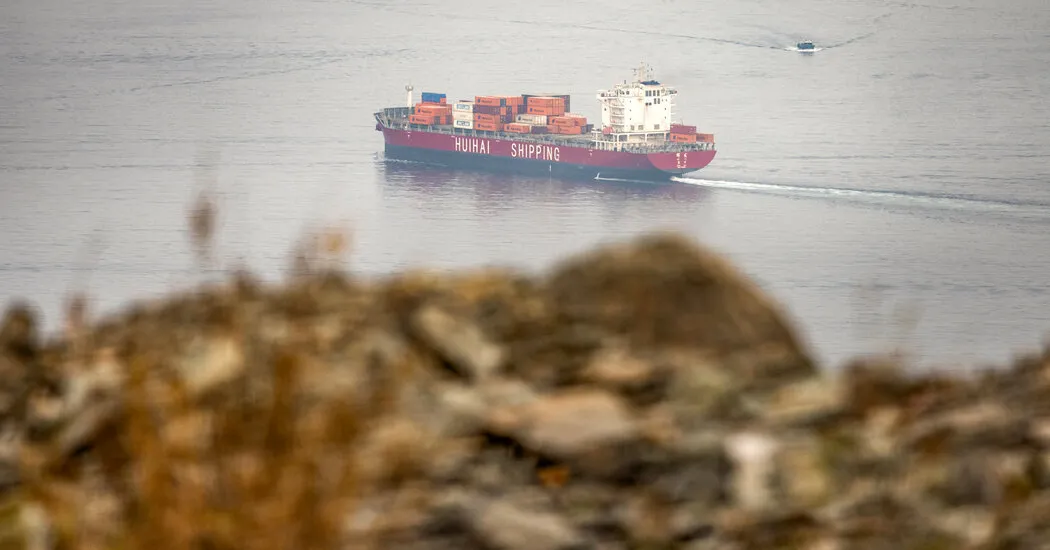
Recent days have seen a marked escalation in maritime incidents in the waters surrounding Iran, with the frequency of attacks in the past week reportedly matching the total for the entire month of September. This surge in activity has significantly heightened risks for commercial vessels transiting the critical Strait of Hormuz, a vital chokepoint for global energy supplies.
On Wednesday, a container ship identified as the GFS Pride sank off the coast of Oman. This incident followed a strike the previous day that left the vessel engulfed in flames, according to assessments by maritime analysts. Photographic evidence and reports from Pakistan’s National Hydrographic Office, a maritime agency operated by the Pakistani Navy, indicated that numerous containers from the ship were left floating in the vicinity of the attack.
Concurrently, another container ship, the GFS Giselle, reportedly sustained damage from “unknown projectiles” while navigating the Strait of Hormuz on Wednesday. The Maritime and Port Authority of Singapore confirmed the incidents, stating that the crew members of both the GFS Pride and GFS Giselle were accounted for and safe. Both vessels were operating under the Singapore flag.
Dimitris Maniatis, the founder of Marisks, a firm specializing in maritime risk management, commented on the situation after reviewing imagery of the GFS Pride incident. He noted that containers were observed scattered across a wide expanse of the waterway. Maniatis described observations of individuals in small boats collecting boxes of goods that had spilled from the containers. While Iran claimed the GFS Pride struck a naval mine, maritime analysts indicated that no independently verified evidence has emerged to substantiate this assertion. The precise perpetrators of the strike remain unconfirmed.
The dramatic increase in maritime attacks, with at least 15 reported in the last week according to maritime analysts, represents a significant shift in the risk landscape for an industry already accustomed to operating in a more perilous environment since the onset of wider geopolitical tensions approximately eight months ago. This period, coinciding with a global rise in instability, has seen shipping companies adjust to heightened threats. The United States’ response to the reported increase in Iranian attacks has largely been described as understated, though Marisks reported a U.S. military fighter aircraft struck a bulk carrier in the Gulf of Oman on Saturday.
“There’s no U.S. response, so Iran is trying to further assert its control over the Strait of Hormuz — and it’s succeeding,” Mr. Maniatis stated, suggesting that the perceived lack of robust international deterrence is emboldening regional actors. Since the intensification of the regional conflict nearly eight months ago, more than 100 ships have reportedly been impacted by various incidents. Adding to the recent maritime casualties, the Cape Dao, another vessel, also sank on Tuesday, three weeks after it was initially struck. The Pakistani naval agency confirmed that one sailor died in that earlier attack.
In response to these developments and broader market dynamics, global oil prices experienced an upward trend on Wednesday. Brent crude, a key international benchmark, reached approximately $106 per barrel. This figure stands in contrast to just under $70 per barrel recorded on the eve of the aforementioned conflict in late February, highlighting the impact of regional instability on energy markets.
Beyond the maritime domain, fighting between Saudi Arabia and the Houthis, an Iran-backed militia operating in Yemen, has intensified, creating palpable tension among residents in the capitals of both Saudi Arabia and Yemen. This broader regional conflict is often viewed through the lens of proxy confrontations involving Iran.
The Houthis, perceived by some analysts as emboldened by the current regional instability, claimed responsibility for striking a building owned by the state-owned energy giant Saudi Aramco on Tuesday night. This attack occurred amidst an ongoing exchange of hostilities between Saudi and Houthi forces. Saudi Arabia, a cornerstone of global energy supply, has been conducting air campaigns against Houthi positions in Yemen in support of the internationally recognized Yemeni government, which seeks to reclaim territory seized by the militia.
Over the preceding weekend, the Houthis carried out what has been described as the deadliest attack on Saudi Arabia in over a decade. This assault targeted King Khalid International Airport, resulting in the deaths of at least 13 individuals and wounding more than 300. The repeated targeting of civilian infrastructure and critical energy facilities underscores the escalating nature of the conflict.
Regarding the strike on the headquarters of Saudi Aramco, Saudi authorities confirmed that while it caused a “limited fire,” there were no reported casualties or injuries. Two individuals with knowledge of the impact, who spoke on condition of anonymity, indicated that the office tower sustained damage to its top three floors. Importantly, the attack did not affect any oil production or export infrastructure, mitigating immediate concerns about direct impacts on global supply.
An initial analysis by Kpler, a maritime data company, revealed that the intensified attacks had a noticeable impact on crude oil exports from the Persian Gulf. In the seven days concluding on October 9, exports reportedly saw a sharp decline compared to the previous week. Kpler attributed a general decrease in oil flows observed this month to the recent attacks, though its analysts anticipate that oil export figures are likely to be revised upwards as more comprehensive shipping data becomes available.
U.S. military forces have continued to play a significant role in safeguarding the transportation of oil from the Persian Gulf to international markets. This includes assisting vessels in navigating the southern part of the Strait of Hormuz, near Oman, often when ships turn off their location trackers for security reasons. However, there are acknowledged limitations to the protective capabilities U.S. Central Command can deploy, even with substantial resources designed to intercept threats such as Iranian drones and missiles.
The Houthi strike on Saudi Aramco’s central offices occurred during the third day of the WPC Energy Congress, a weeklong international oil and gas summit being held in Riyadh. Despite the attack, the conference proceeded as scheduled on Wednesday, featuring discussions on topics such as the future of hydrogen and the outlook for natural gas, indicating an attempt to project business as usual amidst regional tensions.
Separately, the International Energy Agency (IEA) reported on Wednesday that Saudi Arabia and other crude oil producers in the Persian Gulf collectively exported 13.9 million barrels per day last month. This figure represents 75 percent of their pre-conflict levels, indicating a rebound in regional output. While this recovery in exports contributed to an increase in the global supply of oil, the IEA stated that it maintained its projections for global supply for the remainder of the year. This decision was largely attributed to the uncertainty generated by this month’s “heightened security concerns” in the region, which continue to pose a risk to stable energy markets.
Peter Eavis contributed reporting from New York.
Why This Matters
The recent escalation of maritime attacks in the Strait of Hormuz and the intensification of hostilities between Saudi Arabia and the Houthi militia carry significant global implications across several critical domains. Firstly, these events directly threaten **global energy security**. The Strait of Hormuz is the world’s most important oil transit chokepoint, through which roughly one-fifth of global oil consumption, and a significant portion of liquefied natural gas, passes. Any disruption, even temporary, can trigger volatility in global oil prices, impacting economies worldwide and increasing costs for consumers and industries dependent on stable energy supplies. The rise in Brent crude prices following these incidents is a clear indicator of market sensitivity to regional instability.
Secondly, the attacks pose a severe risk to **international shipping and global supply chains**. The sinking and damage of container ships highlight the direct physical dangers to vessels and their crews. Such incidents lead to increased insurance premiums, longer transit times due to rerouting or heightened security measures, and potential delays or losses of goods. This ripple effect can disrupt the movement of essential commodities and manufactured products, affecting industries from automotive to consumer electronics and potentially driving up inflation.
Thirdly, these developments underscore the **fragility of regional stability and the complexity of geopolitical tensions** in the Middle East. The incidents are often viewed as manifestations of a broader proxy conflict between Iran and its regional rivals, with the Houthis acting as an Iranian-backed force. The perceived “muted” international response to certain aggressions, as noted by analysts, could embolden actors to further assert control or challenge established norms, leading to a cycle of escalation. The ongoing conflict in Yemen, with Saudi Arabia’s involvement, is a critical component of this regional dynamic, and attacks on Saudi territory, including energy infrastructure and civilian targets, raise the stakes significantly.
Finally, the situation impacts **international law and freedom of navigation**. Unhindered passage through international waterways like the Strait of Hormuz is a fundamental principle of global commerce and security. Challenges to this principle, whether through direct attacks, intimidation, or the deployment of naval mines, necessitate a robust international response to uphold maritime security and prevent future escalations. The limitations faced by U.S. forces in fully mitigating these threats demonstrate the intricate challenge of protecting commercial shipping in a volatile region. Therefore, these events are not isolated incidents but reflect deeper, interconnected geopolitical and economic vulnerabilities that demand international attention and diplomatic efforts to de-escalate tensions and ensure the safe passage of global trade.