
Unlock the White House Watch newsletter for free
Your guide to what Trump’s second term means for Washington, business and the world
Key Takeaways
- **Geopolitical Risks Fuel Inflation:** The ongoing conflict in Iran has directly driven a significant surge in petrol prices, undermining the White House’s “cheap energy” promise and contributing to broader consumer price index (CPI) inflation, impacting consumer spending and potentially influencing Federal Reserve policy.
- **AI’s Energy Appetite Strains Grids:** The explosive growth of AI data centers is creating localized spikes in electricity demand and prices, posing significant challenges for utility providers, raising operational costs for tech giants, and becoming a potent political issue in swing states.
- **Policy Missteps & Investor Sentiment:** Perceptions of a failed foreign policy and “crony capitalism” are eroding confidence in energy policy stability, dampening investor sentiment, and potentially accelerating a global pivot towards renewable energy sources, with long-term implications for traditional energy investments.
One of Donald Trump’s campaign promises in 2024 was cheaper energy. At an Economic Club of New York event in September that year, he promised to cut energy prices by half or more within 12 months of taking office. “Destroying inflation” by “unleashing American energy” production was at the core of the Republican platform that gave Trump a second term. From a market perspective, this pledge was designed to signal a favorable environment for domestic fossil fuel producers and a potential easing of inflationary pressures on consumers, theoretically boosting discretionary spending and corporate profitability.
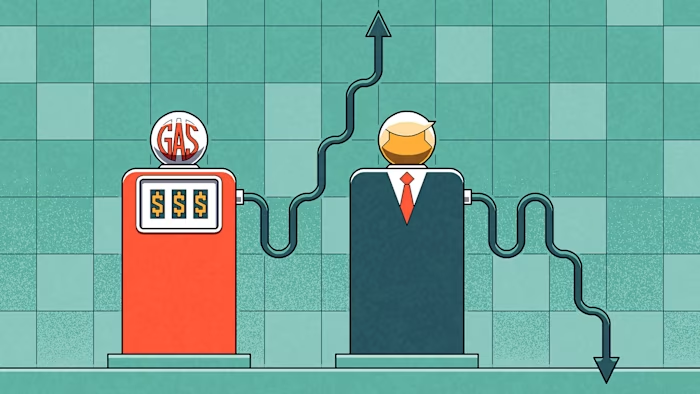
What a difference a war makes. Consumer price index (CPI) data released last week shows that petrol prices jumped 9.1 per cent in September, the highest rate since the war in Iran started. This sharp increase in a highly visible consumer cost not only directly impacts household budgets but also feeds into broader inflation expectations. For investors, rising energy costs translate into higher operational expenses for transport-dependent industries, reduced consumer purchasing power, and potential pressure on corporate earnings. Given that petrol is the price most Americans see advertised at the roadside every day as they drive to work or home or school, that doesn’t bode well for conservative Republicans in the midterm elections a little over two weeks away, creating a palpable sense of economic vulnerability that can sway market confidence.
In the past, Republicans have often scored points with petro-politics. When Democrats are in office, they trot out the “drill baby drill” line in the face of the threat of environmental regulation or, God forbid, clean energy subsidies. Republican presidential candidate John McCain, who supported offshore energy exploration and more domestic drilling, lost to Barack Obama in 2008 but brought a large chunk of the country along with his policies. Thirty-three per cent supported fewer drilling restrictions at the beginning of his candidacy, and 40 per cent did after. This historical pattern suggests a reliable political playbook, often interpreted by markets as a signal of future deregulation and increased domestic supply, potentially capping price spikes and supporting exploration & production (E&P) companies.
But this time around, things are different. Voters increasingly understand that energy inflation isn’t primarily about a lack of domestic supply, but rather terrible policy choices at home and abroad. This shift in public perception is critical for markets, as it implies that traditional supply-side responses may not be as effective in stabilizing prices, leading to sustained volatility. The geopolitical risk premium embedded in crude oil prices, particularly from the Iran conflict, has become a more dominant factor than domestic production capacity alone. Oil futures markets reflect this, with traders pricing in continued uncertainty and supply chain disruptions rather than a simple supply/demand imbalance that could be solved by more drilling.
An October poll conducted by Reuters and Ipsos found that 60 per cent of Americans disapproved of Trump’s handling of Iran; a whopping 78 per cent blamed the White House for higher prices. The Searchlight Institute, a left-leaning policy group, asked voters in September what would best help lower their energy bills. The top answers included curbing excessive utility profits (21 per cent), ending the Iran war (18 per cent), improving grid efficiency (16 per cent) and banning data centres (11 per cent). These responses highlight a growing public distrust in existing market structures and government policy, signaling potential regulatory shifts that could impact energy utilities, defense contractors, and technology firms alike. Investor sentiment becomes increasingly fragile when policy uncertainty reigns and public opinion actively seeks interventionist measures.
None of these things play to Republican strengths. In particular, the AI hyperscalers rolling out all those data centres have unlimited support from the White House but are increasingly unpopular with the public, left on the hook for higher electricity costs. An August Centre for Economic Policy Research discussion paper that examined data centre expansion across US utility territories estimated that an increase of 10 data centres in a particular territory raises household electricity prices by 13 per cent, and a single large facility can raise household prices by 4 per cent. No wonder even the president has called on Big Tech to pay for increases in utility prices and infrastructure inflation caused by AI rollout. This burgeoning demand from the AI sector represents a significant, often under-appreciated, strain on existing power grids and energy markets. For utility companies, it means increased capital expenditure for infrastructure upgrades, potential capacity constraints, and a complex regulatory environment as they balance industrial demand with residential affordability. For technology companies, the rising cost of power for data centers could directly impact operating margins and dictate future site selection strategies, prompting greater investment in energy efficiency or on-site renewable generation.
The intersection of electricity prices and AI is a national issue, but it is creating special vulnerabilities for Republicans in key swing states. In Pennsylvania, for example, electricity rates went up 18.9 per cent last year, a topic voters link explicitly to data centres (one poll found three quarters believe prices go up when data centres are built). And in Ohio, conservative incumbent senator Jon Husted may lose his seat after pushing for the state to become a data centre destination, something that his pro-union left competitor Sherrod Brown is now making political hay with. His TV ads promise that he’ll force companies, rather than consumers, to pay for electricity inflation related to AI rollouts. These localized energy price shocks could have broader implications for regional economic development and bond markets, particularly for municipal utilities or states looking to attract high-tech investment. The political pressure to shift costs from consumers to corporations could lead to new taxes or regulatory frameworks impacting the profitability of both utility providers and the tech firms they serve.
That plays to another midterm problem for Republicans, which is crony capitalism. Another Reuters/Ipsos poll in August showed that even half of all Republicans think that Trump’s business decisions influence his policy decisions. Given that Big Oil is the strongest historical backer of the GOP, and new domestic shale production requires about $80 a barrel pricing to achieve profitability, is it any wonder that Trump has failed in his promise to unleash cheap domestic energy? This perceived alignment between political donors and energy policy decisions can erode investor confidence in market fairness and foster greater demand for ESG (Environmental, Social, Governance) considerations in investment portfolios. The need for $80/barrel oil for profitability also explains why energy majors may not be incentivized to flood the market and drive prices down, a dynamic that clashes with the president’s promise and contributes to persistent inflation.
But in the end, the biggest energy own goal for the president is the failed war in Iran. Not only has it caused energy inflation to rise and pushed average US petrol prices up 45 per cent since the war began, it has also exposed the fundamental weakness of the US in the Middle East and in relation to China. Beijing remains the biggest buyer of Iranian oil (which makes it impossible for the US to isolate the regime). But it will also be the biggest beneficiary of the shift towards electric vehicles and clean energy sources that is speeding up in parts of the world, according to the IEA, because of the war. This geopolitical dynamic has profound long-term market implications. The inability to fully curb Iranian oil exports due to Chinese demand complicates global oil supply management and undermines U.S. sanctions leverage. Furthermore, a war-driven acceleration towards EVs and renewables, while positive for climate goals, disproportionately benefits China, a major player in battery technology and critical mineral supply chains, potentially shifting global economic power balances and investment flows towards Asian clean energy manufacturers.
Beyond the midterms, what will all this mean for Maga? That is tougher to say. Rightwing populism was never just an economic movement. I’ve interviewed plenty of Trump voters who would find a justification for their politics no matter what the price of oil. But it is also true that populists love a strongman. Rising inflation off the back of a failed war and an inability to negotiate any sort of meaningful settlement isn’t a good look for a president who prides himself on the art of the deal. Some 57 per cent of Republicans say that inflation is rising faster than their wages, and 40 per cent disapprove of how the White House is handling it. So much for making America cheap again.
[email protected]
Market Impact
The confluence of escalating geopolitical tensions, domestic energy policy missteps, and unprecedented demand from sectors like AI is creating a highly volatile and uncertain market environment. Investors face continued inflationary pressures, particularly from energy costs, which will likely constrain consumer spending and impact corporate earnings across various sectors, from transportation to retail. The Federal Reserve’s stance on interest rates will remain acutely sensitive to these CPI prints. Furthermore, the burgeoning energy appetite of AI data centers presents both opportunities and risks for utility companies, requiring substantial infrastructure investment but also facing increased regulatory scrutiny and political pressure to cap consumer prices. The tech sector, particularly hyperscalers, may see rising operational costs, prompting greater focus on energy efficiency or distributed energy solutions. Geopolitically, the enduring conflict in Iran, coupled with China’s strategic role in global energy markets and the clean energy transition, signals a potential long-term shift in investment flows towards renewable technologies and Asian markets, while traditional fossil fuel investments may face sustained headwinds from both political pressure and evolving global energy landscapes. Overall, market participants should anticipate continued volatility, a re-evaluation of sector-specific risks, and a heightened focus on policy and geopolitical developments as key drivers of asset performance.