
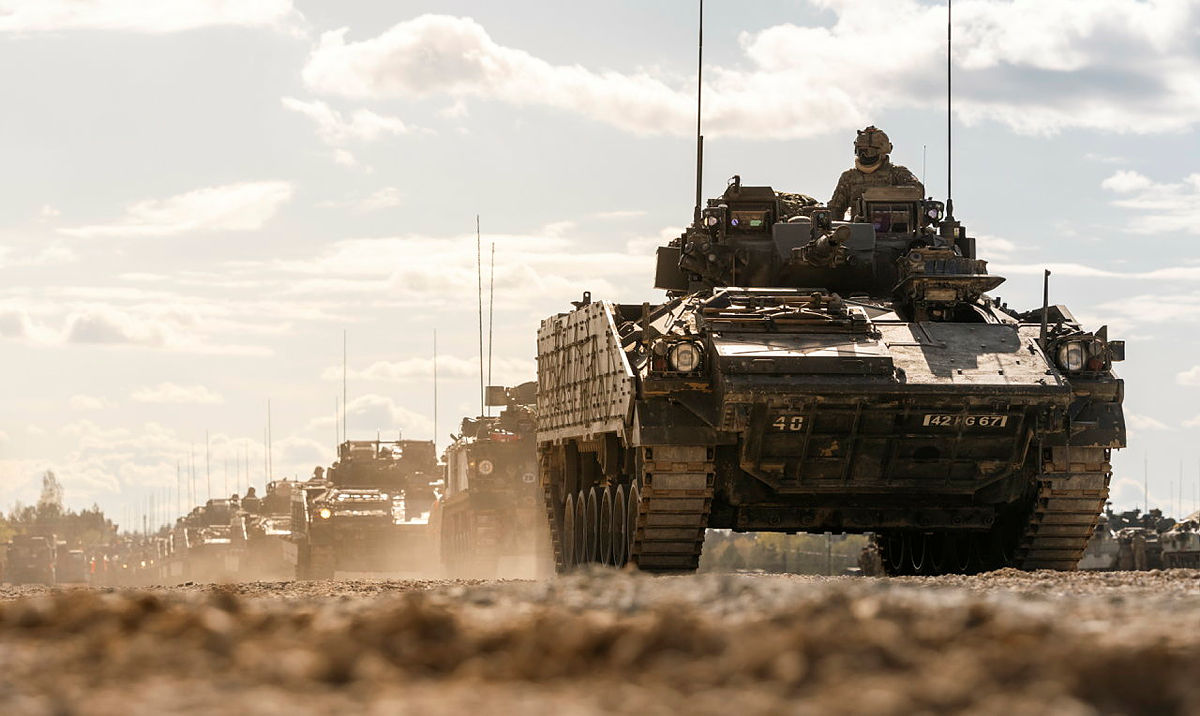
Ministry of Defence Withholds Details on Disposal of Warrior Infantry Fighting Vehicles Amid Transparency Concerns
London, UK– The United Kingdom’s Ministry of Defence (MoD) has refused to disclose specific information regarding the disposal of 78 Warrior infantry fighting vehicles (IFVs) that have been removed from the British Army’s operational fleet. Citing national security as the reason for withholding these details, the decision has prompted questions about government transparency and the pace of the Army’s transition away from the long-serving armoured platform.
The request for information originated from Ben Obese-Jecty, the Conservative Member of Parliament for Huntingdon. Mr. Obese-Jecty had formally asked for the precise dates on which each of the 78 vehicles was disposed of, following a previous parliamentary answer on September 7 that had confirmed their removal from service.
Luke Pollard, the Minister for Defence Readiness and Industry, responded to the parliamentary question. In his official statement, Minister Pollard said:“The answer to Question 23452 explained that the seventy-eight Warrior Infantry Fighting Vehicles removed from the reported fleet between 2025 and 2026 have been disposed of in accordance with Defence disposal policy. It would be inappropriate for me to provide exact disposal details, such as dates or variants as to do so could, or would be likely to, prejudice the capability of our Armed Forces.”
While the minister’s response confirms the total number of vehicles that have been retired, it notably omits any specific timeline for these disposals or identification of the particular variants of the Warrior IFV involved. This lack of granular detail means that the public record does not allow for an independent assessment of the rate at which the Warrior fleet is being drawn down. Consequently, understanding the British Army’s current and evolving armoured infantry capabilities becomes more challenging without this contextual information.
The Warrior IFV: A Legacy and Strategic Shift
The FV510 Warrior infantry fighting vehicle has been a foundational asset for the British Army since its introduction into service in 1988. Designed primarily to transport a section of dismounted infantry directly into combat zones under armour protection, the Warrior is a tracked vehicle equipped with a two-man turret housing a 30mm RARDEN cannon. Throughout its operational life, it has demonstrated its capabilities in various theatres, including the Gulf War, the Iraq War, and operations in Afghanistan, establishing a reputation for resilience and effectiveness.
Recognising the need for continuous modernisation to counter evolving threats, the Ministry of Defence initiated the Warrior Capability Sustainment Programme (WCSP). This ambitious programme aimed to significantly upgrade the vehicle, with the most prominent feature being the replacement of its original 30mm cannon with a stabilised 40mm Cased Telescoped Cannon (CTC). The WCSP was intended to enhance the Warrior’s lethality, accuracy, and survivability, thereby extending its operational lifespan well into the future, potentially until the 2040s.
However, after more than a decade of development and an expenditure of approximately £430 million, the WCSP was ultimately cancelled in March 2021. The decision to scrap the programme was attributed to a confluence of factors, including escalating costs, persistent technical difficulties, and a broader strategic re-evaluation of the British Army’s future requirements. Defence planners increasingly questioned the programme’s long-term value and affordability, particularly in light of shifting geopolitical landscapes and military doctrines that favoured a combination of lighter, more agile forces and new generations of heavy armour.
Since the cancellation of the WCSP, the Warrior fleet has entered a phase of gradual reduction and eventual retirement. The British Army’s “Future Soldier” programme, which outlines a comprehensive restructuring and modernisation plan, has confirmed the Warrior’s eventual withdrawal from service without a direct, immediate replacement in the same armoured infantry role. While new platforms such as the Boxer Mechanised Infantry Vehicle (MIV) are being introduced, these primarily serve troop transport functions and do not possess the same direct combat firepower as the Warrior IFV. The Challenger 3 main battle tank programme addresses the heavy armour component, but the specific gap left by the Warrior as a dedicated armoured infantry fighting vehicle remains a subject of ongoing strategic consideration.
Transparency, Accountability, and National Security
The MoD’s justification for withholding specific disposal dates and variants – that such information could “prejudice the capability of our Armed Forces” – underscores the inherent tension between government transparency and the need to protect national security interests. While it is broadly accepted that certain defence details must remain classified to prevent adversaries from gaining intelligence, the withholding of information about decommissioned equipment often triggers closer scrutiny.
Critics argue that revealing the disposal dates and specific variants of older, phased-out vehicles would provide minimal actionable intelligence to potential adversaries, particularly when the overall number of vehicles removed has already been publicly confirmed. Instead, they contend that such secrecy can diminish public trust and impede effective parliamentary oversight, making it more difficult for elected representatives and the wider public to hold the government accountable for defence expenditure, procurement decisions, and the overall readiness of the armed forces.
This issue gains additional resonance within the broader context of UK defence procurement challenges, most notably the highly publicised difficulties encountered by the Ajax armoured vehicle programme. The Ajax project has faced significant delays, substantial cost overruns, and technical issues related to noise and vibration, leading to heightened calls for greater transparency and accountability across all defence acquisitions and disposals.
The gradual removal of the Warrior fleet, without clear public visibility into its exact pace and specific composition, could also lead to temporary capability gaps within the British Army. As older platforms are retired and new ones are introduced, there is often an interim period during which the armed forces may operate with reduced numbers or less capable equipment. A clear understanding of the specifics of this transition is vital for assessing the UK’s immediate defence posture, particularly in the current volatile global security environment marked by conflicts such as the war in Ukraine, which highlights the critical importance of effective armoured capabilities.
The British Army’s ongoing transformation under the “Future Soldier” initiative aims to develop a more agile, lethal, and globally deployable force. However, the successful realisation of this vision depends heavily on the timely and efficient procurement and deployment of new equipment, alongside the responsible and transparent management of legacy assets. The disposal of the Warrior IFVs represents a significant step in this transformation, but the continued lack of transparency surrounding its details underscores the complexities and sensitivities inherent in modernising a national defence force.
Why This Matters
The Ministry of Defence’s decision to withhold specific details about the disposal of Warrior infantry fighting vehicles carries significant implications for several key areas:
- Parliamentary Oversight and Public Accountability:In a democratic system, robust parliamentary scrutiny is fundamental to ensuring that the government is held accountable for its expenditure of taxpayer money and its management of national assets. The refusal to provide disposal dates and specific variants, even for equipment confirmed as decommissioned, curtails the ability of elected representatives and the public to fully scrutinise defence policy and financial decisions. This concern is amplified given the substantial £430 million previously invested in the now-cancelled Warrior upgrade programme.
- Understanding Military Capability:The Warrior IFV has served as a critical component of the British Army’s armoured infantry for decades. Its phased removal, without an immediate and direct replacement, inevitably affects the UK’s military capability. Without clear information on the rate of disposal and the specific variants being retired, it becomes challenging for defence analysts and the public to accurately assess potential capability gaps, the current readiness level of the armed forces, and the overall strategic direction of the Army as it transitions to new platforms.
- Strategic Planning and Industrial Impact:Precise details concerning equipment disposal can offer valuable insights into the Army’s strategic planning and its prioritisation of various military capabilities. For the defence industry, understanding which variants are being retired and on what schedule can influence future maintenance contracts, spare parts logistics, and potential opportunities for the recycling or repurposing of components. The absence of transparency in this area can obscure the real-time implications for the defence industrial base and future defence investment.
- Precedent for Transparency:While national security is a legitimate and paramount concern, the decision to classify details about the disposal of older, already confirmed retired equipment sets a precedent for the level of information the public can expect regarding defence matters. Striking an appropriate balance between necessary operational secrecy and public transparency is crucial for maintaining trust between the government, its armed forces, and the citizens they serve, particularly in an era where effective military capability is increasingly vital amidst evolving global instabilities.