
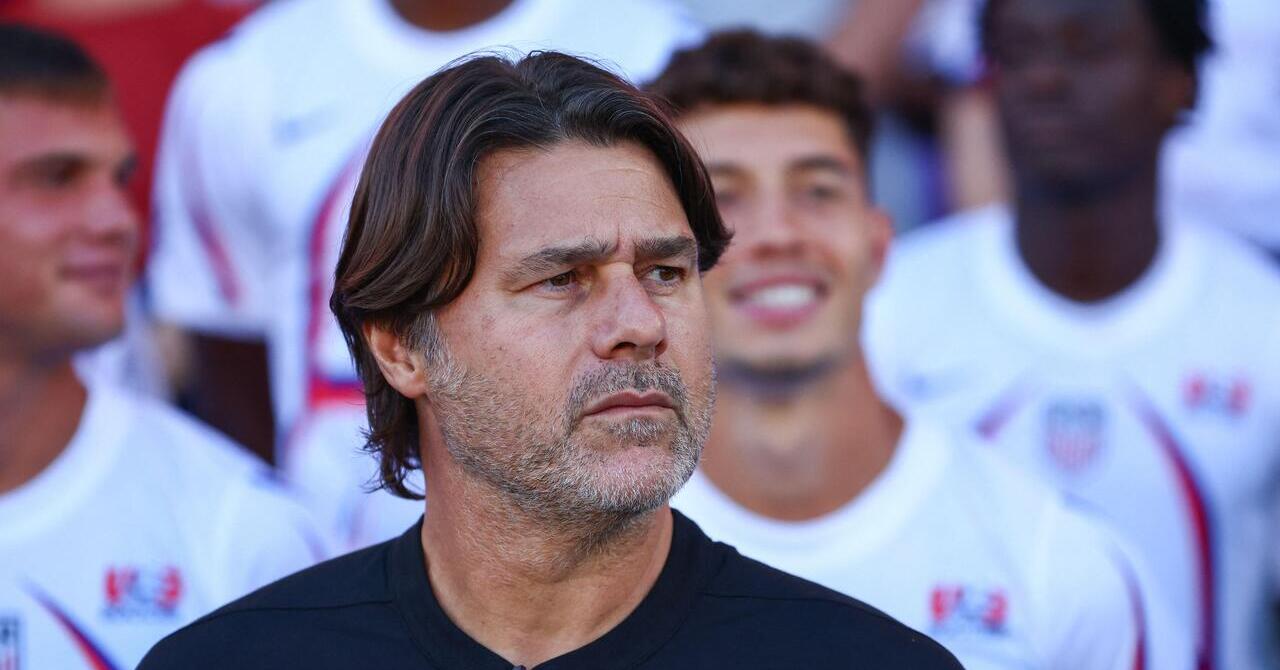
The footballing world just had its fault lines shift! Old Trafford, a stadium synonymous with glory, is now gripped by a potent mix of desperation and audacious hope. Manchester United, a club currently adrift in a sea of mediocrity, has thrown a lifeline to a manager renowned for his transformative touch: Mauricio Pochettino.
The Argentine maestro, fresh from a transformative stint with the US Men’s National Team, will swap the Stars and Stripes for the Red Devils’ crest, effective immediately after his final, crucial responsibilities with the USMNT conclude. This isn’t just a managerial change; it’s a seismic shift, a desperate gamble by a fallen giant yearning to reclaim its formidable identity.
Pochettino’s appointment comes with a hefty price tag – a £7.4 million release clause paid to the US Soccer Federation – underscoring United’s conviction that he is the man to drag them out of their current abyss. His departure from the USMNT after the two-legged tie against Haiti on Tuesday, November 17, leaves him with virtually no breathing room. He will barely have time to unpack his bags before being thrust into the cauldron of Premier League action, with a trip to arch-rivals Liverpool looming large on Sunday, November 22. A baptism of fire awaits, a true test of his immediate impact and leadership.
A club statement, almost breathless in its anticipation, declared: “Mauricio Pochettino has agreed to become the Manchester United men’s head coach from 18 November. The club has reached an agreement with the US Soccer Federation for Mauricio and his staff to be released after the conclusion of their responsibilities with the US Men’s National Team.” The message is clear: United believes this is their moment for revival.

United’s Abyss: A Club Crying Out for Identity
But let’s not mince words: Pochettino isn’t inheriting a sleeping giant. This is a giant currently drowning in its own recent failures. United sits inside the relegation zone, a stark and humiliating testament to their worst start to a top-flight season since 1986. Michael Carrick, who initially steadied the ship after Ruben Amorim’s departure and even secured Champions League qualification last season, found himself tossed overboard after just one win in ten Premier League games. His two-year deal proved to be as fragile as the team’s confidence.
The club statement, in attempting to justify the massive investment, highlighted Pochettino’s “high-intensity, attacking style of football, his dedication to building strong, cohesive teams and his outstanding record of developing individual players.” These aren’t just buzzwords; they are the desperate prayers of a fanbase starved of cohesive play and genuine identity. The blame game has been rampant, from Carrick’s tactics to director of football Jason Wilcox’s “underwhelming summer of recruitment.” While midfield was bolstered with names like Youri Tielemans, Carlos Baleba, and Andrey Santos, glaring voids remained, particularly at left-back and in attack, leaving a squad unbalanced and ill-equipped for the rigours of modern football.
Pochettino’s Pedigree: The Messiah United Needs?
Enter Pochettino, a figure whose CV reads like a blueprint for resuscitation. His journey from Espanyol in 2009, where he began honing his unique philosophy, to Southampton, where he defied gravity to achieve a club-record Premier League points tally in 2014, established his credentials. At Tottenham Hotspur, he was the architect of a genuine revolution, transforming them into consistent Champions League contenders for four consecutive seasons and leading them to their first final in the competition in 2019. While silverware eluded him there, the exhilarating style of play and the palpable sense of progress etched him into the hearts of Spurs fans.
His subsequent stint at Paris Saint-Germain brought Ligue 1, Coupe de France, and Trophée des Champions titles, albeit in a different, more expectation-laden environment. A brief spell at Chelsea in 2023, though less successful, further solidified his experience in England’s top flight. Most recently, he took the US Men’s National Team to the Round of 16 at the FIFA World Cup, leaving a profound mark with his leadership and vision. US Soccer CEO JT Batson hailed his impact, noting, “Mauricio has left a lasting mark on US Soccer through his leadership, professionalism and commitment to our players and culture. He and his staff raised standards, strengthened our culture and created clearer connections from the youth national teams to the senior team.” This emphasis on culture and pathways is precisely what United craves.

Beyond the tactical whiteboard, Pochettino faces a more insidious challenge: a fractured dressing room. Public discord, such as Lisandro Martinez criticising the club hierarchy after the defeat at Atletico Madrid, and captain Bruno Fernandes questioning Carrick’s tactics after the 4-1 thrashing in Como, suggests individual interests have often superseded the collective good. Pochettino, alongside his long-time assistant Jesus Perez and the rest of his trusted staff, will need to be a masterful psychologist to unite a squad seemingly at war with itself. Yet, his history of building strong, cohesive teams, a trait highlighted by US Soccer, suggests he possesses the tools for this monumental task. United will also hope he can rekindle their cherished tradition of nurturing young talent, a skill he demonstrated brilliantly with the USMNT, where 16-year-old Cavan Sullivan and 17-year-old Mathis Albert notched their first goals in impressive wins over Chile and Mexico – a testament to his belief in youth.
Pochettino’s parting words to the USMNT reflected his profound impact: “The opportunity to represent the USA crest was one of the greatest honours of my career. We are so grateful to the players for their commitment, to the fans for their belief, and to the Federation for always supporting our staff and creating the opportunities to impact the culture of soccer in this great country.” His legacy there is clear, setting a high bar for the incoming Steve Cherundolo, who will lead the December camp while Emma Hayes and Oguchi Onyewu spearhead the search for a permanent successor.
GAME HIGHLIGHTS: Pochettino’s USMNT Era – A Glimpse of the Future
Pochettino’s tenure with the US Men’s National Team, marked by 21 wins and only 2 draws from 35 games, was a vibrant tapestry of developing talent and tactical sophistication. Here’s a look at some defining moments:
USMNT vs. Chile (Friendly, October 2025)
The crowd roared as 16-year-old Cavan Sullivan, a blur of youthful exuberance and audacious skill, weaved through the Chilean defense, leaving two defenders in his wake before unleashing a low drive that nestled in the bottom corner. It was a moment of pure magic, a glimpse into the future, and a clear signal of Pochettino’s commitment to blooding and trusting prodigious young talent. The energy was infectious, the pressing relentless, and the attacking intent clear for all to see.
USMNT vs. Mexico (Friendly, November 2025)
Another star ascended! Mathis Albert, just 17, demonstrated predatory instincts in the box, latching onto a flick-on from a corner kick and clinically firing home from close range. The celebration was wild, reflecting the newfound belief and cohesion within the squad. Pochettino’s tactical setup, allowing young players the freedom to express themselves while maintaining defensive solidity, was paying dividends against CONCACAF rivals.
USMNT vs. Haiti (World Cup Qualifier, 1st Leg, November 13, 2026)
A pulsating encounter in Port-au-Prince saw Pochettino’s tactical masterclass on full display. The relentless pressing, the swift transitions, and the disciplined shape ensured the USMNT dominated possession and territory. A crucial away goal, hammered in by Christian Pulisic after a blistering counter-attack orchestrated from deep, gave them a vital advantage. It was a performance of controlled aggression, designed to withstand a hostile environment and seize the initiative.
USMNT vs. Haiti (World Cup Qualifier, 2nd Leg, November 17, 2026)
Cincinnati erupted! Pochettino’s final bow as USMNT coach was a triumphant symphony of fluid, attacking football. From the first whistle, the team played with conviction and swagger, securing a dominant win that sealed their qualification in style. The movement, the inter-passing, the sheer intensity – it was a fitting farewell, showcasing a team that had truly bought into their manager’s vision and was poised for future success. Pochettino leaves the USMNT in rude health, ready for the next chapter.
Prediction: A New Dawn at Old Trafford?
Mauricio Pochettino’s arrival at Manchester United is not merely a change of guard; it is a declaration of intent. The club, battered and bruised, has chosen a manager who epitomizes passion, tactical innovation, and a profound belief in developing talent and fostering unity. The immediate challenges are immense – a squad in disarray, a hostile trip to Liverpool, and the daunting task of reversing decades of underperformance. Yet, Pochettino’s history suggests he thrives in such environments.
While a top-four finish this season might be a bridge too far given the current predicament and the sheer strength of the competition, expect a dramatic upward trajectory. The Liverpool game will be less about the result and more about a statement of intent, a glimpse into the high-intensity, attacking football that will soon define Old Trafford. Pochettino will restore pride, inject purpose, and, crucially, lay the foundations for a genuine title challenge within two seasons. The era of aimless drift is over; the Pochettino project at Old Trafford has officially begun, and it promises to be nothing short of exhilarating. The Red Devils are finally poised to unleash their inner devil once more.