
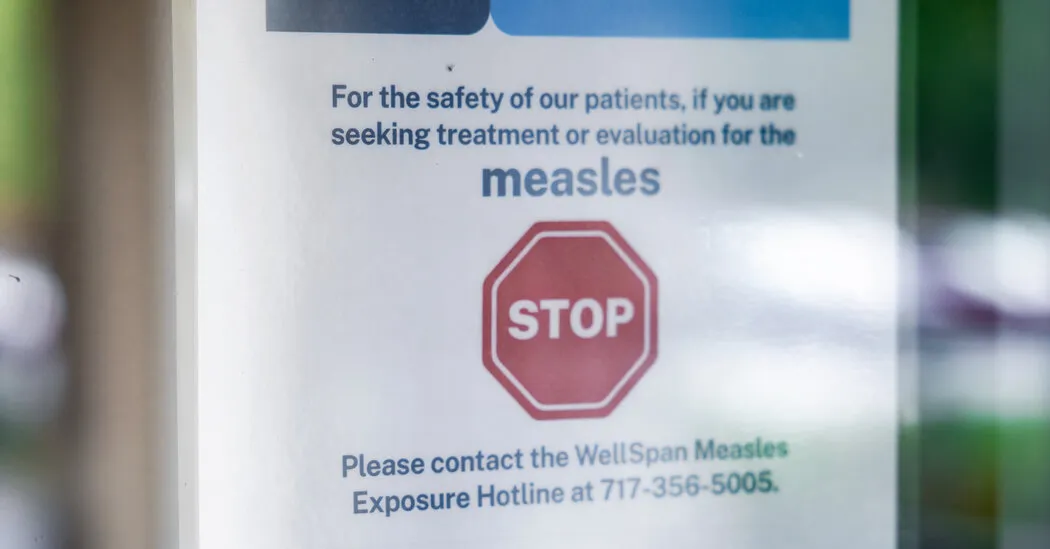
The United States has officially lost its measles elimination status, marking a significant setback in public health efforts against the highly contagious virus. This announcement comes after a sustained period of measles transmission across the nation, driven largely by declining vaccination rates. The virus, once considered eradicated in the U.S., has now circulated uninterrupted for over a year, according to public health authorities.
The decision was formally announced on Tuesday by the Pan American Health Organization (PAHO). Public health experts have reacted with grave concern, viewing the reversal as a serious blow to the nation’s public health achievements. Dr. Jennifer Nuzzo, director of the Pandemic Center at the Brown University School of Public Health, articulated the sentiment, stating that the situation represents a profound disappointment and a preventable regression to an era of increased illness and mortality.
This development signifies a new challenge for communities across the United States, where widespread outbreaks could become a more frequent occurrence, potentially affecting thousands of children. It also represents a notable reversal for a country that previously demonstrated the efficacy of public health interventions against measles, having achieved elimination status in 2000.
Since the resurgence began in January 2025, originating within a Mennonite community in Texas, state health officials have documented more than 7,700 cases of measles, resulting in 10 fatalities. Hundreds of individuals, many of whom were unvaccinated children, have required hospitalization. There has also been a reported increase in infections among pregnant women and newborns, populations particularly vulnerable to severe complications and increased mortality risk associated with measles.
“Losing measles elimination status has broader implications than losing a public health designation,” stated Dr. Jarbas Barbosa, director of the Pan American Health Organization, during the news conference announcing the decision. He emphasized that the prolonged circulation of the virus places families and communities at increased risk of preventable illness, hospitalization, and death.
The Pan American Health Organization also revealed on Tuesday that Bolivia and Mexico have similarly lost their measles elimination status, further underscoring a regional challenge in controlling the highly contagious virus. Canada previously lost its elimination status last year, indicating a broader trend across North America. Dr. Peter Hotez, a vaccine scientist and pediatrician at the Baylor College of Medicine, expressed profound sadness over the situation, lamenting its preventable nature.
Public health experts indicate that the conditions conducive to measles re-establishment in the United States have been developing for several years. A critical factor has been the decline in childhood vaccination rates, which began during the COVID-19 pandemic and have continued to fall. Current national vaccination coverage is now below the approximately 95 percent threshold generally considered necessary to achieve herd immunity and prevent widespread transmission.
In specific populations, including several insular religious communities disproportionately affected by recent outbreaks, an even smaller proportion of children are vaccinated, creating fertile ground for the virus to spread rapidly.
Furthermore, critics have pointed to the leadership of Health Secretary Robert F. Kennedy Jr., alleging that federal health officials did not implement sufficient measures to contain early outbreaks. Concerns have also been raised regarding Secretary Kennedy’s public statements, which some experts argue have undermined efforts to boost vaccination rates by promoting unproven treatments for measles and casting doubt on the safety and efficacy of routine childhood vaccines.
Dr. William Moss, an epidemiologist at the Johns Hopkins Bloomberg School of Public Health who has dedicated over 25 years to studying measles, commented on the timing, suggesting that the resurgence’s occurrence under the current administration is not coincidental.
In response to these criticisms, Grace Davis Jamison, a spokeswoman for the Department of Health and Human Services (HHS), issued a statement affirming the department’s commitment to “stop transmission, close vaccination gaps, strengthen outbreak response and protect Americans from measles.”
Ms. Jamison highlighted actions taken by the Centers for Disease Control and Prevention (CDC), including convening a meeting this year to develop a national strategy aimed at regaining elimination status. She also noted that HHS provided a $100 million infusion to states to support their efforts in responding to outbreaks of measles and other vaccine-preventable diseases. It is important to note that losing measles elimination status does not carry any formal penalties, but it signals a significant public health challenge.
However, public health experts warn that the task of regaining elimination status will be monumental. It is expected to necessitate a comprehensive public education campaign, substantial investment in on-the-ground immunization programs, and a concerted effort to strengthen school vaccination requirements. Several states have relaxed these requirements in recent years, contributing to the decline in overall vaccination coverage.
Even with such significant investments from the CDC and financially constrained state public health departments, experts like Dr. David Kimberlin, a pediatric infectious disease expert at the University of Alabama at Birmingham, project that it will likely take “many years before we get the situation back under control.”
Between 2000, when elimination status was first achieved, and 2025, the United States typically reported fewer than 200 measles cases annually. Most of these cases were linked to international travel, and outbreaks in unvaccinated communities were successfully contained within a year, allowing the country to maintain its status. This meant that many healthcare professionals across the nation had not encountered a measles case until last year, when hospitals began admitting children suffering from severe respiratory distress or life-threatening brain swelling.
A significant proportion of those infected since 2025 have been young children, and several of the recorded deaths have occurred in infants too young to receive the measles-mumps-rubella (MMR) vaccine.
“We are going to see a growing number of children, as well as young adults, dying from measles,” cautioned Dr. Daniel Salas, who contributes to immunization efforts at the Pan American Health Organization.
Beyond immediate fatalities, infectious disease experts like Dr. Cameron Wolfe, professor of infectious diseases at the Duke University School of Medicine, underscore the “baked-in” long-term health repercussions. Even individuals who appear to recover fully from measles may face heightened vulnerability to other infections months or years later, as the virus is known to suppress the immune system.
In the coming decade, experts also anticipate a rise in cases of subacute sclerosing panencephalitis (SSPE), a rare but devastating neurological condition that can manifest years after a measles infection. SSPE progressively degrades cognitive functions, motor control, and ultimately respiratory function, and is almost invariably fatal.
The resurgence of measles extends its impact beyond individual health, affecting broader societal functions. This year alone, hundreds of unvaccinated children have missed weeks of in-person schooling due to quarantine measures and local health departments’ efforts to control outbreaks. Economically, measles has cost the country approximately $125 million since 2025, factoring in medical care expenses, lost productivity, and public health resource allocation, according to one estimate.
Why This Matters
The loss of measles elimination status for the United States is more than a bureaucratic designation; it represents a tangible decline in public health security with far-reaching consequences. Measles is one of the most contagious diseases known, and its re-establishment means that a preventable illness can now freely circulate, threatening vulnerable populations, especially unvaccinated infants, immunocompromised individuals, and pregnant women.
Globally, this setback diminishes the U.S.’s standing as a leader in disease eradication and complicates international efforts to control measles, as imported cases can now more easily seed domestic outbreaks. It signals a potential erosion of trust in established public health measures and science, which could have ripple effects on vaccination rates for other preventable diseases.
Economically, the resurgence imposes a significant burden, diverting millions of dollars from other public health initiatives towards outbreak response, medical care, and lost productivity. Beyond direct costs, it strains healthcare systems, particularly pediatric intensive care units, and disrupts education through school closures and quarantines. The long-term health implications, including the risk of severe neurological conditions like SSPE and prolonged immune suppression, mean that even individuals who recover face enduring health challenges, underscoring the severe and lasting impact of this preventable disease. This situation serves as a critical reminder of the importance of maintaining high vaccination coverage to protect not just individuals, but entire communities and national health infrastructure.