
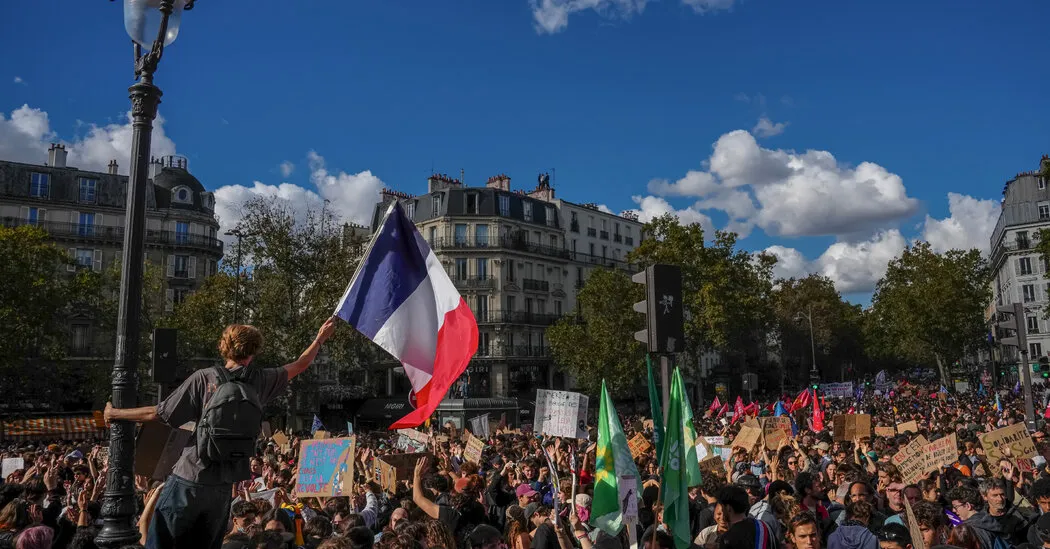
France is currently grappling with a period of significant social and political tension, marked by widespread youth-led protests and a deeply polarized political landscape. This environment is particularly evident five months ahead of a crucial presidential election, where candidates from the far-left and far-right are dominating the political discourse. At the heart of this “combustible French moment” are two young women, Soumaya Sarré and Louise Montangon, who have emerged as prominent, albeit unofficial, voices representing the starkly divergent views within the nation’s youth.
Soumaya Sarré, an 18-year-old history and Arabic studies undergraduate, grew up in a working-class district on the periphery of Paris. She has become a leading voice among the young demonstrators whose protests have ignited unrest across France since September. “I can carry our voices, the voices of young people from working-class neighborhoods,” Ms. Sarré stated, articulating her role in the movement.
Conversely, Louise Montangon, a 22-year-old philosophy undergraduate hailing from rural France, has taken on the role of a leading critic of these student protests. As the demonstrations gained momentum, Ms. Montangon frequently appeared on television panels and social media, condemning the young demonstrators. “The majority of university and high school students actually want to attend their classes,” she remarked in an interview, highlighting a perceived disruption to academic life.
Unknown to the broader public until this autumn, these two young women, operating from opposing ends of the political spectrum, have quickly become symbolic figures of the current French volatility. Their rise to prominence is particularly noteworthy as the nation anticipates further strikes and protests, signaling a potential intensification of social unrest. While neither Ms. Sarré nor Ms. Montangon are formal leaders of their respective political factions, their sudden visibility partly reflects a societal tendency to seek identifiable figures, or “avatars,” for leaderless or decentralized movements. Their simultaneous emergence, coupled with their fundamentally divergent political stances, serves as a powerful illustration of the escalating polarization within French society, especially among its younger demographic, just months before a presidential election that is increasingly defined by extremist candidates.
Recent polling data underscores this youth polarization. Surveys of individuals under the age of 25 suggest that more than 40 percent express support for Jean-Luc Mélenchon, the main far-left presidential candidate. Simultaneously, over 20 percent of this demographic back Marine Le Pen, his far-right opponent. This trend was also visible in the 2024 legislative elections, where nearly half of voters in this age group cast their ballots for Mr. Mélenchon’s party, while a third voted for Ms. Le Pen’s. These statistics indicate a significant shift away from centrist politics among younger voters.
Support for moderate political solutions has reportedly declined following several years of centrist governance under Emmanuel Macron, France’s term-limited president. During his tenure, Mr. Macron implemented policies that contributed to a reduction in unemployment figures and, on the international stage, successfully spearheaded efforts for Europe to assume greater responsibility for its own security. However, his administration has faced considerable challenges in revitalizing France’s economy and its public institutions, including the education system. These struggles have been cited as key drivers of street unrest and have contributed to the country’s current proximity to a significant debt crisis.
Ms. Sarré and Ms. Montangon, through their differing perspectives, embody a broader French society that appears to be increasingly gravitating towards maximalist solutions to these complex national problems, yet remains deeply divided on the precise path forward to address them.
Despite their political differences, both young women concur on the fundamental issues that initially triggered the student protests. They share concerns over the deteriorating condition of French schools, the critical shortage of teachers, and the perceived opacity and unfairness of the university application system. Furthermore, both Ms. Sarré and Ms. Montangon express strong disapproval of President Macron and his political allies, signaling a shared disillusionment with the incumbent government’s handling of these critical areas.
Ms. Sarré’s emergence into national prominence began with a selfie video in late September. In the video, she directly challenged the President, declaring, “Seriously, Macron, you’re pushing it!” She proceeded to critique government policies, arguing that they prioritized banning Muslim attire, such as her hijab, from schools over implementing meaningful improvements to the education system itself.
Ms. Montangon gained national attention approximately ten days later, on October 6, when she participated in a televised debate alongside Gabriel Attal, one of Mr. Macron’s former prime ministers and a candidate in the presidential race. During the debate, she confronted the politician with a self-assured demeanor, stating, “There’s no point in looking at me with a little smile — your track record is disastrous.” She referenced France’s decline in academic rankings as evidence and concluded by labeling him “the face of permissiveness.” These public confrontations underscored their shared grievances with the government’s performance, but also highlighted their contrasting approaches to political engagement.
Their paths diverge significantly, however, on the question of France’s future direction and the appropriate methods for achieving change. “It’s possible to make our voice heard without breaking everything, without blocking everything,” Ms. Montangon asserted, advocating for more measured forms of protest and political engagement.
In a separate interview, Ms. Sarré articulated a contrasting view. She maintained that the protests should continue “as long as there is no concrete change,” emphasizing the need for sustained direct action until tangible policy shifts are achieved. This fundamental disagreement on the efficacy and legitimacy of protest tactics further illustrates the deep ideological chasm between them.
Growing Up on the Fringes
Soumaya Sarré’s left-wing political convictions were significantly shaped by her upbringing in Bondy, a town situated north of Paris. Bondy is notable for its unusually large immigrant population and faces high rates of poverty and unemployment, creating a specific socio-economic context for her formative years. She is the daughter of a Senegalese father, who works in the civil service, and a French mother, who is currently unemployed. Her educational experience at Jean Renoir high school further solidified her views; she described buildings so inadequately insulated that students often kept their coats on during classes held in rooms characterized by peeling walls, broken chairs, and malfunctioning computers. These conditions fostered a sense of systemic neglect within the public education system.
During her senior year in 2026, Jean Renoir high school garnered media attention when an adviser was suspended amid accusations of racism towards a student. This incident profoundly impacted Ms. Sarré, inspiring her to co-lead an antiracist student movement, marking her initial foray into organized activism. The school administration and the education ministry, which oversees the institution, did not provide a response to requests for comment regarding this matter. This experience cemented her belief in the necessity of direct action against perceived injustices.
Ms. Sarré, like many other students from the working-class districts surrounding Paris, encountered significant difficulties with her university application process. Despite possessing what she described as “stellar grades,” Ms. Sarré stated that she was not immediately accepted into her first-choice program. This personal struggle resonated deeply with her. “So, if I, with that academic record, found it this difficult to get into university, I knew it was even worse for everyone else,” she reflected, underscoring a perceived systemic bias against students from her background. This experience fueled her empathy for the grievances of other students who had initiated school blockades in September. She actively participated in their protests, organized solidarity demonstrations, and played a pivotal role in establishing a union for students from working-class neighborhoods, which she now leads. Her activism stems from a conviction that profound, systemic changes are necessary to address educational inequality and social injustice.
Louise Montangon, in contrast, shared that she was raised in a single-parent household within a small, unnamed village in western France, a location she declined to disclose due to concerns about potential retribution against her family. She recounted a high school experience that bore similarities to Ms. Sarré’s, including overcrowded classrooms and poorly insulated buildings, suggesting that structural issues in education are not confined to urban areas. Interestingly, during her teenage years, Ms. Montangon admitted that she initially leaned left politically and admired Jean-Luc Mélenchon, the far-left leader she now implicitly opposes.
However, Ms. Montangon’s conservative political views solidified around the age of 18, after she began her bachelor’s degree studies in Bordeaux. She described her university as “an extremely politicized university,” an experience that she stated fundamentally altered her perspective. “There’s pressure on students who don’t want to join the various left-wing and far-left groups,” she explained, detailing an environment she perceived as intolerant of dissenting views. She also noted, “There’s pressure on professors who don’t want their classes disrupted by activists” from left-wing backgrounds. This perceived academic climate pushed her away from her earlier left-leaning sympathies.
Consequently, Ms. Montangon gravitated towards and subsequently joined a right-wing student union at her university. Later, she further aligned herself with the National Rally, the political party led by Marine Le Pen. As student demonstrations began to spread across France in September, she stated that she made a conscious decision to actively counter what she viewed as disruptive and unproductive protest tactics. Her journey illustrates how personal experiences within academic and social environments can significantly reshape political ideologies, leading individuals to embrace positions that contrast sharply with their youthful inclinations.
The trajectories of Soumaya Sarré and Louise Montangon, while distinct, collectively paint a vivid picture of a French youth profoundly concerned about their nation’s future, yet fiercely divided on how to navigate the challenges ahead. Their contrasting narratives, forged in different social realities and shaped by opposing interpretations of systemic issues, underscore the deep ideological fissures permeating contemporary France as it approaches a pivotal electoral moment.
Why This Matters
The stories of Soumaya Sarré and Louise Montangon are more than just individual narratives; they are crucial indicators of the profound social and political shifts occurring within France, with significant implications for its future and potentially for broader European trends. The widespread youth-led protests, coupled with the dramatic rise in support for far-left and far-right candidates among young voters, signal a deep disillusionment with traditional centrist politics and a demand for radical change.
Firstly, **Political Instability and Governance:** The intense polarization among youth, as epitomized by Ms. Sarré and Ms. Montangon, suggests that future French governments will face immense challenges in forging consensus and implementing policies. A deeply divided electorate, especially among its younger, future-defining demographic, can lead to political gridlock, increased social unrest, and a cycle of policy reversals. The upcoming presidential election, framed by figures at the extremes, could result in a leader struggling to unite a fragmented nation, impacting everything from economic reforms to social cohesion.
Secondly, **Socio-economic Consequences:** The underlying grievances fueling the protests—dilapidated schools, teacher shortages, an opaque university system, and broader economic anxieties—point to systemic failures that, if left unaddressed, could further exacerbate inequality and limit upward mobility. A debt crisis, combined with persistent issues in education and employment, risks creating a generation of young people who feel increasingly marginalized and disenfranchised, potentially leading to long-term economic stagnation and social fracturing.
Thirdly, **The Health of French Democracy:** The tendency for “leaderless movements” to seek “avatars” and the strong gravitational pull towards the political extremes raise questions about the resilience of France’s democratic institutions. The rejection of moderate solutions and the embrace of maximalist ideologies could make it harder for the country to find common ground and engage in constructive dialogue, a cornerstone of democratic governance. This trend is not unique to France and reflects a broader challenge to liberal democracies across Europe and globally.
Finally, **European Context and Precedent:** As a major European power, France’s internal dynamics often ripple across the continent. The rise of populism, youth disillusionment, and debates over identity and social policy in France could foreshadow similar developments in other European nations grappling with economic pressures, immigration, and the search for national identity. Understanding the drivers of polarization in France, as illuminated by the experiences of Ms. Sarré and Ms. Montangon, offers critical insights into the evolving political landscape of the European Union as a whole.
PARIS, France– France is grappling with a wave of student protests, primarily centered on government reforms to the university admissions system and calls for increased investment in public education. While thousands of high school and university students have mobilized, blocking institutions and demanding action, the movement has also brought to light a significant generational divide and the emergence of unexpected voices from both the left and the far-right.
At the heart of this unfolding story are two young women, Maryam Sarré and Lilith Montangon, who have become prominent, albeit contrasting, figures in the national discourse. Both former high school students, now enrolled in university, their ascent to public attention has highlighted the complexities of youth engagement, the impact of social media, and the deepening political polarization within French society.
Divergent Paths Amidst Protest
The student protests have been characterized by blockades of high schools, often leading to clashes and disruptions. Maryam Sarré, a 20-year-old university student from a working-class neighborhood, initially shared many of the left-wing concerns driving the movement, particularly regarding the need for greater investment in public education. However, her perspective diverged significantly on the methods employed by some protesters.
Ms. Sarré has publicly stated her belief that nothing justifies the disruption caused by certain protest tactics, advocating for a more orderly approach. Her views reflect a nuanced position, acknowledging the validity of the grievances while criticizing the means. “They have good reasons to demonstrate,” she remarked, referring to the student protesters, “but nothing justifies the disruption they caused.”
While she supported calls for educational investment, Ms. Sarré concluded that the emphasis on law and order, a hallmark of the far-right, might be more conducive to ensuring national stability. Her alignment with aspects of this conservative viewpoint is further underscored by her statement regarding the National Rally party: “advocates common sense and a return to order in a society that’s going through a lot right now.”
In stark contrast, Lilith Montangon has emerged as an outspoken critic of the protest movement itself, particularly condemning instances of violence and accusing politicians of manipulating student sentiment for their own agendas. Ms. Montangon, also a university student, has openly aligned herself with the far-right National Rally, advocating for a strong stance on law and order and a return to what she perceives as national stability.
Her rise to prominence has been meteoric, driven by her forceful denouncements and conservative rhetoric. Ms. Montangon has positioned herself as a voice for young right-leaning voters who are disaffected by the protest movement, seeking to galvanize a new generation of patriotic, conservative youth. “We are awakening a genuine patriotic, right-wing youth movement within universities and high schools,” she proclaimed. She has also expressed a desire for her right-wing student union to participate in negotiations between the government and youth representatives, a proposal currently rejected by left-leaning negotiators, reflecting the deep ideological chasm.
Thrust Into the Limelight: Media Scrutiny and Social Media Influence
Since September, Ms. Sarré and Ms. Montangon have been among a handful of young individuals who have been catapulted into the national spotlight by the French news media. This media focus, however, has drawn criticism from experts. Fabien Truong, a sociologist specializing in working-class districts, points out a problematic aspect of this media strategy: neither Ms. Sarré nor Ms. Montangon, nor most of the other young people highlighted, are currently high school students. This fact, according to Truong, undermines the idea that they truly represent the generation of high school students at the forefront of the protests.
“The fact that the media has focused on just a few people and had them appear on every talk show says nothing about those people, but it says a lot about the French media landscape,” Mr. Truong observed, suggesting a potential misrepresentation of the broader student body’s views and demographics.
Both women have experienced significant growth in their social media presence as a result of their newfound visibility. Ms. Sarré’s Instagram following, for instance, jumped from 200 to over 8,000. She attributes this increase, in part, to her unique background: “it is rare to see someone from a working-class neighborhood who expresses themselves well, who knows what they’re talking about, and is capable of defending their positions.”
Ms. Montangon has seen an even more dramatic surge in her online following, with her Instagram account growing from 3,800 to approximately 280,000 followers. Her sharp criticisms of protester violence and alleged political manipulation have resonated with a large audience, particularly those on the right.
Facing Abuse and Sustaining Advocacy
The increased public profile has also come with a significant downside: both Ms. Sarré and Ms. Montangon have faced frequent and severe abuse online. Ms. Sarré, who is French and wears a Muslim headscarf, has shared screenshots of comments on her videos that told her to “return to her country” and to remove her headscarf, highlighting instances of xenophobia and religious discrimination.
Ms. Montangon has also documented the abuse she has received, including doxxing – the public release of private personal information – and death threats directed at her family. The severity of these threats has led her to withhold certain details about her background, fearing further retribution.
Despite the challenges, neither woman plans to relinquish their newfound platforms. Ms. Sarré expressed dissatisfaction with the government’s response to the student demands, viewing recent promises to overhaul the university admission program as superficial rather than substantive change. She also believes the pledge to fund school renovations does not go far enough to address systemic issues. She intends to continue her advocacy until more satisfactory outcomes are achieved.
Ms. Montangon views this moment as a crucial opportunity to mobilize a bloc of young, right-leaning voters who feel unrepresented by the mainstream protest movements. Her objective is to build a robust, patriotic youth movement within educational institutions and to ensure that her right-wing student union is included in national negotiations, thereby giving a voice to conservative student perspectives that she believes are currently marginalized. The existing political climate, however, prevents such collaboration, with left-leaning negotiators boycotting any meetings that their right-wing counterparts seek to join, further illustrating the deep polarization within France’s youth political landscape.
Why This Matters
The French student protests and the emergence of figures like Maryam Sarré and Lilith Montangon are significant for several reasons, reflecting broader trends in modern democracies:
- Youth Engagement and Discontent:The protests underscore persistent generational concerns about education, economic opportunity, and the future. They highlight how young people, despite often being dismissed as disengaged, are actively participating in political discourse, even if their methods and ideologies diverge sharply.
- Deepening Political Polarization:The stark contrast between Ms. Sarré’s nuanced critique and Ms. Montangon’s far-right alignment, coupled with the inability of left and right-wing student groups to even sit at the same negotiating table, is a microcosm of France’s increasingly fractured political landscape. This division among the youth suggests that future political discourse may continue to be characterized by ideological stalemates.
- The Role of Media and Social Platforms:The rapid rise of these two individuals, facilitated by traditional media attention and exponential growth on platforms like Instagram, demonstrates the power of modern media to elevate voices. However, it also raises questions about media representation, the potential for mischaracterizing a movement by focusing on a few select individuals, and the vulnerability of public figures to online abuse and threats.
- Impact on Democratic Processes:Student movements have historically played a role in shaping government policy. The current protests test the government’s responsiveness to youth demands and the ability of democratic institutions to bridge ideological divides. The challenges in negotiation signal a broader struggle for consensus in a highly politicized environment.
- Global Resonance:Youth movements grappling with education reform, economic anxiety, and political polarization are not unique to France. The dynamics seen in Paris resonate with similar youth-led activism and ideological clashes observed in various countries worldwide, making this a relevant case study for understanding contemporary social and political trends.