
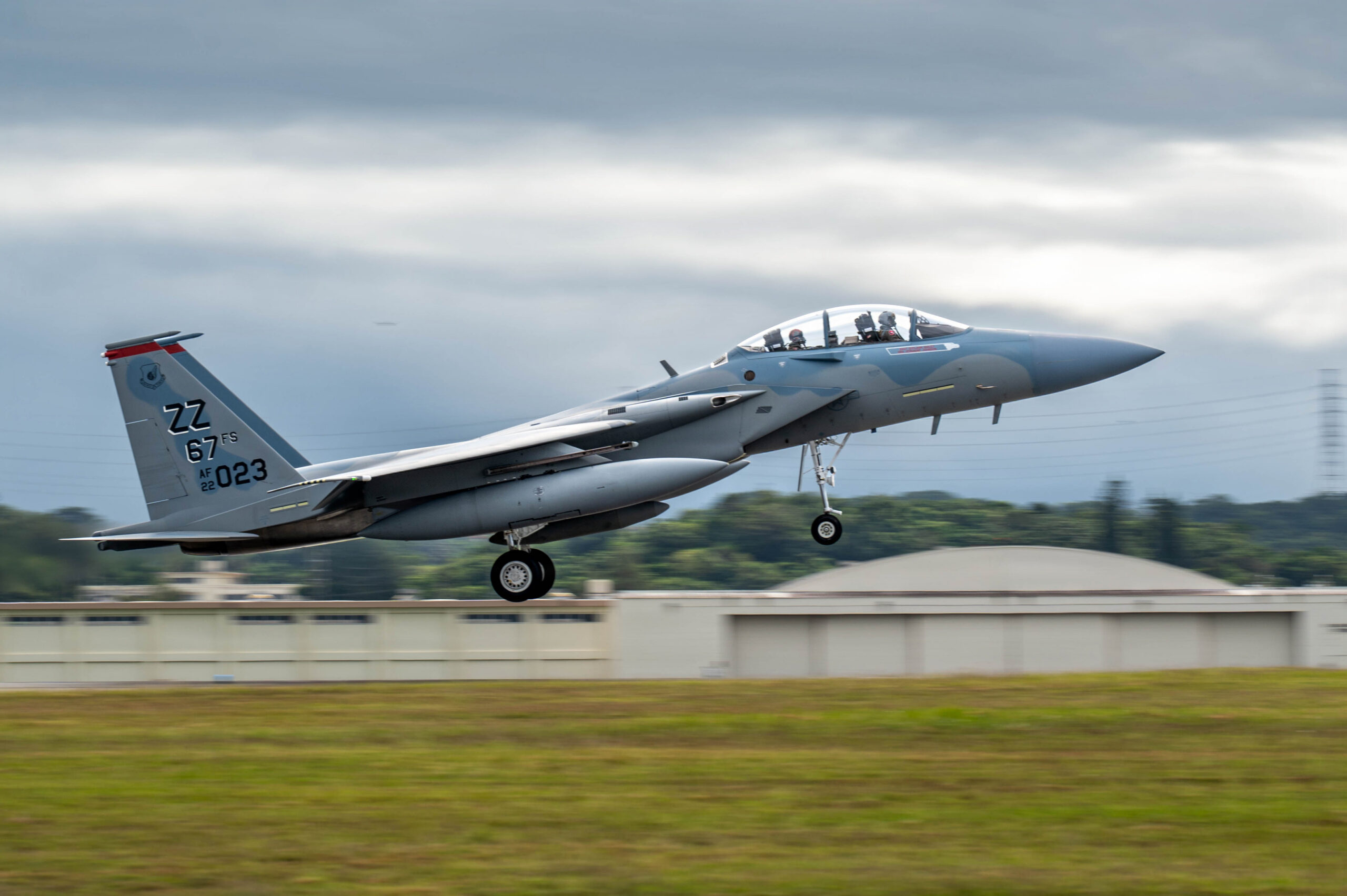
Kadena Air Base, a strategically vital U.S. installation, recently received its first permanently stationed F-15EX Eagle II fighter aircraft. This deployment is anticipated to provide the base with enhanced capabilities while concurrently beginning to alleviate the operational strain on the U.S. Air Force, which has relied on rotational deployments of fighter units to the location, according to defense experts.
For the past four years, the U.S. Air Force has maintained an operational presence at Kadena through a continuous series of rotational deployments. These deployments were initiated following the decision to withdraw the 18th Wing’s fleet of 48 aging F-15C/D aircraft, creating an operational gap prior to the arrival of their F-15EX replacements. During this transitional period, sometimes referred to as a “bathtub” effect, units equipped with F-35s, F-22s, F-16s, F-15Es, and F-15Cs were deployed to Okinawa.
These rotational deployments involved units from various commands, including Pacific Air Forces, Air Combat Command, and the Air National Guard. A significant portion of these rotations utilized advanced fifth-generation aircraft such as the F-22 Raptor and F-35 Lightning II.
The complete cessation of rotational deployments is not expected immediately, as the 18th Wing is projected to achieve its full complement of 36 F-15EXs by 2028. For instance, F-15Cs from the 159th Fighter Wing, based at Naval Air Station Joint Reserve Base New Orleans, Louisiana, arrived as recently as October.
Nevertheless, the arrival of the initial F-15EX aircraft marks a significant milestone toward the eventual establishment of a permanently assigned fighter fleet at Kadena.
Retired Gen. James C. Slife, former Vice Chief of Staff of the Air Force, commented on the significance of the F-15EX deployment, stating, “More F-15EXs, getting them forward in Kadena is great news for the Air Force. It just can’t happen fast enough.”
General Slife elaborated that a full complement of F-15EX aircraft at Kadena is expected to reduce operational pressure on U.S. Pacific Command (USPACOM). This would enable USPACOM to maintain necessary fighter squadrons in other critical locations such as mainland Japan and Alaska, supporting its extensive operational requirements. Furthermore, it would free up fighter units that could be allocated to other combatant commands, based on global strategic needs.
“In theory,” General Slife explained, “it will make essentially two to three squadrons’ worth of capacity available for other taskings, whether it’s SOUTHCOM, AFRICOM, or CENTCOM.” He added, “We are starting now to grow the number of allocatable fighter squadrons.”
General Slife also emphasized that providing relief to the fighter community is crucial for an Air Force facing high operational demands, citing recent military engagements as an example.
Retired Lt. Gen. Joseph T. Guastella Jr., former deputy chief of staff for operations, further elaborated that transitioning from rotational deployments to permanent basing at Kadena will enable fifth-generation fighter pilots to engage in more advanced and specialized training. This training, optimally conducted at home stations with appropriate ranges and facilities, is vital for maintaining proficiency in the complex capabilities of these advanced aircraft.
General Guastella explained that deployed units often face limitations in achieving the same level of comprehensive training compared to units operating from their home stations, which typically offer superior ranges and training infrastructure.
He remarked, “It’s the irony that by being forward deployed, you actually diminish your own readiness.”
Both General Slife and General Guastella highlighted additional benefits of permanently based squadrons. These include enhanced opportunities to cultivate stronger relationships with allied forces, such as the Japan Air Self-Defense Force, gain in-depth familiarity with the operational environment, and strengthen the overall deterrence posture in a region proximate to significant geopolitical actors.
In a broader context, General Slife also suggested that reducing the burden of frequent rotational deployments and increasing opportunities for training and flying time could positively impact personnel retention rates within the Air Force.
Rotational Units at Kadena
| Unit | Home Base | Aircraft |
|---|---|---|
| 525th Fighter Squadron, 3rd Wing | Joint Base Elmendorf-Richardson, Alaska | F-22 Raptor |
| 480th Fighter Squadron, 52nd Fighter Wing | Spangdahlem Air Base, Germany | F-16 Fighting Falcon |
| 355th Fighter Squadron, 354th Fighter Wing | Eielson Air Force Base, Alaska | F-35A Lightning II |
| 336th Fighter Squadron, 4th Fighter Wing | Seymour Johnson Air Force Base, North Carolina | F-15E Strike Eagle |
| 391st Fighter Squadron, 366th Fighter Wing | Mountain Home Air Force Base, Idaho | F-15E Strike Eagle |
| 144th Fighter Wing, California Air National Guard | Fresno Air National Guard Base, California | F-15C Eagle |
| 159th Fighter Wing, Louisiana Air National Guard | Naval Air Station Joint Reserve Base New Orleans, Louisiana | F-15C Eagle |
| 356th Fighter Squadron, 354th Fighter Wing | Eielson Air Force Base, Alaska | F-35A Lightning II |
| 34th Fighter Squadron, 388th Fighter Wing | Hill Air Force Base, Utah | F-35A Lightning II |
| 19th Fighter Squadron, 15th Wing | Joint Base Pearl Harbor-Hickam, Hawaii | F-22 Raptor |
| 199th Fighter Squadron, 154th Wing, Hawaii Air National Guard | Joint Base Pearl Harbor-Hickam, Hawaii | F-22 Raptor |
| 114th Fighter Wing, South Dakota Air National Guard | Joe Foss Field Air National Guard Station, Sioux Falls, South Dakota | F-16 Fighting Falcon |
| 148th Fighter Wing, Minnesota Air National Guard | Duluth Air National Guard Base, Minnesota | F-16 Fighting Falcon |
| 27th Fighter Squadron, 1st Fighter Wing | Joint Base Langley-Eustis, Virginia | F-22 Raptor |
| 77th Fighter Squadron, 20th Fighter Wing | Shaw Air Force Base, South Carolina | F-16 Fighting Falcon |
| 158th Fighter Wing, Vermont Air National Guard | Burlington Air National Guard Base, Vermont | F-35A Lightning II |
| 421st Fighter Squadron, 388th Fighter Wing | Hill Air Force Base, Utah | F-35A Lightning II |
| 177th Fighter Wing, New Jersey Air National Guard | Atlantic City Air National Guard Base, New Jersey | F-16C Fighting Falcon |
| 140th Wing, Colorado Air National Guard | Buckley Space Force Base, Colorado | F-16C Fighting Falcon |
| 90th Fighter Squadron, 3rd Wing | Joint Base Elmendorf-Richardson, Alaska | F-22 Raptor |
Deliveries and Quantities
The delivery of the first combat-coded F-15EX to Kadena on November 15 occurred approximately six months behind its original schedule. This delay was attributed to a strike at the Boeing manufacturing facility responsible for the aircraft in a previous year.
Since the resolution of the strike, deliveries have reportedly resumed and are currently proceeding according to the revised schedule.
Lt. Col. Alli Stormer, spokesperson for the 18th Wing, informed Air & Space Forces Magazine that “the F-15EX beddown is a phased transition, with additional aircraft arriving as production and operational requirements allow.”
For reasons of operational security, specific details regarding the current quantity of F-15EX aircraft at Kadena or precise timelines for future arrivals were not disclosed.
Josh Roth, a spokesperson for Boeing, stated that the company is collaborating closely with the U.S. Air Force (USAF) and the Pentagon to “ramp up F-15EX production.”
In an email, Roth confirmed, “We have completed all Lot 2 deliveries, and Lot 3 deliveries are underway.”
To address the increased demand for F-15EX aircraft, Boeing has recently expanded its workforce training programs and enhanced its F-15 manufacturing capabilities at its St. Louis, Missouri facility, the location of the earlier strike.
The U.S. Air Force has adjusted its acquisition plans for the F-15EX fleet, increasing the target from 129 to 267 aircraft. Additionally, some members of Congress have proposed legislation that could potentially authorize further expansion of the fleet, reaching up to 329 F-15EXs.
Why This Matters
The deployment of F-15EX Eagle II aircraft to Kadena Air Base represents a critical development with broad implications for U.S. national security interests, regional stability in the Indo-Pacific, and the operational readiness of the U.S. Air Force.
Strengthening Regional Deterrence:Kadena Air Base, located on Okinawa, Japan, is a cornerstone of U.S. military presence in the Western Pacific. The permanent basing of advanced fighters like the F-15EX strengthens the credible deterrence posture against potential adversaries in a strategically sensitive region. This deployment underscores the U.S. commitment to its allies, particularly Japan, and enhances collective security arrangements. A stable, enduring presence allows for sustained joint training exercises and deeper integration with the Japan Air Self-Defense Force, crucial for effective interoperability and response capabilities in a dynamic security environment.
Enhancing U.S. Air Force Readiness and Capacity:The previous reliance on continuous rotational deployments placed significant strain on U.S. Air Force units and personnel, particularly those flying fifth-generation aircraft like the F-22 and F-35. These rotations often diverted high-end assets from critical training at home stations, potentially impacting their peak readiness. By establishing a permanent F-15EX fleet at Kadena, the Air Force can free up these advanced aircraft to conduct complex, full-spectrum training essential for maintaining their technological edge. This shift also alleviates the logistical and personnel burdens associated with frequent deployments, potentially improving quality of life for service members and positively impacting retention rates.
Optimizing Global Force Allocation:With permanent fighter presence restored at Kadena, the U.S. Pacific Command gains greater flexibility in managing its assets. This not only secures critical air superiority capabilities within the Indo-Pacific but also frees up other fighter squadrons that can then be allocated to support operations in other combatant commands around the globe, such as U.S. Southern Command (SOUTHCOM), U.S. Africa Command (AFRICOM), or U.S. Central Command (CENTCOM). This increased flexibility is vital for responding to emerging global crises without compromising regional security commitments.
Technological Modernization and Strategic Complementarity:The F-15EX is a highly capable fourth-generation fighter, equipped with advanced avionics, electronic warfare systems, and a large weapon-carrying capacity. Its integration into the U.S. force structure at Kadena complements the stealth and advanced sensor capabilities of fifth-generation fighters. This “high-low mix” strategy provides a versatile and robust air combat capability, ensuring that the U.S. Air Force can meet a wide range of operational requirements, from air defense to strike missions, against sophisticated threats in the modern battlespace. The F-15EX’s role in absorbing pressure allows the more specialized fifth-generation platforms to focus on their unique roles where stealth and advanced networking are paramount.