
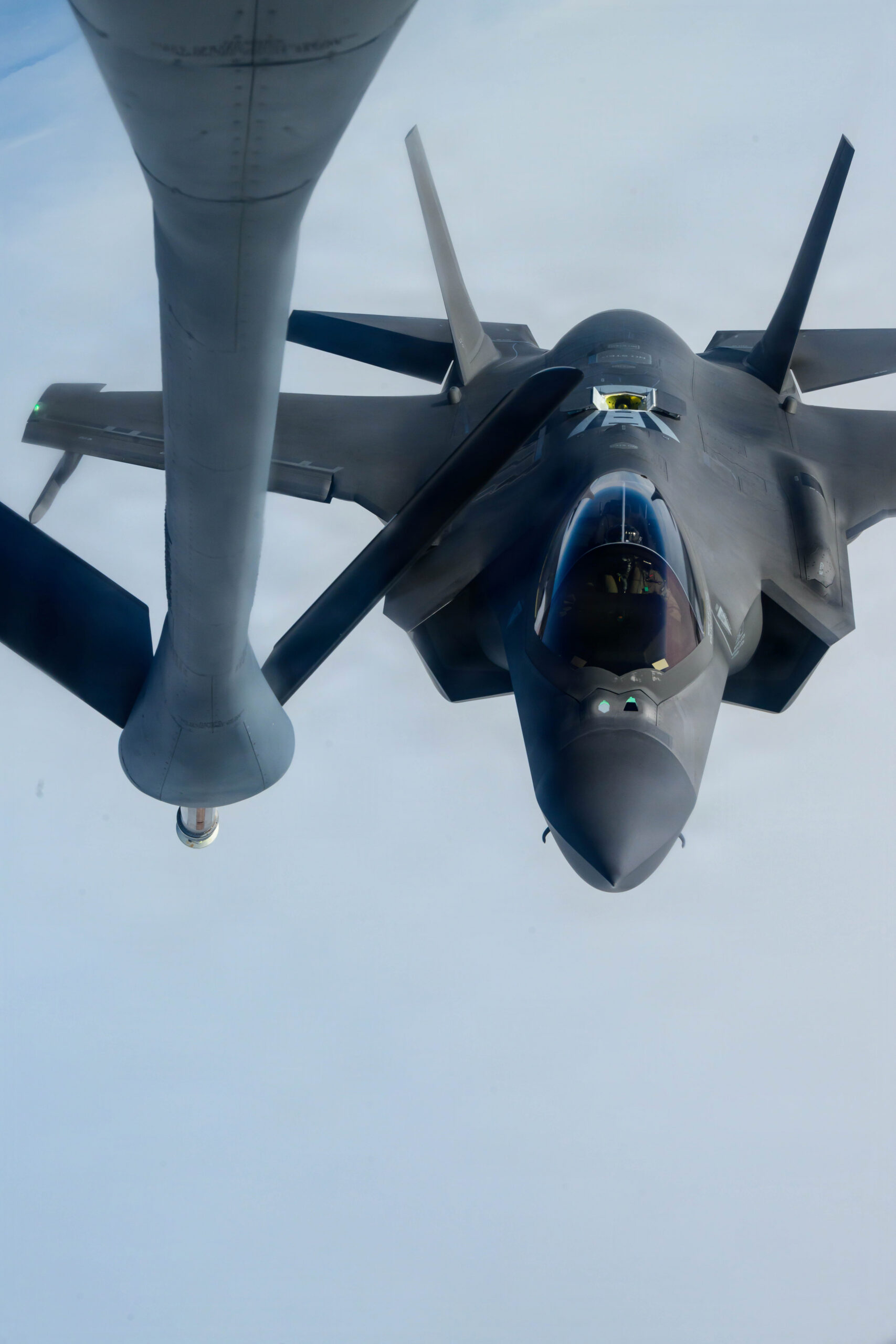
The Senate Appropriations Committee has taken a restrictive stance on several Air Force programs in its proposed fiscal year 2027 defense appropriations bill. The committee notably declined to authorize multi-year procurement contracts for key programs, including the F-35A Lightning II and F-15EX Eagle II fighter jets. Furthermore, the bill proposes reduced funding for new fighter aircraft, advanced semi-autonomous drones, and development for the Air Force’s future F-47 fighter program.
Under the Senate’s proposed budget, five F-35A fighters would be added to the administration’s baseline budget request, bringing the total procurement for this variant to 29 jets in fiscal year 2027. However, the committee’s bill simultaneously reduces the Air Force’s planned acquisition of F-15EX Eagle II fighters by 25 percent, cutting the purchase from 24 to 18 aircraft for the same fiscal year.
The Senate Appropriations Committee released its nearly $1.1 trillion budget bill for the Department of Defense on November 16, 2026, as one of its final appropriations measures for fiscal year 2027. This defense package represents an increase of $69 billion above the initial baseline budget. However, it falls significantly short of the $1.5 trillion defense spending target sought by President Donald Trump’s administration.
The White House had previously asked Congress in the spring of 2026 to approve a $1.5 trillion Pentagon budget, structured as a $1.15 trillion “base” appropriations bill complemented by a separate $350 billion reconciliation bill. Following an overwhelming electoral victory by Democrats earlier this month, this two-stage, $1.5 trillion budget strategy is now considered unlikely to pass. The shift in congressional control, particularly within the appropriations process, has reshaped budget priorities and feasibility.
For the Air Force, these proposed changes translate into a reduction of 15 new fighter jets compared to its initial request, resulting in a total acquisition of only 47 new Air Force fighters in 2027. This figure remains substantially below the Air Force’s stated objective of procuring 72 new fighter aircraft annually to maintain and modernize its fleet.
The comprehensive budget proposal allocates $11.1 billion for F-35 accounts across the U.S. Air Force, Navy, and Marine Corps, covering new procurement, modifications, and sustainment activities. Additionally, $2.9 billion is designated for F-35 research, development, test, and evaluation (RDT&E). The decision to add five F-35A aircraft to the base budget increased the total F-35 funding by $704 million.
Senators largely funded the increase in F-35A procurement by cutting six F-15EX jets from the administration’s initial request, yielding a savings of $618.7 million. This adjustment leaves just over $2 billion allocated for the purchase of 18 Eagle IIs in 2027. Concurrently, the committee proposes an additional $245 million for advance F-15EX funding, though the specific allocation or purpose of these advance funds was not detailed in the bill’s accompanying documents.
A significant aspect of the Senate bill is its denial of the Pentagon’s request for multi-year procurement authority for several major programs. These include the F-35 and F-15EX fighters, the Joint Advanced Tactical Missile, the Lower Tier Air and Missile Defense Sensor, and the Air-Launched Rapid Response Weapon Increment 1 hypersonic program. Multi-year procurement contracts typically allow the Pentagon to commit to purchasing a certain quantity of equipment over several years, often resulting in cost savings due to economies of scale and providing greater stability for defense contractors and their supply chains.
In an explanatory statement accompanying the bill, the committee justified its denial of these multi-year requests. It cited that the original budget proposal either “did not request sufficient fiscal year 2027 discretionary funding,” that “the program is not adequately funded over the [Future Years Defense Plan (FYDP)],” or that “the program has not proven an ability to manufacture at scale.” The FYDP is a five-year projection of military force structure, weapon systems, and other programs, along with their associated costs.
Despite these denials, the committee did approve multi-year procurement authority for two programs: the KC-46 Pegasus refueling tanker and the Guided Multiple Launch Rocket System (GMLRS).
The revised Senate budget also proposes a substantial cut of $603 million from the Air Force’s requested Research & Development (R&D) spending for the next-generation F-47 fighter program, reducing its allocation from $5 billion to $4.4 billion. This program is critical for developing future air superiority capabilities.
Proposed spending on the Air Force’s semi-autonomous Collaborative Combat Aircraft (CCA) program, identified as one of the service’s top modernization priorities, would also see significant reductions. The Pentagon initially requested $1.37 billion for CCAs in its budget, but the Senate’s revision would nearly halve that to $711 million.
Specifically, the Air Force had sought over $996 million in procurement funds to acquire CCAs in 2027, along with an additional $150 million for advance purchases in fiscal year 2028. The Senate’s revised budget would reduce 2027 procurement funding to approximately $848 million and cut 2028 advance spending to $120 million. The bill also slashes $164 million from the CCA program’s advanced development and prototyping funds, decreasing it from $214 million to nearly $50 million. Budget documents attributed this particular reduction to “misaligned acquisition phasing,” suggesting concerns about the timing or structure of the program’s development stages.
Beyond these adjustments, Senate appropriators’ budget would also implement several increases related to the F-35 program:
- Provide a $205 million increase in discretionary funds to fully support Lot 6 of the F-35’s upgraded APG-85 radar, enhancing its sensor capabilities.
- Add $223.7 million for F-35 sustainment activities, crucial for maintaining fleet readiness.
- Allocate an additional $300 million for F-35 spares and repair parts, addressing supply chain challenges.
- Provide $243.8 million more to fully fund the F-35’s Engine Core Upgrade program, improving engine performance and reliability.
- Designate $89.8 million to fully fund the Power Thermal Management Upgrade program, addressing critical cooling needs for advanced systems.
- Add $500 million to fully fund Block 4 upgrades, which incorporate new capabilities and address obsolescence issues for the F-35 fleet.
Why This Matters
The Senate Appropriations Committee’s proposed defense bill carries significant implications for the future of U.S. air power, military readiness, and the defense industrial base. The overall reduction in the defense budget, falling substantially short of the administration’s $1.5 trillion target, reflects a shift in national spending priorities and political realities following the recent election. This budgetary constraint directly impacts the Pentagon’s ability to fund ambitious modernization plans.
For the Air Force, the most immediate concern is the shortfall in new fighter jet acquisitions. The procurement of only 47 new fighters in 2027, well below the desired 72 annually, exacerbates the service’s challenge of maintaining an adequate fleet size amidst the retirement of older aircraft. This could lead to a smaller, older fleet, potentially affecting global presence, responsiveness, and combat readiness against peer adversaries. The reduction in F-15EX buys, in particular, affects the recapitalization of the Air Force’s aging F-15C/D fleet, which is crucial for homeland defense and certain international commitments.
The denial of multi-year procurement authority for critical programs like the F-35 and F-15EX is another major point of impact. While the committee cited funding and manufacturing concerns, this decision typically forfeits potential cost savings that come from bulk purchases and long-term production commitments. It also introduces uncertainty for defense contractors, potentially affecting their long-term planning, workforce stability, and supply chain investments. This could lead to higher unit costs in the long run and slower delivery schedules for essential military hardware.
Cuts to the Collaborative Combat Aircraft (CCA) program are particularly noteworthy given the Air Force’s emphasis on these semi-autonomous drones as a force multiplier and a more affordable way to enhance future air combat capabilities. Reducing funding for CCAs, especially in advanced development and prototyping, signals a potential slowdown in this crucial modernization effort. This could delay the integration of these systems, which are envisioned to work alongside crewed fighters like the F-35 and F-47, and impact the U.S. military’s ability to innovate quickly in areas of artificial intelligence and autonomous systems. The “misaligned acquisition phasing” rationale suggests deeper concerns within Congress about the program’s strategic direction or execution.
Similarly, the reduction in R&D for the future F-47 fighter program could impede the development of next-generation air dominance capabilities. Investment in R&D is vital for maintaining a technological edge over potential adversaries. Delays or cutbacks here could have long-term consequences for the U.S. Air Force’s ability to project power and deter aggression decades from now.
Conversely, the Senate’s decision to fully fund F-35 upgrades (Block 4, Engine Core Upgrade, Power Thermal Management Upgrade, APG-85 radar, sustainment, spares) demonstrates a commitment to ensuring the effectiveness and readiness of the existing F-35 fleet. These investments are critical for enhancing the F-35’s combat capabilities, improving its reliability, and addressing known performance issues, thereby maximizing the return on investment for this cornerstone fifth-generation fighter. This mixed funding approach indicates a congressional desire to prioritize the health and modernization of current, proven platforms while exercising caution with future or rapidly developing programs.