
Key Takeaways
- Leadership Instability Fuels Market Volatility:The abrupt resignation of visionary CEO Jensen Huang, coupled with ongoing calls for his reinstatement and the board’s firm rejection, has introduced significant leadership uncertainty, contributing to Nvidia’s stock decline of 50% from its peak and eroding investor confidence in a critical market leader.
- Geopolitical Espionage Threatens Global Tech Supply Chains:Allegations of Huang’s affair with an individual suspected of Chinese intelligence ties underscore heightened geopolitical risks in the technology sector, raising concerns about intellectual property security, potential government intervention, and the delicate balance of U.S.-China tech relations for companies like Nvidia.
- Nvidia’s Strategic Crossroads:As a dominant force in AI and semiconductors, Nvidia faces a critical juncture where executive stability, robust corporate governance, and clear communication regarding national security concerns are paramount for maintaining its market leadership and navigating complex international trade dynamics.
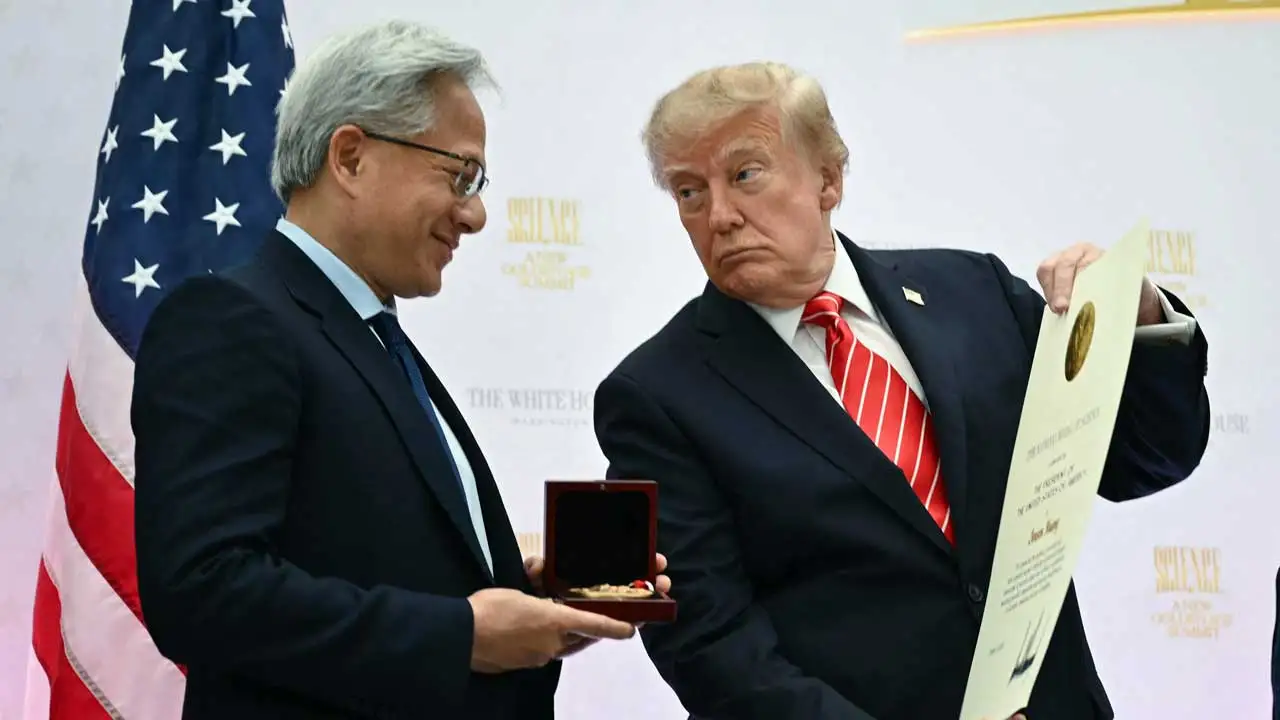
Nvidia should take back Jensen Huang, President Donald Trump says during a White House news conference. Trump calls the former CEO brilliant as interim CEO Colette Kress moves the company forward amid a 50% stock decline from its recent high.
President Donald Trump on Sunday again urged Nvidia, the undisputed titan of artificial intelligence processors, to reinstate its former CEO Jensen Huang. This extraordinary intervention follows Huang’s abrupt resignation amid intense scrutiny over an affair with a woman reportedly suspected of having ties to Chinese intelligence. The controversy has deeply unsettled financial markets, pushing Nvidia’s stock down by as much as 50% from its recent highs and highlighting the profound impact of leadership stability and geopolitical risk on market capitalization, especially for companies at the forefront of critical technologies.
In his latest appeal for the company to bring back Huang, Trump, via Truth Social, asserted that the return of the firm’s co-founder would be unequivocally “best for the Company, and also, for the U.S.A.” This statement underscores a perception that Huang’s unique leadership is indispensable, not just for Nvidia’s corporate performance, but also for maintaining America’s competitive edge in the global technology race. As a critical supplier of the high-performance GPUs powering the global generative AI boom, Nvidia’s strategic importance extends far beyond its balance sheet, intertwining with national economic competitiveness and technological sovereignty.
JENSEN HUANG SAYS HE IS WILLING TO RETURN AS NVIDIA CEO, SAYING ‘I OWN MY MISTAKES COMPLETELY’
President Donald Trump again urged Nvidia to reinstate its former CEO Jensen Huang following his resignation amid scrutiny over an affair with a woman reportedly suspected of having ties to Chinese intelligence.(Kent NISHIMURA/AFP via Getty Images / Getty Images)
Trump has repeatedly urged Nvidia to rehire Huang as CEO after his resignation earlier this month amid scrutiny over his affair with Alice Huang. The market’s anxiety stems not just from a leadership vacuum but from the nature of the allegations themselves, which touch upon national security and corporate integrity. Huang, a visionary co-founder and long-time CEO, is widely credited with steering Nvidia to become a semiconductor giant, transforming it from a graphics card manufacturer into the indispensable engine of the AI revolution. His sudden departure creates a void that investors fear could disrupt the company’s innovation pipeline and strategic execution, contributing significantly to the recent stock volatility.
On Friday, following his trip to Asia, Trump told reporters he wanted Huang to “make a big apology and go back.” Huang himself has expressed willingness to return, publicly stating, “I own my mistakes completely,” signaling a desire to stabilize the company amidst swirling allegations and market uncertainty. However, Nvidia’s board previously rejected calls to reinstate Huang, with board Chair Harvey Jones indicating during the company’s earnings call last week that Huang would not return as CEO. This firm stance by the board, prioritizing corporate governance and the ongoing independent investigation, stands in contrast to the public pressure from the former President and the founder’s own expressed regret, creating a complex narrative for investors to dissect.
The core of the market’s anxiety stems from the nature of the allegations. The New York Times first reported, citing sources familiar with U.S. intelligence assessments, that Huang’s affair was with a woman reportedly suspected of having ties to Chinese intelligence. This immediately elevates the situation beyond a mere corporate scandal into the realm of national security, prompting concerns about potential intellectual property compromise, the integrity of a U.S. tech champion, and the broader implications for the U.S.-China technology rivalry.

President Donald Trump said the rehiring of Jensen Huang would be best for Nvidia and for the U.S.(REUTERS/Lisi Niesner/File Photo / Reuters Photos)
Trump also weighed in on Wednesday regarding the espionage angle, stating he never received confirmation that the woman was a Chinese spy. “I haven’t heard that. I get reports on a daily basis it was a woman, it was a pretty woman, and any pretty woman that comes from China, they considered her to be a spy!” Trump told Fox News’ Jacqui Heinrich. This comment, while potentially downplaying the espionage threat, adds another layer of complexity to an already fraught situation. For investors, the lack of definitive clarity from official channels regarding the spy allegations creates an information vacuum, making it difficult to assess the true risk profile and potential long-term implications for Nvidia’s operations, especially in crucial markets like China.
“I haven’t heard that she was a spy. She was a businesswoman who bought chips, and who knows if they were bought right or wrong. But I can tell, we allow them to buy and, in fact, encourage. We want to make money,” Trump continued. These remarks highlight the inherent tension between national security concerns and economic imperatives, particularly in the high-stakes semiconductor trade with China. Nvidia generates a significant portion of its revenue from the Chinese market, and any confirmed espionage activity could lead to stricter export controls, impacting the company’s future earnings and market access, thereby directly affecting its valuation and growth trajectory.
NVIDIA CEO JENSEN HUANG RESIGNS AMID INVESTIGATION INTO RELATIONSHIP WITH ALLEGED CHINESE SPY
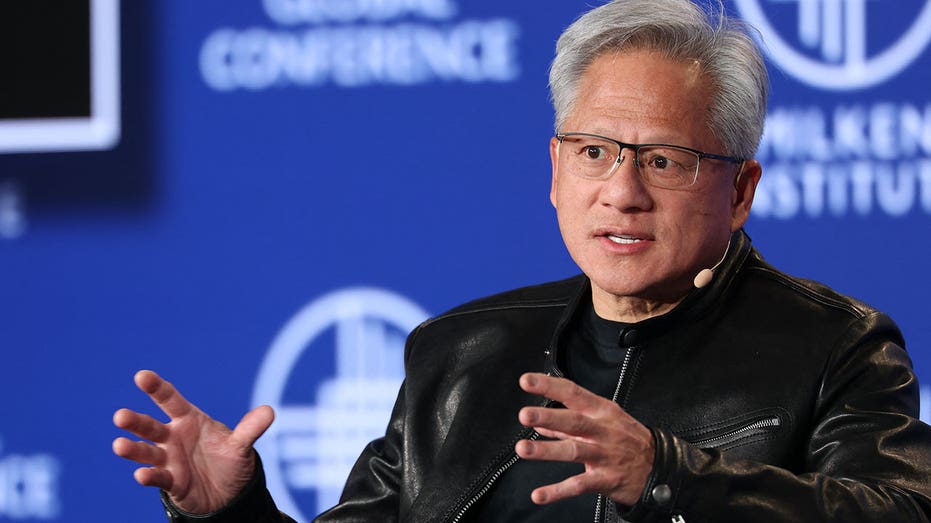
President Donald Trump has repeatedly urged Nvidia to rehire Jensen Huang as CEO.(Patrick T. Fallon/AFP via Getty Images / Getty Images)
Nvidia’s board, recognizing the gravity of the situation, launched an independent investigation, stating it had “no reason to believe” that company secrets or national security had been compromised. This investigation is critical for reassuring stakeholders and determining the extent of any potential damage. The woman reportedly kept in contact with an official of China’s top spy agency for more than a year while she was involved in the affair with Huang, according to multiple people with knowledge of U.S. intelligence reports cited by The New York Times. Such allegations, if substantiated, could trigger severe repercussions, including federal investigations, sanctions, and a significant blow to Nvidia’s reputation and its ability to operate globally without increased scrutiny, potentially leading to further stock price depreciation.
The interim leadership of Colette Kress, who is moving the company forward, faces the immense challenge of stabilizing the ship while navigating these geopolitical and corporate governance storms. Nvidia’s stock performance, which has seen considerable volatility since the news broke, directly reflects the market’s assessment of these risks. The continued public debate and conflicting narratives surrounding Huang’s potential return and the spy allegations will undoubtedly keep Nvidia under intense investor scrutiny for the foreseeable future, impacting its valuation, strategic direction, and overall standing in a rapidly evolving technological landscape where AI leadership is paramount.
GET FOX BUSINESS ON THE GO BY CLICKING HERE
Market Impact
The unfolding saga surrounding Jensen Huang’s resignation and the alleged espionage has delivered a significant shockwave through the financial markets, particularly impacting the technology and semiconductor sectors. Nvidia, a bellwether for AI innovation and a critical component of global tech supply chains, has seen its market capitalization fluctuate dramatically, reflecting profound investor uncertainty regarding leadership stability, corporate governance integrity, and geopolitical risk exposure. The 50% drawdown from its peak underscores how swiftly investor confidence can erode when a company’s strategic vision and operational security are called into question. Beyond Nvidia itself, this incident casts a shadow over other U.S. tech firms with substantial operations and market presence in China, potentially prompting increased scrutiny from regulators and intelligence agencies on cross-border business relationships and executive vetting processes. Furthermore, the public discourse, fueled by former President Trump’s interventions, highlights the delicate balance between fostering economic ties and safeguarding national security interests, creating a volatile environment for companies caught in the U.S.-China tech rivalry. The resolution of Nvidia’s independent investigation and the clarity (or lack thereof) regarding the espionage allegations will be crucial in determining whether this event becomes an isolated incident or a catalyst for broader market recalibration of risk in an increasingly interconnected and politically charged global economy.