
Kerch Bridge Sustains Significant Damage, Blocking Key Waterway for Sea of Azov Vessels
London, UK– The Kerch Bridge, a critical link between Russia and the annexed Crimean Peninsula, has suffered substantial damage following a series of Ukrainian strikes, rendering a key section of the road bridge inoperable and blocking maritime transit between the Sea of Azov and the Black Sea. According to an intelligence update issued by UK Defence Intelligence on November 27, the bridge was targeted multiple times between November 16 and 19.
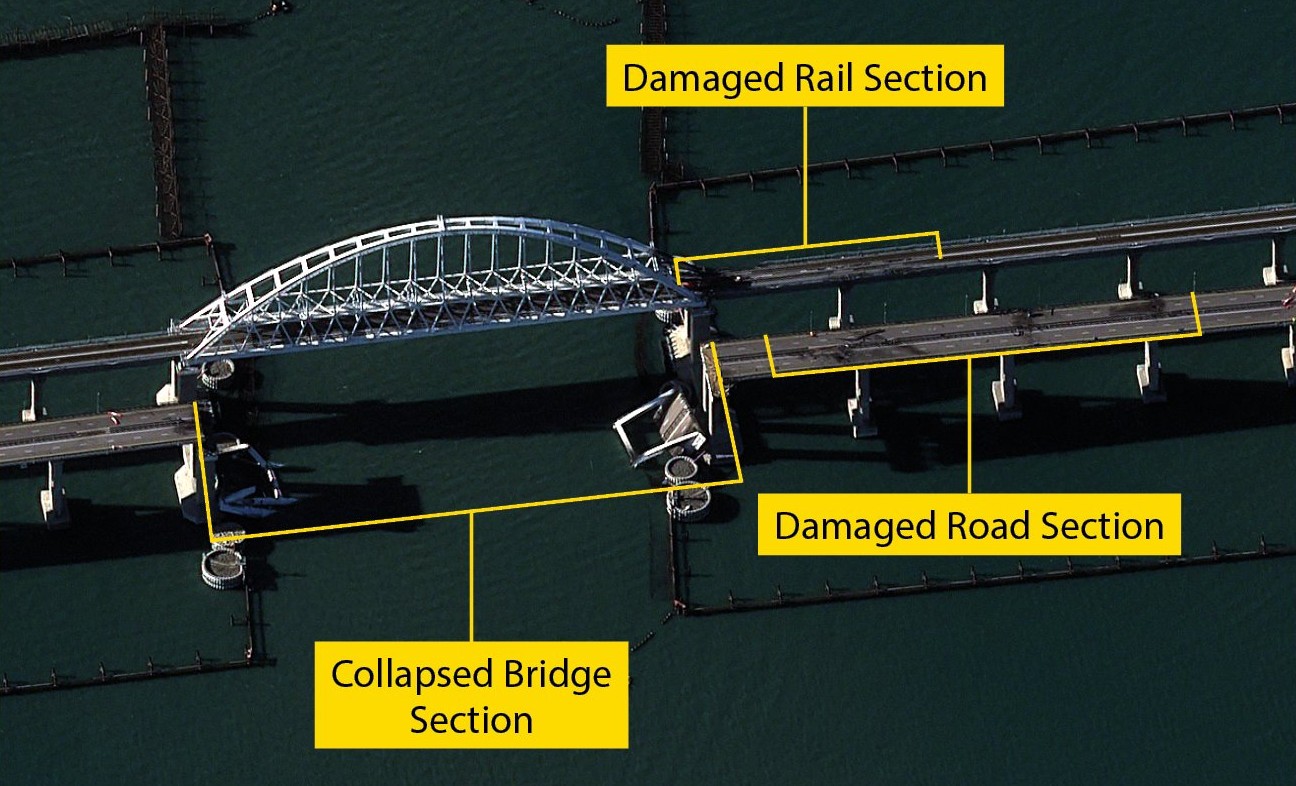
The UK Defence Intelligence report details three distinct attacks on the structure. The second strike, occurring on November 17, is reported to have caused the collapse of an arch section of the road bridge. This damage not only halted road traffic but also obstructed the channel beneath, preventing vessels from navigating the crucial waterway. The report further indicates that a 200-meter section of the road bridge sustained damage, with craters observed on its surface.
The intelligence update, which provides a detailed account of the incidents, states:
“The Kerch bridge, which links Crimea to the Russian mainland, was struck three times between the 16 and 19 November [current year assumed, original text stated 2026] by Ukrainian forces using missiles and uncrewed aerial systems. The second attack, on 17 November [current year assumed], collapsed the arch section of the road bridge, rendering it inoperable for road transit and blocking passage for vessels seeking transit between the Sea of Azov and the Black Sea. In addition, a 200m area of the road bridge sustained damage with craters identified.
The third attack occurred at midnight on the 19 November [current year assumed], against the rail bridge. The rail bridge sustained damage adjacent to the bridge arch, resulting in additional damage to railings, as well as scorch marks on the arch. It is likely that one rail track is still in use.
Despite significant measures designed to protect the bridge, Russian air defence, which included two SA-22 Pantsir systems approximately 2.4km south of the now-collapsed bridge section, was unable to prevent the Ukrainian strike.
Azov port has reportedly ceased operations due to the successful Ukrainian strikes against Russian bridges, including a bridge in Rostov-on-Don, which was struck 10 October [current year assumed], as well as the Kerch bridge. The blocking of maritime routes for the Sea of Azov has restricted Russian maritime logistics. It is likely that vessels in the Sea of Azov will be unable to conduct direct transit into the Black Sea until the waterways have been cleared.”
The report highlights a significant failure in Russian air defense capabilities. Two SA-22 Pantsir air defense systems, positioned approximately 2.4 kilometers south of the affected bridge section, reportedly failed to intercept the Ukrainian munitions despite the presence of “significant measures designed to protect the bridge.” This indicates a potential vulnerability in Russian defensive strategies for high-value targets within occupied territories.
Ukrainian forces have reportedly claimed responsibility for the attacks, with Janes, a global agency for open-source defense intelligence, reporting that Ukraine has listed eleven drones and missiles used in the operation. Russia has acknowledged that the bridge sustained damage and is partly destroyed. Following the second strike, video footage purportedly showing the arch section falling into the strait was circulated online. Al Jazeera has published analyses detailing the sophisticated methods Ukraine may have employed to execute the attack on a structure that the Kremlin considers a prime symbol of its control over Crimea, annexed from Ukraine in 2014.
The Kerch Bridge, inaugurated by Russian President Vladimir Putin in 2018, holds immense strategic and symbolic value for Russia. It serves as a crucial logistical artery for supplying military and civilian goods to Crimea and southern Ukraine. Its partial destruction and the resulting blockage of the Kerch Strait represent a significant disruption to Russian supply lines and a notable success for Ukrainian forces in targeting critical Russian infrastructure.
Why This Matters
The extensive damage to the Kerch Bridge and the subsequent blockage of the Kerch Strait carry profound implications across military, economic, and geopolitical spheres. This incident underscores the ongoing vulnerability of Russian infrastructure within annexed territories and represents a strategic victory for Ukraine, even as the conflict continues.
Military Impact:For Russia, the Kerch Bridge is an indispensable conduit for military logistics, facilitating the movement of troops, equipment, and supplies to Crimea and onward to the southern front lines in Ukraine. Its partial incapacitation significantly hampers Russia’s ability to reinforce its forces, potentially slowing down operations and increasing reliance on less efficient and more vulnerable alternative routes, such as overland routes through occupied Ukrainian territories or ferry services. The failure of sophisticated air defense systems like the SA-22 Pantsir to prevent these strikes also raises questions about the effectiveness of Russian air defense networks in protecting vital assets, potentially encouraging further long-range Ukrainian attacks on Russian infrastructure.
Economic and Trade Disruptions:The blocking of the Kerch Strait has immediate and severe economic consequences. The Sea of Azov is a critical waterway for maritime trade, particularly for agricultural and industrial exports from both Russia and Ukraine’s occupied territories. Ports like Azov, Rostov-on-Don, and Mariupol (under Russian occupation) rely on access to the Black Sea via the Kerch Strait. With this passage obstructed, vessels currently in the Sea of Azov are effectively trapped, and no new cargo ships can enter or exit, leading to significant delays, increased shipping costs, and potential shortages of goods. The reported cessation of operations at Azov port, coupled with previous damage to a bridge in Rostov-on-Don, exacerbates these logistical challenges, impacting regional economies and Russia’s ability to export goods.
Geopolitical and Symbolic Significance:The Kerch Bridge is more than just a piece of infrastructure; it is a powerful symbol of Russia’s annexation of Crimea and its asserted control over the region. Its construction was hailed by the Kremlin as a monumental achievement, solidifying its hold on the peninsula. Repeated successful Ukrainian strikes on this structure deliver a potent symbolic blow to Russia’s prestige and demonstrate Ukraine’s capacity to challenge Russian authority even in deeply entrenched territories. This also serves as a morale booster for Ukrainian forces and population, reaffirming their resolve to reclaim all occupied territories. Internationally, the attacks reinforce the narrative that Crimea remains disputed territory and highlight the ongoing efforts to disrupt Russia’s war machine.
Humanitarian Concerns:While not immediately apparent, prolonged disruptions to logistical routes can indirectly affect civilian populations. Delays in commercial shipping could impact the availability and pricing of essential goods in Crimea and other occupied areas, potentially leading to humanitarian concerns if supply chains remain severed for extended periods.
In conclusion, the damage to the Kerch Bridge is a multi-faceted event with far-reaching consequences. It represents a significant operational challenge for Russia, a notable strategic success for Ukraine, and a stark reminder of the volatile nature of the conflict and its capacity to impact critical global trade and security interests.