
Access the White House Watch complimentary bulletin
An insight into the implications of Trump’s subsequent presidency for Washington, commerce, and the globe
While Donald Trump amplified his ominous declarations of a military action targeting Iran, a fresh nocturnal tempest over Tehran, the capital city, caused certain inhabitants to rush from their slumber towards their panes and elevated areas, convinced that the eagerly-awaited hostilities had commenced.
It was merely an unfounded scare. Nevertheless, the feeling of apprehension has only escalated. The American president on Thursday issued an ultimatum to Iran to finalize an agreement in no more than a fortnight and a day, failing which, dire consequences will ensue. Washington has now gathered one of the most substantial armed contingents in the Middle East since the conflict in Iraq in 2003.
Numerous inhabitants of the capital, Tehran — still deeply affected by the June hostilities with Israel and the lethal suppression of anti-government demonstrations last month — apprehend that it’s just a question of when brutality will once again disrupt their daily existence.
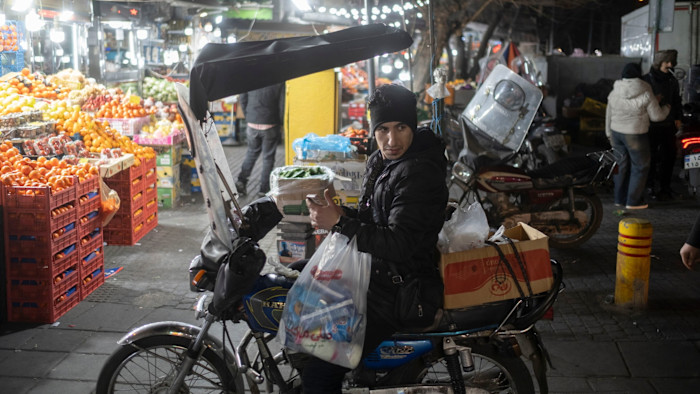
Throughout the metropolis, individuals recount restless evenings, and certain chemists report an increasing call for sedatives and hypertension drugs. Additional inhabitants have endeavored to accumulate provisions, loading grocery carts with necessities such as grains, legumes, and cleaning agents, and lining up in lengthy queues for settlement.
“I will remain in Tehran,” declared Homayoun, a former government employee who, akin to other respondents, utilized an alias to safeguard his anonymity. He mentioned being excessively weary to escape the urban area. “I will perish, whether at the hands of the Islamic republic or the United States, yet I refuse to depart. Here, it appears one cannot even experience a natural demise.”
Prior to the tempest, anxieties were already heightened. Amidst festivities commemorating the previous week’s anniversary of the 1979 Islamic uprising, government loyalists canvassed districts, recited maxims, and ignited pyrotechnics late into the evening. To numerous individuals already feeling apprehensive, these exhibitions caused disquiet.
“Upon their arrival on our thoroughfare, I assumed the United States had launched an assault,” remarked Soheila, a sexagenarian resident of an affluent district within Tehran, elucidating her belief that inhabitants were evacuating their dwellings due to an aerial bombardment. “My arterial tension has climbed since that evening. Physicians attribute this to anxiety stemming from the apprehension of conflict.”
In June, when Israel launched an offensive against Iran, initiating a twelve-day conflict during which the capital, Tehran, endured intensive shelling, a wave of patriotic fervor enveloped the nation. Numerous Iranians united behind their national emblem, disregarding Israeli exhortations to rebel against the clerical rule, notwithstanding their disappointment in their governance.
On this occasion, following the severe suppression of anti-government demonstrations that occurred last month, sentiments are considerably more intricate.
Over the past week, a series of commemorative services were observed, signifying 40 days — a significant cultural benchmark in Iran — following the fatalities of demonstrators who perished during the disturbances, marking the most lethal occurrence in Iran since the 1979 revolution.
The human rights organization HRANA stated its confirmation of over 7,000 fatalities, with further inquiries underway. Numerous Iranians attribute the majority of the brutality to the state’s armed personnel, while the government has accused foreign-supported armed instigators and reports a reduced casualty count of 3,117.

President Masoud Pezeshkian’s administration has endeavored to quell resentment regarding the suppression, pledging pay raises for public sector employees and consistently extending sympathies to the bereaved relatives. Even Ayatollah Ali Khamenei, the nation’s paramount spiritual figure, expressed this month, for the initial occasion, his sorrow over the demise of blameless individuals.
However, these overtures have proven insufficient to persuade numerous Iranians, who perceive that the schism between the government and its populace is beyond repair.
“It incites fury and a desire for retribution within me,” expressed Mojgan, a schoolmistress in her mid-forties, recounting her experience of viewing footage from the recent commemorative rites. “It brings to mind my separation from my former spouse. I simply wished for his departure, irrespective of the repercussions. I desire the Islamic republic’s abolition and am indifferent to its successor.”
A segment of Iranians apprehends that openly challenging America’s menacing warnings towards Iran regarding the Islamic republic’s atomic initiative might be misinterpreted by governmental bodies as endorsement for the clerical regime and its directives. Certain individuals even yearn for conflict as a potential resolution to the present stalemate.
Nasrin, an individual employed by a private firm who participated in the demonstrations, remarked that “for many years, our choices lay between undesirable and more deplorable options.” She added, “Currently, I wish for the nation to advance singularly.”
These circumstances have fostered a melancholic atmosphere, notwithstanding the commencement of the sacred Muslim month of Ramadan and the forthcoming celebrations for Nowruz, the Persian annum’s inception, scheduled for the following month.

Merchants, whose establishments would ordinarily teem with patrons making ready for celebratory repasts and festivities, reported commercial inactivity.
“Ordinarily, I would have replenished my inventory by this time, and patrons would be acquiring goods for the observances,” stated a provisions dealer in central Tehran. “This year, however, none of us have done so. We cannot endure under these conditions.”
Mehdi, a building constructor, expressed his inability to proceed with his existence. “We find ourselves trapped betwixt a government unwilling to yield and the United States and Israel refusing to retract,” he declared. “One cannot subsist amidst such a degree of unpredictability.”