
This piece serves as an online edition of our Inside Politics newsletter. Subscribers have the option to registerhereto receive the bulletin every weekday. Should you not be a subscriber, you can still obtain the newsletter without charge for a period of 30 days.
Good morning. The most significant development in Westminster currently — a topic likely to resonate for many months and potentially years — involves the apprehension of three individuals, all previous consultants to Labour during the 2010s, on suspicion of engaging in espionage for China.
This serves as a potent reminder of the principal constraint impacting the government’s approach to China.
Inside Politics is compiled by Georgina Quach. You can followStephen on BlueskyandGeorgina on Bluesky. The preceding issue of the newsletter is available for review here. Please direct any insights, thoughts, or comments to insidepolitics@ft.com.
Prepare for further awkwardness
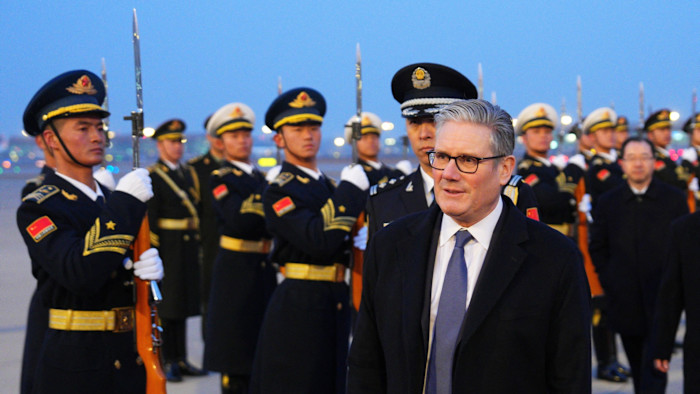
Keir Starmer is pursuing a similar China strategy to Rishi Sunak, but Sunak confronted two primary limitations, whereas Starmer faces only one.
Sunak was hindered by 1) a substantial and influential contingent of Conservative backbenchers advocating for an overtly hostile stance towards the world’s second-largest economy, and 2) the stark reality that China engages in intelligence activities against us.
Starmer enjoys greater latitude because there isn’t a notable anti-China group within the Parliamentary Labour Party or the broader Labour movement. Nevertheless, he contends with the identical real-world impediment that Sunak encountered: China isbothan essential global power in the contemporary eraanda nation that conducts espionage against us.
I will not elaborate extensively on the rationale for the Starmer-Sunak China policy today, as it has been discussed previously, and Janan Ganesh articulated it more eloquently some time ago:
Friedrich Merz is anticipated to visit China soon, despite Germany needing to recover considerably less diplomatic ground there than Britain. (Olaf Scholz had made two trips, and bilateral trade is immense.) Mark Carney traveled last month, and Emmanuel Macron the month before. Was Starmer genuinely expected to abstain from going? Britain has legitimate security concerns, but what threats does it encounter that other North Atlantic democracies have deemed manageable? If the matter is ethical — pertaining to human rights and such — what did nearly a decade of alienation from China accomplish on that front? Will the absolute monarchies of the Gulf be shunned? With which democratic partners, if not those directly across the Channel, should the UK seek collective strength against autocratic regimes?
To these points, I would add: the alternative to the Starmer-Sunak perspective on China is not merely more aggressive than that of any of the UK’s true counterparts; it is more bellicose than the approach favored by Donald Trump’s America. The US remains the world’s indispensable force, possessing immense scale, advantages, and military might. The UK is . . . not.
Nonetheless, the detention of three men, all consultants to Labour in the early 2010s, on allegations of spying for China, will further destabilize this government. Given the deep personal and political connections among senior figures within the Labour Party, accusations of espionage against prominent party officials will profoundly unsettle, disorient, and anger many individuals, simultaneously causing considerable embarrassment and potential electoral harm.
The current geopolitical epoch dictates that British governments must accustom themselves to foreign policies that will incur public embarrassment. These include a US policy entailing a degree of degradation, whether through criticism from Donald Trump or compliance with policies that most British voters strongly disapprove of. Regarding China, this will involve narratives like the present one, stories that will, eventually, lead to at least one ministerial resignation.
Foreign policy has rarely been a domain that garners votes in democracies, but it may increasingly become one where votes and political careers are jeopardized.
Now consider this
I viewedMy Father’s Shadow, an outstanding cinematic work set during Nigeria’s 1993 election. It represents an astonishingly confident directorial debut by Akinola Davies Jr, and I eagerly anticipate his future endeavors. Jonathan Romney’s analysis is available here.
Leading dispatches today
Reliable broadcast| The BBC intends to press ministers to commit to extensive reforms, including the discontinuation of political appointments to its board, as part of its strategy to secure greater institutional autonomy in discussions regarding its next royal charter.
‘Embodiment’ of Labour principles| Shabana Mahmood plans to restrict asylum seekers’ entitlements to housing and assistance as she reiterates stricter immigration measures, despite pressure from backbench Labour MPs.
A million gratitude| Nigel Farage’s Reform UK received a second substantial contribution from entrepreneur Christopher Harborne, propelling the party’s fundraising significantly beyond Labour and the Conservatives last year.
Espionage claims| Two men, one a former Border Force official, “took matters into their own hands” by conducting covert policing operations in the UK on behalf of Hong Kong authorities, a jury heard.