
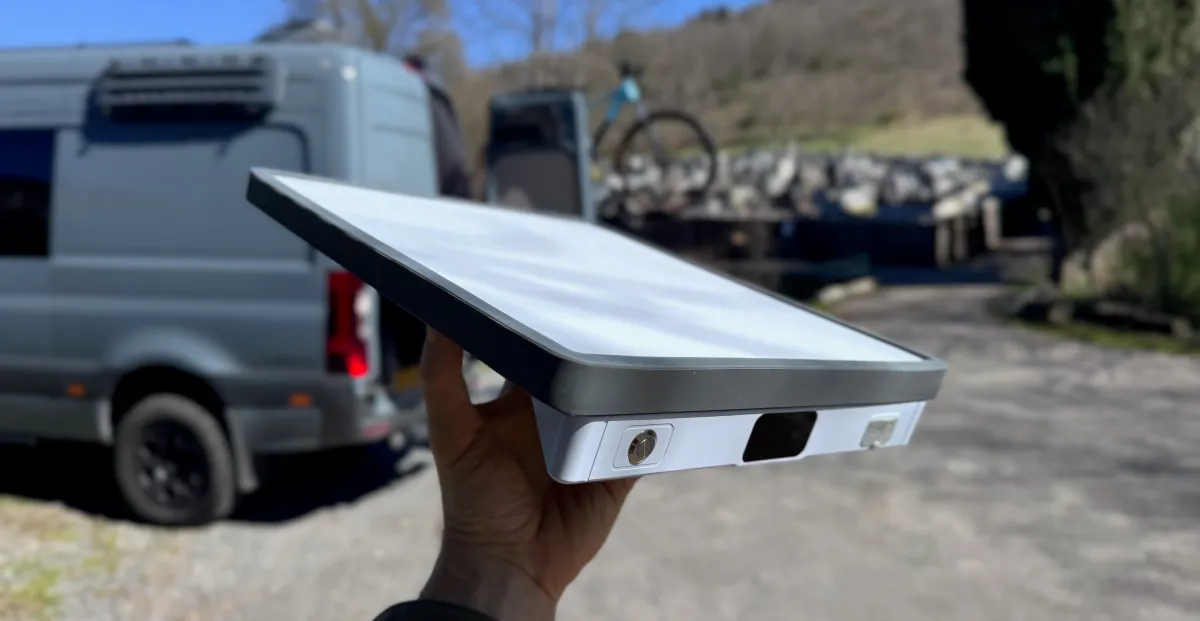
My Starlink Mini has fundamentally transformed my lifestyle. It stands as the primary enabler for my distant work from my modified camper van, offering swift and dependable web access in locations where standard 4G and 5G mobile data struggles to connect. Peakdo’s newest LinkPower power pack further enhances the utility of the most compact Starlink device by liberating it from electrical cords for extended periods.
Although this may seem insignificant, I can confirm its importance. For instance, I can station my vehicle in the shade and position the Mini at a distance to bypass foliage and impediments, provided I remain within range of its wireless connection. It even functions effectively on my control panel devoid of cumbersome wires that might entangle, delivering consistent information for traversing secluded mountain routes as my spouse carries out her tasks from the adjacent seat.
I’ve been evaluating PeakDo’s second iteration of the LinkPower 2 power source over the past several weeks during my journey through the French and Spanish stretches of the Pyrenees mountains. The cost of $219 – a significant increase from last year’s $119 versions – is irksome, yet I foresee numerous Starlink Mini proprietors willing to incur this additional expense.

$219
The Good
- Provides more than 5 hours of wireless Starlink Mini connectivity
- Energizes Starlink while concurrently replenishing its charge for perpetual operation
- Novel magnetic quick-release charging connector
- Facilitates simpler Starlink positioning by eliminating lengthy, catch-prone cords
The Bad
- Costly for a 99Wh portable power unit
- Clunky online application
Similar to the prior model, the LinkPower 2 battery integrates seamlessly into the rear of the Starlink Mini akin to a typical SpaceX attachment. The linkage is robust; however, I would not rely on it without protective housing should you intend to deploy it on the rooftop of your traveling automobile. PeakDo provides an appropriate suction fastener, should that be your preference.

A brief DC-to-DC cylindrical connector links the 99Wh power source to the Starlink Mini, enabling genuinely cable-free web access. The device retains the identical dimensions of its predecessor and remains controllable from a distance via Bluetooth through an online application (A dedicated application must be acquired by iPhone users).
Beyond its USB-C port, the LinkPower 2 incorporates a built-in DC cylindrical input which corresponds to the Starlink Mini’s power socket. Consequently, the battery can be recharged utilizing the power cord supplied with the Starlink antenna. Furthermore, a novel quick-release magnetic connector, provided within the packaging, facilitates its charging, potentially preventing your Starlink Mini from a damaging descent should the charging lead be inadvertently caught.
A novel power bypass function enables direct energization of the Starlink Mini when the LinkPower 2 is connected to an electrical supply. This minimizes strain on the power pack and assists in maintaining lower operating temperatures, obviating the need to disconnect the battery on each occasion.
Throughout my evaluations, I reliably achieved approximately 5 hours and 30 minutes of operational time from a completely charged LinkPower 2. This represents an extra hour compared to the initial LinkPower unit I assessed previously. Moreover, maintaining the LinkPower power source – regardless of its generation – connected to the Starlink Mini offers significantly greater flexibility for sustaining the antenna’s power perpetually, such as via USB ports integrated into your automobile, a used portable charger, or even a photovoltaic panel.
As an illustration, during a clear day, I managed to prolong the Starlink Mini’s operational duration to exceed seven hours by connecting a compact, foldable photovoltaic panel, which generated a consistent 7.3W, to the LinkPower 2’s USB-C port. In remote areas, my Starlink Mini typically consumes around 18W, while the USB-C outlets integrated into my vehicle deliver a constant 28W, readily compensating for this consumption when positioned on my dashboard.
Lacking the connected LinkPower power pack, the Starlink Mini must be connected to an AC outlet or a robust portable charger providing 100W (20V/5A), as “the Starlink Mini is incompatible with USB Power Delivery specifications of 65W or less.”


Ordinarily, the LinkPower 2 battery recharges via USB-C, reaching a maximum of 65W and requiring approximately 100 minutes for a complete replenishment. Alternatively, the peak charging speed can be configured to 100W within expert mode, should one desire quicker charging, albeit at the risk of shortening the battery’s operational life. USB-C offers the quickest charging method, succeeded by a 57W charge observed through the DC barrel connector, and a 55W charge achieved via the magnetic adapter. If necessary, that two-way USB-C port also enables the LinkPower 2 to function as a conventional portable charger for powering devices such as a phone or laptop, delivering up to 65W.
PeakDo asserts an IP65 designation for resistance to dust and water penetration. This signifies its resilience during a rain shower while static, though not when affixed to the top of a vehicle in motion. Furthermore, this classification is invalidated if charging cords leave the device’s ports uncovered.
1/12
My appreciation for this battery is such that I have continuously kept the LinkPower 2 connected to my Starlink Mini for several weeks, even when utilizing an alternative external power source. This portable charger contributes an extra 667g (1.47lb) to the 1.1kg (2.43lb) Starlink Mini, imparting a robust feel, yet remaining manageable enough for single-handed operation. Furthermore, I fastened a magnet, acquired from Amazon, into the battery’s tripod attachment point to prevent its dislodgment from my roof — an unlikely event, but its occurrence would severely disrupt my Starlink connectivity.
Upon my assessment of the initial LinkPower last summer, its price was $119, making the increase to $219 for the LinkPower 2 undeniably concerning, particularly given that reliable 99Wh portable chargers offering 100W USB-C PD outputs are available for less than half the price. The first iteration, LinkPower 1, remains accessible, albeit now priced at $159. My suggestion is to acquire the more economical variant, unless the additional hour of battery duration, the detachable charging adapter, or the battery bypass capability offered by the LinkPower 2 are absolute necessities for you.
Images captured by Thomas Ricker / The Verge
Thomas Ricker
Content created by this writer will be integrated into your daily electronic summary and your main page’s updates.
Explore all entries by Thomas Ricker