
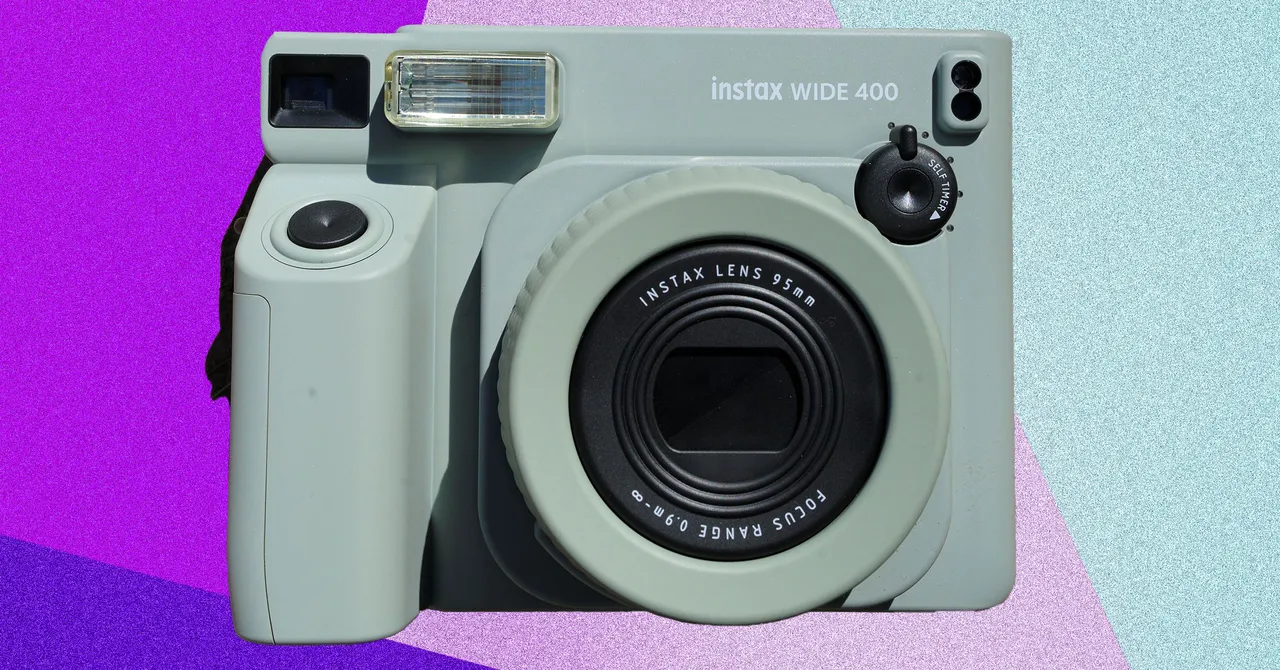
Take a bold approach or abstain. Photographers have consistently favored the Instax Wide due to its expansive image size. Resourceful hobbyists even devised methods to modify earlier versions (the Wide 300) with specialized lenses, leading to superior picture quality. In many aspects, the Instax Wide 400 bears a resemblance to its predecessor, the 300. It incorporates an identical lens and an identical fully automatic exposure mechanism. Should you desire comprehensive exposure manipulation, this particular Instax model is unsuitable. Nevertheless, I appreciate this particular format, and consequently, this device.
It possesses a somewhat substantial build. Given the considerable dimensions of the film, the camera itself is similarly large; however, I find this makes it more comfortable to grip compared to certain other models available. A substantial, well-designed grip accommodates the four AA batteries, providing sufficient power for approximately 100 shots as per Fujifilm’s specifications. From a design perspective, its monochrome appearance echoes that of the SQ1 (mentioned previously), characterized by minimalism and straightforwardness. Composed of two plastic elements, the 95mm f/14 lens delivers an equivalent focal length of 35mm on a full-frame camera. Fujifilm incorporated a novel close-up focusing capability, complementing the existing 10-foot to infinite focus range. I had hoped Fuji would have inverted this sequence, as I occasionally neglected to rotate the lens past the second detent, resulting in blurred photographs. Nonetheless, once familiarized with its operation, it functions adequately.
This camera’s inherent simplicity forms a significant part of its allure. The lens yields respectable photographs, and the expansive format enhances the enjoyment of sharing them with companions. My desire is for some form of manual adjustment—any at all—as this would unlock additional creative avenues; however, for those who appreciate this format, this remains the optimal camera choice.
Alternative Instax Wide Devices:
Lomography Lomo’Instant Wide at $200:Should you be inclined to invest a slightly higher sum, Lomography’s Instant Wide utilizes Instax Wide film and supports the attachment of supplementary lenses. It operates in both fully automatic and programmatic shutter modes. As I have not yet evaluated this model, I cannot comment on its photographic output; however, its integrated 90mm lens provides an approximately comparable field of vision.
Fujifilm Wide Evo priced at $409:Initially, the Wide Evo appears to be a replica of our primary selection, the Mini Evo, adapted for the broader Instax film format. I wish this were truly the case. Certain commonalities exist: you gain access to filter effects, a pair of novel lens filters, and an “intensity” dial that enables precise adjustment of the strength of diverse effects. The lens is capable of transitioning between a wide-angle perspective (equivalent to 16mm on a full-frame sensor) and a standard view (equivalent to 28mm on a full-frame sensor), with dedicated controls for all effects. The shutter release mechanism is an irksome lever-type design, requiring a downward flick instead of a simple button press. This perplexing design choice is, frankly, suboptimal. In my assessment, it feels cumbersome and detrimentally impacts the photographic process in an irreparable manner. When factoring in a significant shutter delay (even by Instax’s own benchmarks) and its cost, this particular model is difficult to endorse. For those seeking a printer, opt for the Instax Wide. However, if a camera is your objective, both the Wide 400 and the Lomography Lomo’Instant Wide represent superior value and performance.
{content}
Source:{feed_title}