
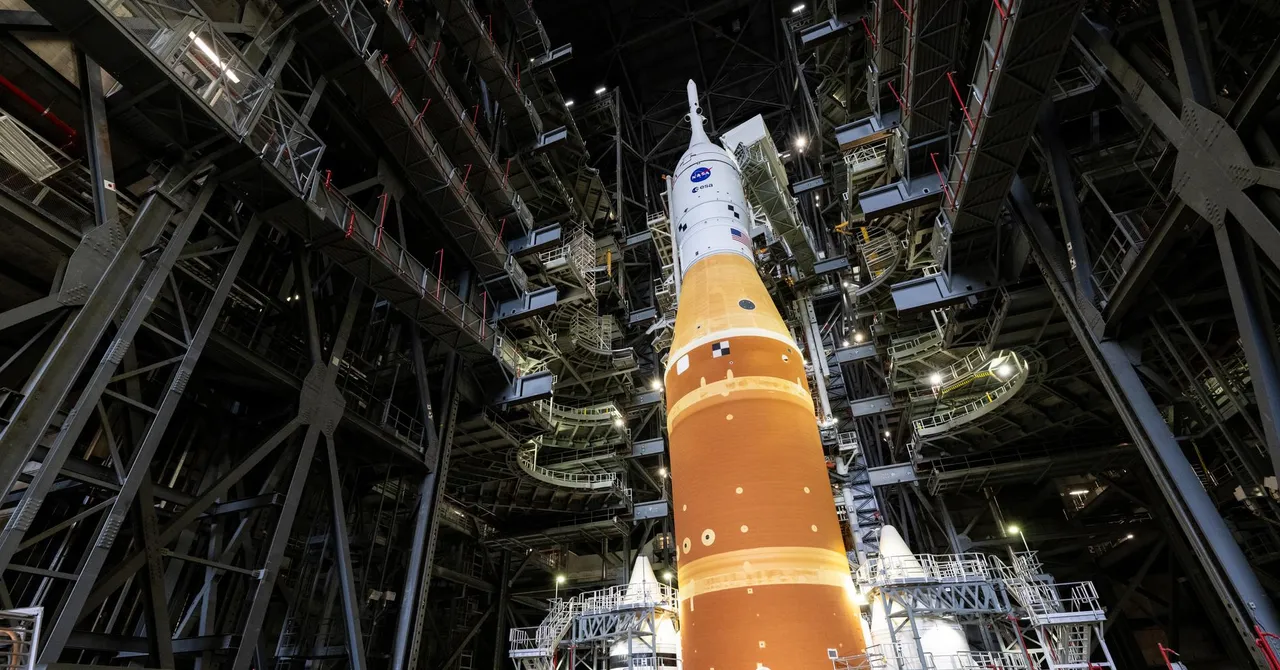
The colossal lunar rocket from NASA, slated for launch aroundApril 1, features a massive central stage that will combine 537,000 gallons of liquid hydrogen with 196,000 gallons of liquid oxygen. This mixture will then ignite the fuel in four engines, each spanning eight feet in width, generating approximately 1.7 million pounds of propulsive force. Immediately following the ignition of these primary engines, a pair of solid rocket boosters, situated on opposing sides, will activate their powder-like fuel, contributing an extra 3.3 million pounds of propulsive power apiece.
This tremendous power will propel the 322-foot-high rocket, designated the Space Launch System (SLS), initiating the maiden phase of Artemis II – a voyage exceeding 600,000 miles to the moon and its return.
“It’s akin to an entire edifice ascending into the sky,” remarks Nathalie Quintero, who spearheads SLS core stage operations at Boeing, the company responsible for constructing the rocket’s central component. “Its sheer magnitude is immense.”
The SLS rocket, designated for Artemis II, a 10-day orbital journey around the moon, recently emerged from the Vehicle Assembly Building (VAB) and was situated on its launch platform at NASA’s Kennedy Space Center. NASA had initially moved the rocket to the pad in January; however, the agency was compelled to return it to the VAB to rectify a problem involving the loading of helium onto the upper segment. The subsequent opportunity for the mission’s liftoff spans from April 1 to April 6.
Artemis II follows more than three years after Artemis I, which served as the inaugural and sole uncrewed trial flight for the SLS and the Orion capsule. The initial journey transported two dummy figures, Helga and Zohar, for the purpose of gauging radiation levels; however, this subsequent flight will transport living, breathing astronauts—the first individuals to undertake the lunar voyage since Apollo 17 in December 1972.
The four-member team comprises commander Reid Wiseman, a Naval aviator with experience living on the International Space Station and completing two extravehicular activities; pilot Victor Glover, another naval pilot who has resided and operated on the ISS; mission specialist Christina Koch, a field researcher and aerospace instrument engineer who holds the female record for the longest continuous space mission at 328 days; and mission specialist Jeremy Hansen, a Royal Canadian Air Force pilot who will become the inaugural Canadian to ever journey to the moon.
These four individuals will join 24 others as the sole humans in history to journey completely to the moon, a typical separation of approximately 240,000 miles. At the time of Artemis II’s launch, the moon will be approaching its apogee, roughly 250,000 miles distant. Furthermore, since the Artemis II crew members will operate at a greater elevation above the moon’s surface compared to their Apollo predecessors, their voyage will take them to a more remote distance from Earth than any individual has previously achieved.
“We are highly likely, contingent on our designated launch window, to observe phenomena no human has ever witnessed,” Wiseman stated during a media briefing prior to liftoff.
NASA intends to succeed Artemis II with Artemis III around mid-2027. This upcoming mission will involve testing a lunar module, either from SpaceX, Blue Origin, or potentially both, within low-Earth orbit, rehearsing rendezvous and coupling procedures. Artemis IV, which NASA aims to dispatch in 2028, would subsequently place astronauts onto the moon’s terrain. The overarching objective of the Artemis initiative is to proceed with a sequence of expeditions to create a permanently staffed lunar outpost, paving the way for voyages to Mars and further into space.
{content}
Source:{feed_title}