
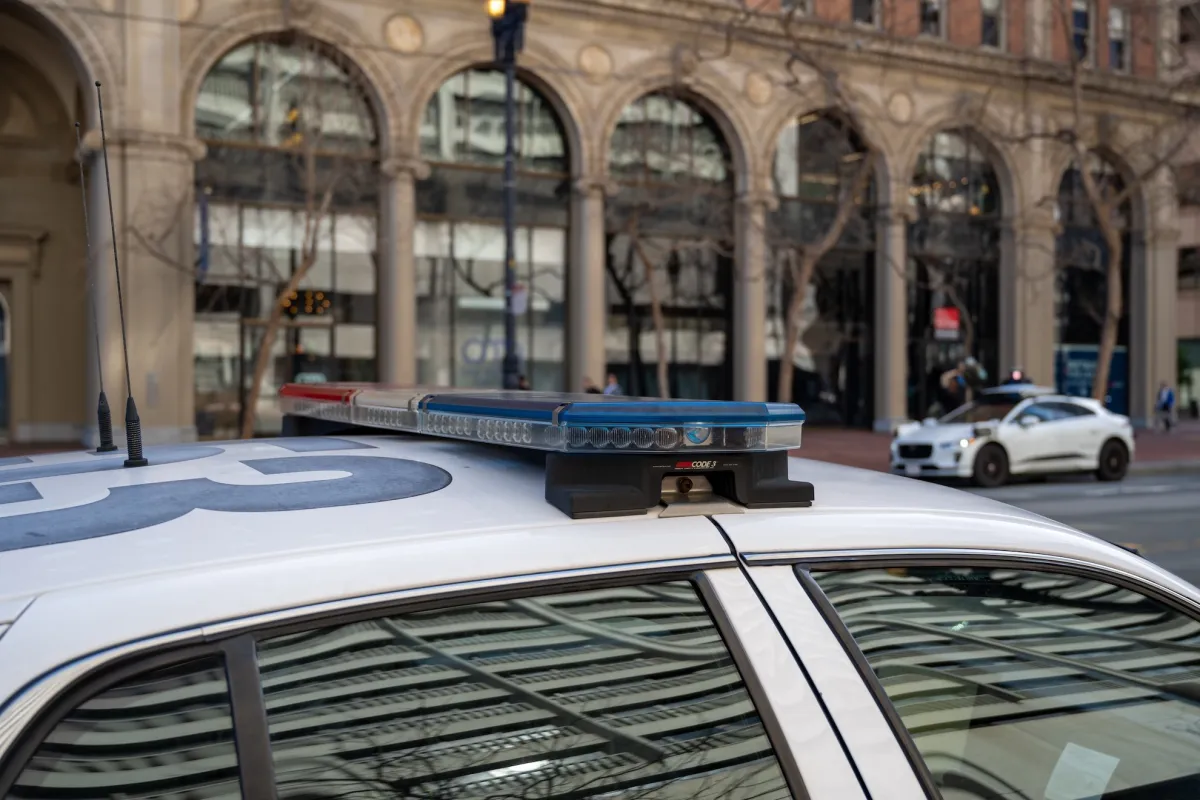
In August of last year, a blaze swept across 10 acres of grassland flanking California’s I-280, close to Redwood City. Congestion formed as emergency services doused the fire, prompting California Highway Patrol (CHP) officers to instruct motorists to reverse course and use the wrong lane to depart the freeway.
Among those motorists, several faced an unforeseen impediment: a Waymo autonomous taxi.
Video evidence from the occurrence reveals the Waymo AV attempted to bypass stalled vehicles by using the emergency lane, only to ultimately back away from approaching wrong-way vehicles before coming to a complete halt.
The autonomous vehicle refused to move, regardless of endeavors from the company’s remote support crew. Consequently, Waymo opted to contact emergency services, a dependable solution, by dialing 911.
“The highway patrol redirected all traffic, but regrettably, our vehicle is incapable of reversing,” a Waymo remote support staff member conveyed to a local 911 dispatcher, according to a transcript secured by TechCrunch via a public records request. The staff member requested that officers at the location relocate the autonomous taxi and organize transit for the occupant inside.
Approximately 30 minutes after Waymo contacted emergency services, a California Highway Patrol (CHP) officer took control and steered the autonomous car to a commuter parking area adjacent to the thoroughfare, as indicated by a CHP incident report secured by TechCrunch. Subsequently, it was transported away by one of Waymo’s “on-site support” personnel, the company stated to TechCrunch.
This Redwood City event might be regarded as an unusual circumstance, an unavoidable yet somewhat mortifying minor setback within Waymo’s swiftly growing autonomous taxi fleet operation.
Techcrunch event
San Francisco, CA
|
October 13-15, 2026
However, this was not a singular occurrence. Waymo has depended upon publicly funded emergency personnel to maneuver its vehicles when they come across difficulties, notwithstanding the existence of the firm’s dedicated on-site support crew. In a minimum of six cases uncovered by TechCrunch, emergency responders have had to assume command of Waymo vehicles and displace them from roadways during critical circumstances, including one wherein a policeman was amidst addressing a violent incident.
Lately, Waymo has faced scrutiny from legislators for its deployment of offsite support staff, comprising several dozen individuals operating from the Philippines, to aid its autonomous taxis in determining the optimal route through intricate scenarios. Its on-site support crew, however, has garnered significantly less focus.
The firm’s spokespersons did not allude to the on-site support personnel at a contentious March 2 session in San Francisco concerning the conduct of Waymo’s autonomous taxis, which became immobilized during an extensive electricity disruption in December. At the gathering, municipal authorities expressed worries that the stranded autonomous vehicles hindered or diverted emergency personnel from their main duties.
“The emerging trend is that our police officers and emergency personnel are compelled to manually relocate [Waymos],” Mary Ellen Carroll, executive head of San Francisco’s Emergency Services Department, stated at the hearing. “Essentially, they are acting as the primary on-site support for these cars, a situation we deem unsustainable.”
Waymo informed TechCrunch that its on-site support staff removed numerous immobilized autonomous taxis during the power failure, though only a few still required relocation by emergency personnel.
“Waymo On-Site Support is a committed group of experts who provide supplementary on-site support to our vehicle collection,” the company conveyed in an electronic message to TechCrunch. “Waymo’s benchmarks for on-site response and service excellence emphasize reducing potential adverse effects on the community.”
The firm refused to respond to queries from TechCrunch regarding the number of on-site support personnel it employs or what external firms might engage them. Additionally, Waymo remained silent on how it intends to expand the crew as it expedites its rollout in approximately two dozen more urban centers this period, extending beyond its present operational zones of Atlanta, Austin, Los Angeles, Dallas, Houston, Miami, Orlando, Phoenix, San Antonio, and the San Francisco Bay Area.
Waymo’s Support Personnel
Waymo’s autonomous taxis furnish over 400,000 compensated journeys weekly, serving as evidence of the firm’s extensive period innovating self-piloting technology. Nevertheless, these autonomous taxis do depend on human assistance at times, achieving this through multiple methods.
Autonomous taxis require intermittent direction in intricate scenarios, particularly since — as the firm asserts — the company is endeavoring to exercise utmost prudence as it expands its operations.
Waymo’s autonomous taxis obtain this direction from offsite support personnel. At any specific moment, approximately 70 individuals are overseeing Waymo’s collection of close to 3,000 cars, the firm has indicated. One half of these workers are situated in the United States, while the other half are located in the Philippines.
These particulars, conveyed in a correspondence to lawmakers in February, provoked criticism for Waymo regarding worries about protection and privacy. Waymo has asserted its justification for the deployment of offsite assistants, stating that the personnel are highly competent and that there is an absence of significant delay attributable to their geographical distance, regardless of their placement in Arizona, Michigan, or the Philippines.
“Our car-to-remote assistant link is also as swift as a flash. The average single-direction delay is roughly 150 milliseconds for operations hubs located in the U.S. and 250 milliseconds for remote assistants situated overseas,” the company recently penned.
Offsite support personnel undertake several duties. Should a Waymo car meet a real-life scenario challenging to traverse, it could dispatch a query to these personnel to assist in determining the optimal route. Waymo explicitly states that these individuals “offer counsel and aid to the [autonomous taxis] but do not directly govern, guide, or operate the vehicle.” Furthermore, they address less urgent inquiries from Waymo autonomous taxis, such as confirming whether the vehicle’s cabin is tidy.
However, this process is not perfect.
The National Transportation Safety Board (NTSB) lately disclosed that, in January, a Waymo autonomous vehicle in Austin requested an offsite support employee to verify if an adjacent school conveyance was embarking or disembarking youngsters. The halt sign and warning lights were activated, but the offsite support worker erroneously instructed the autonomous taxi to advance. The Waymo subsequently proceeded past the school conveyance while it was receiving children, despite the bus’s “stop indicators” remaining deployed, the NTSB reported.
Waymo informed TechCrunch that it “routinely reviews remote assistant responses, encompassing
accuracy. Should an event be recorded, it will be promptly marked for subsequent actions, spanning from supplementary instruction to total disqualification.”
If a Waymo is involved in a collision, or becomes immobilized during a crisis, the firm relies on its “Incident Management Crew.” Waymo states this team is “solely located within the U.S.” — despite operating remotely — and that they are “qualified for more challenging assignments like liaising with first aid personnel and overseeing post-accident procedures.”
According to that description, the distant support operative who aided CHP in relocating the Waymo autonomous vehicle from the Redwood City occurrence was probably a member of that incident management squad, despite Waymo withholding confirmation.
Developmental challenges also exist here. Sound files from CHP communications, coupled with the occurrence log acquired by TechCrunch, indicate that officials believed for approximately ten minutes that Waymo desired the occupant to operate the autonomous vehicle away from the blaze.
Only after the off-site assistant telephoned 911 again did CHP understand that a law enforcement official had to operate it away from the location. (Waymo refused to respond to particular inquiries about this misunderstanding. The company stated it doesn’t ever instruct occupants to operate its vehicles.)

Subsequently, we have the breakdown support crew. These operatives manage “immediate, face-to-face engagement” tasks and are frequently assigned the duty of relocating a vehicle. Waymo chose not to address queries concerning the frequency with which these operatives have shifted an autonomous taxi, the number available for deployment at any moment, or the count present in every urban area.
A portion appear to be employed by Transdev, an external service provider that Waymo has previously engaged, and some had even served as security operators or observers for Waymo, based on professional data found on LinkedIn.
The firm further informed TechCrunch that it “mandate[s] indigenous towing collaborators to uphold swift readiness for pressing towing demands and deliberately situate assistance throughout our operational zones.”
“Should it occur that a Waymo vehicle requires aid, we deploy Waymo Breakdown Support and/or indigenous towing collaborators to provide on-site help,” the firm declared in a communiqué. “Although we do not anticipate initial responders to relocate our automobiles as a routine matter, we acknowledge that time is critical during urgent circumstances. Consequently, we devised a simple procedure that enables initial responders to assume command of the vehicle in mere moments.”
Depending on initial aid personnel
Although Waymo asserts it doesn’t anticipate initial responders engaging with its automobiles, it persistently occurs — and its complete preventability remains uncertain.
In no fewer than half a dozen instances during the recent several months, initial aid personnel have been obliged to physically guide Waymo automobiles, encompassing two ongoing incident sites.
Previously in the current month, an Austin law enforcement official was compelled to shift a Waymo clear of an emergency vehicle that was attending a large-scale firearm incident. In February, an initial aid worker in Atlanta was required to deactivate a Waymo subsequent to its entry into an ongoing criminal location, prior to one of the firm’s breakdown support operatives “recovering it,” as stated by the enterprise. And in the current week, a Nashville law enforcement officer was forced to physically operate a Waymo autonomous taxi away subsequent to it becoming immobilized at a crossroads.
At the March 2nd session in San Francisco, municipal authorities consistently inquired what measures Waymo would take to reduce reliance on initial aid personnel. Waymo failed to state it employs personnel who are specifically assigned to relocating automobiles throughout the three-hour assembly.
Area overseer Bilal Mahmood, who presided over the session, informed TechCrunch during an interview that he believed Waymo failed to offer numerous adequate responses.
“My inquiry was: what steps will you take to assume greater responsibility to guarantee our initial aid personnel are not performing that task?” he stated. “And we did not obtain the desired response during the session, specifically: what actions will they undertake to guarantee they assume greater command of that breakdown support aspect?”
A director within Waymo’s incident management crew, Sam Cooper, declared during the session that the firm has instructed “over 30,000 initial aid personnel worldwide on how to engage” with its autonomous taxis. He additionally praised Waymo’s cooperation with initial aid personnel in formulating the mechanism that enables them to assume command.
“Our sole aim is to provide them the capacity, in such an occurrence, to suitably relocate that automobile from the site and render that location secure, allowing them to carry out their duties,” he stated.
Cooper stated Waymo has implemented “enhancements to our rapid deployment capacities” ensuring Waymo would be more adequately equipped for more extensive crisis scenarios. However, he did not elaborate on those enhancements, and Mahmood informed TechCrunch his department has not obtained the committed subsequent information.
Cooper further mentioned Waymo would contemplate utilizing collaborations such as its existing arrangement with DoorDash, wherein temporary workers secure autonomous taxi doors that remained ajar, for relocating automobiles.
The distinction between that and Waymo’s current breakdown support personnel remains ambiguous. But municipal authorities persistently reiterated the identical statement. “Our initial aid personnel must not serve as roadside recovery,” area overseer Alan Wong declared.
{content}
Source:{feed_title}