
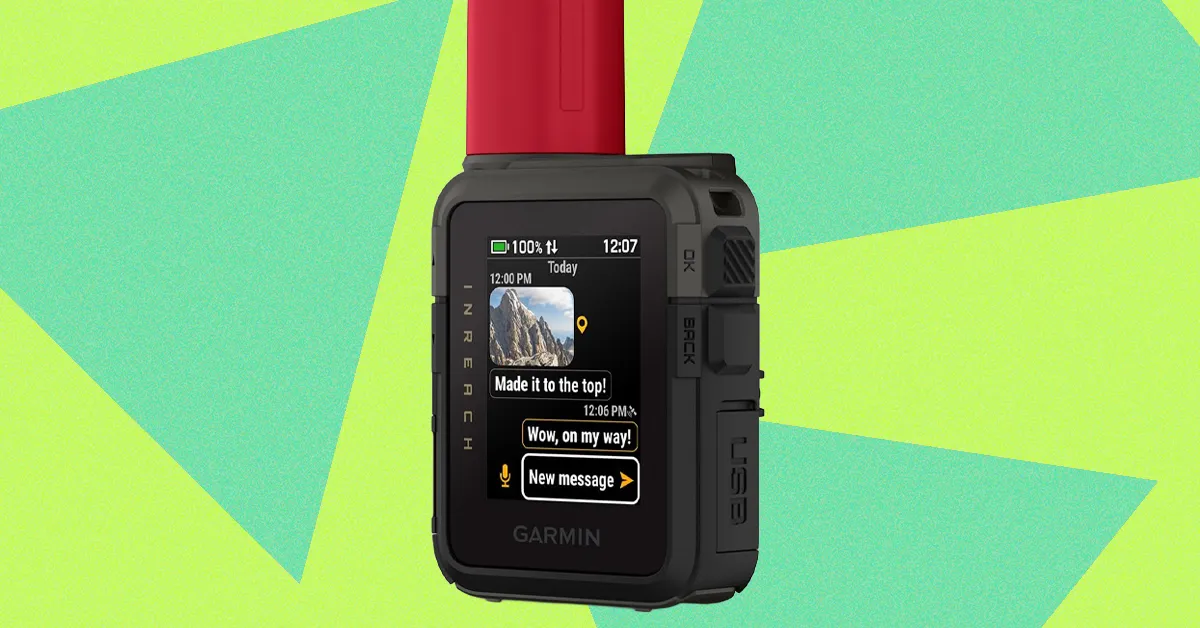
The navigational charts on the inReach proved mostly ineffective. Offline maps available on the Garmin Fenix 8 Pro and the Garmin Forerunner 970 offer greater granularity. Additionally, there are no impending directional alerts, unlike those provided by the Fenix; merely a warning appears if you deviate 50 meters from the path. Eventually, I ceased tracking my journey on the inReach Mini 3 Plus.
Aside from its real-time monitoring and distress signal functions, the inReach’s most invaluable feature is unequivocally its satellite communication capability. Incorporating voice functionality represents a significant advancement. Composing messages directly on the touchscreen proves exceptionally cumbersome. Consequently, for communications beyond the predefined and personalized rapid messages, it’s immeasurably simpler to capture a brief 30-second audio clip. As another option, you can leverage the Garmin Messenger application on your mobile device to compose extended communications and transmit them wirelessly via Bluetooth to the inReach for onward satellite transmission. I deemed this remarkably convenient for more extensive dispatches.
Audio communications are also beneficially converted to text for the intended parties within Garmin Messenger, and similarly, the responses returned to you on the inReach Mini 3 Plus. Furthermore, capturing an image with your phone and dispatching it through Messenger is quite simple, despite the fact that transmitting even a basic text message and accompanying photo could occasionally consume up to 10 minutes via satellite. Prompt delivery is not its forte.
Endurance Capacity
Regarding its power autonomy, the Garmin inReach Mini 3 Plus advertises 55 hours of operation when employing high-performance messaging with bi-minute location refreshes. This extends to a maximum of 350 hours under low-energy messaging with ten-minute position logging intervals. During evaluation, I configured the position logging to ten-minute intervals and the display at 75 percent luminosity with a 15-second dormancy period. I engaged the messaging in its optimal performance setting and the GPS on an all-systems multi-frequency configuration. Additionally, I kept the navigational functions active and engaged in a reasonable volume of communication.
My 80-mile expedition spanned a cumulative 51 hours, during which I kept the inReach powered on overnight. Departing Florence with 97 percent charge, I reached Bologna with 29 percent of the battery capacity left, following a combined 21.5 hours of real-time monitoring and directional guidance. The power consumption during the nocturnal period proved unexpectedly substantial, however, one can clearly conserve energy by activating the automatic power-down feature, or simply deactivating the gadget. Furthermore, its recharging speed is quite rapid; I replenished the power cell completely in just over sixty minutes.
In summary, the Garmin inReach Mini 3 Plus stands as a superb satellite communication device. It is sturdily constructed, user-friendly, and sufficiently rugged and diminutive for extended expeditions. It also incorporates a collection of security and communication utilities that instill considerable reassurance.
Nevertheless, considering the acquisition cost, initiation charge, and ongoing subscription, it represents a significant financial commitment. The inReach Mini 3 Plus justifies its elevated cost compared to the Mini 2, yet its value is likely realized only by those who frequently venture beyond cellular service range. Conversely, the pairing of your mobile phone with a capable sports timepiece providing real-time location updates might provide all the necessary contingency you require.
{content}
Source:{feed_title}