
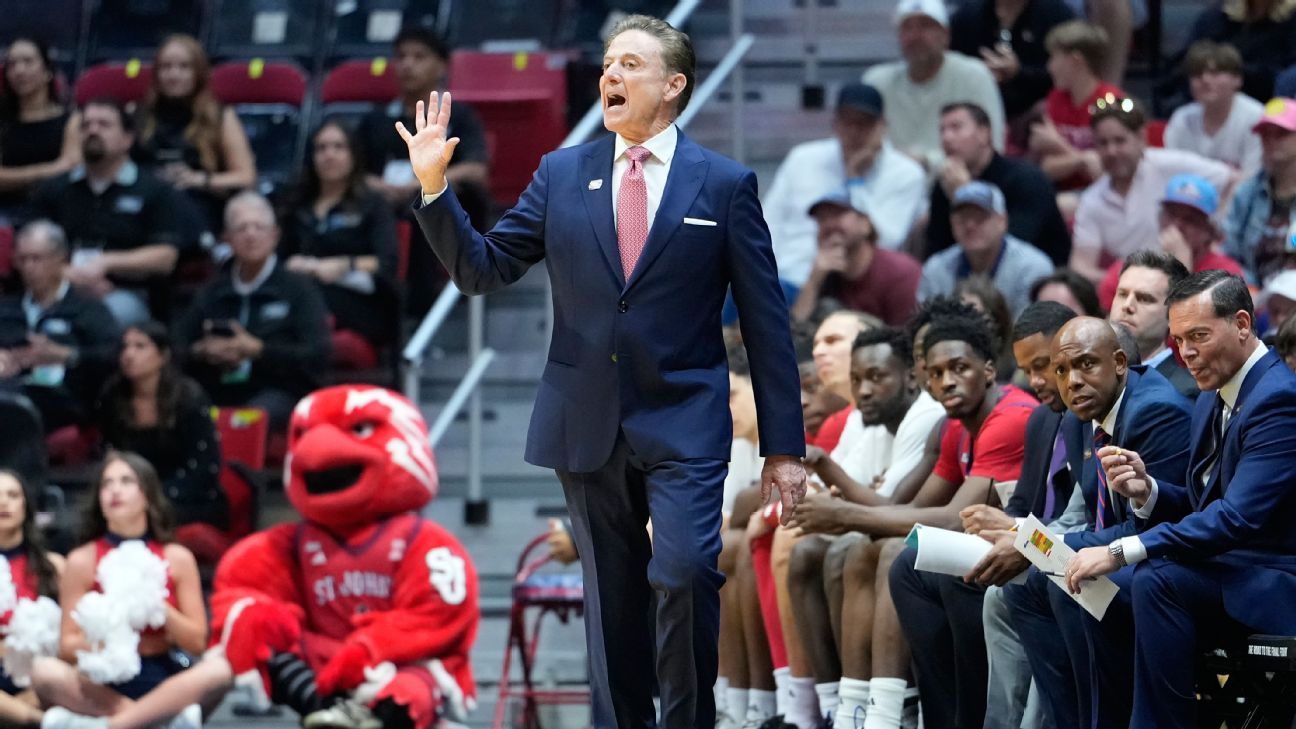
The St. John’s squad struggles with its shooting ability.
Nationally, the Red Storm rank 182nd in field goal accuracy (45.2%) and 225th for shots beyond the arc (33.2%).
Nevertheless, this appears inconsequential. Rick Pitino’s group (30-6) has demonstrated opportunism, physicality, and courage on its path to the Sweet 16, where a matchup against Duke awaits on Friday.
This brings to mind Pitino’s Louisville team from the 2012-13 season, which, despite a mere 33.3% success rate from long range (ranking 216th nationwide), still clinched the national championship. However, it contrasts sharply with his Cinderella Providence squad of 1987, which advanced to the Final Four largely due to his then-groundbreaking strategy of emphasizing the recently introduced three-point shot. That Friars team converted 42.2% of their attempts.
Pitino possesses the knack for winning in various styles, whether conventional or unconventional; his journey spans from Kentucky’s golden era to his career resurgence at Iona College.
Seasons pass, and rosters transform. The athletes, game approach, regulations, team composition, and even the tailoring of his impeccably fitted suits evolve.
Yet, a singular element persists.
Pitino triumphs.
The argument for Rick Pitino being college basketball’s all-time greatest coach requires some intricate reasoning, though its validity strengthens annually. The 73-year-old mentor’s coaching debut occurred five decades ago, in 1976, when he served as an interim at Hawai’i. Presently, he seems more proficient than at any prior point.
Pitino’s record of 915 wins, a .743 winning ratio, and a pair of national championships will not, by sheer numbers, rival Mike Krzyzewski’s 1,202 victories, Adolph Rupp’s .822 success rate, or John Wooden’s ten titles.
This is partly attributable to his choices — Pitino dedicated eight seasons to the NBA, six of which were spent as a head coach in New York and Boston. Additionally, he was involved in several NCAA and private controversies that rendered him a transient outcast and, for some, irrevocably damaged his standing.
His professional inheritance will forever be associated with controversy. That Louisville national championship, along with 123 wins, was “nullified” by the NCAA following its inquiry into claims that a team employee furnished escorts for athletes and prospective players at campus gatherings. Furthermore, the athletic program found itself embroiled in a federal fraud and corruption lawsuit concerning Adidas.
For a period, he endured a professional banishment to Greece, where he guided a professional team for two seasons, also securing a couple of championships there.
Beyond the court’s boundaries, Pitino presents one persona. Within those lines, however, a distinct narrative unfolds. If he had merely remained at Kentucky in 1997 instead of transitioning to the Celtics — and managed his affairs properly (a potential improbability) — his career statistics would be incalculable. Kentucky, after all, was thriving, capturing another national championship under Tubby Smith the season immediately following Pitino’s departure.
Nevertheless, he has consistently moved between teams, revitalizing six struggling programs (Boston University, Providence, Kentucky, Louisville, Iona, and St. John’s). The season prior to his tenure, these teams collectively held a record of 76-105 (.419).
Regardless.
He guided five of these programs back to the NCAA tournament within two seasons (or, in Kentucky’s specific case, upon the conclusion of their tournament prohibition). At Boston University, the process spanned four years.
This observation is not intended to disparage other esteemed coaches who established national powerhouses and maintained their positions. Sustaining a dominant force is no easy feat and warrants recognition. Nonetheless, Pitino has demonstrated that he, rather than the organization, was the catalyst for change.
While Pitino has certainly had gifted athletes (particularly among the 1996 Kentucky national champions), he has mentored only three future NBA All-Stars: Donovan Mitchell, Jamal Mashburn, and Antoine Walker.
While this record doesn’t quite match the remarkable achievement of Bob Knight, who amassed 902 victories and three championships with only one future NBA All-Star (Isiah Thomas), neither does it represent the procession of future Hall of Famers seen under Dean Smith (UNC), Krzyzewski (Duke), or Wooden (UCLA).
Pitino, a past point guard from New York, is profoundly dedicated to basketball. He continues to lead individualized skill-building sessions. He persists in meticulously analyzing game recordings. He consistently discovers methods to optimize his resources — at times employing a full-court press, at other times utilizing the familiar 2-3 zone defense he adopted while assisting Jim Boeheim.
He maintains his communication style, blunt yet sincere, which, for instance, not only enables current guard Dylan Darling to assertively demand the ball in the final moments of Sunday’s triumph against Kansas but also permits Pitino to confidently rely on “Church Bells” — a moniker originating from Pitino’s portrayal of Darling’s, well, audacity — to execute the play, even using his non-dominant hand.
Pitino’s professional journey has spanned several epochs; encompassing not only distinct playing styles (he coached before the shot clock and three-point line existed) but also differing compensation models. As an assistant coach at Hawai’i during the mid-1970s, the NCAA penalized him for providing athletes with McDonald’s vouchers. Presently, they have the opportunity to possess an entire franchise.
A portion of his most exemplary coaching has occurred in recent times.
He emerged from his Greek exile to guide the lower-tier Iona program to two NCAA appearances within three campaigns. At seventy years old, he assumed leadership of St. John’s, securing successive Big East regular-season and tournament championships. Currently, the Red Storm have reached the Sweet 16 for the inaugural time this century.
The athletes continue to heed instructions. They persist in their defensive efforts. They maintain their vigorous exertion. They retain their conviction.
They continue to achieve victory, despite their less-than-stellar shooting proficiency.
Such is the essence of a true college basketball mentor, arguably the finest ever to grace the sport.