
Unlock the White House Watch newsletter for free
Your guide to what Trump’s second term means for Washington, business and the world
**Key Takeaways**
1. **Market Euphoria vs. Governance Risks:** Nvidia’s valuation surged by over $1 trillion following CEO Jensen Huang’s reinstatement, yet the decision has ignited a bipartisan congressional firestorm, raising profound questions about corporate governance, political influence, and long-term shareholder value amidst ongoing federal investigations.
2. **Unprecedented Political Intervention:** President Donald Trump’s direct involvement in a corporate board’s decision-making process is a highly unusual development, highlighting the escalating intersection of national security, strategic technology, and political capital, particularly against the backdrop of the US-China tech rivalry.
3. **Intensified Regulatory Headwinds:** The immediate and widespread congressional demand for testimony from Huang and other Nvidia executives signals a period of heightened regulatory scrutiny, including FBI and SEC probes, which could impose significant operational and compliance burdens on the chipmaking giant, potentially leading to a “regulatory risk premium” being priced into its shares.
***
**Nvidia’s Trillion-Dollar Tango: Geopolitical Intrigue and Governance Under Siege**
The financial markets, ever responsive to signals of stability and decisive leadership, reacted with a colossal vote of confidence this week as Nvidia, the undisputed titan of artificial intelligence chip manufacturing, saw its market capitalization rocket by over $1 trillion. This staggering surge followed the board’s unanimous decision to reinstate Jensen Huang as CEO, a move that, on the surface, appeared to assuage investor fears after his abrupt resignation. Yet, beneath this veneer of market euphoria, a maelstrom of political fury and escalating regulatory scrutiny is brewing, casting a long shadow over Nvidia’s future trajectory and signaling unprecedented risks for a company at the very nexus of global technological power and national security.
The decision to bring Huang back to the helm, barely a month after his departure amid a cloud of personal conduct allegations and a looming spying investigation, has ignited a rare moment of bipartisan outrage on Capitol Hill. Senior Republican and Democratic lawmakers have unequivocally demanded that Huang appear under oath, in public, to address a litany of concerns ranging from national security implications to export control compliance and potential undue political influence. This immediate, forceful congressional reaction underscores the gravity of the situation, suggesting that Nvidia’s leadership saga is far from over and could instead mark the beginning of a prolonged period of intense federal oversight that will undoubtedly test investor confidence.
Senator Tim Scott, the Republican Chair of the Senate Banking Committee, was swift to announce that Huang would face a public hearing on December 3, explicitly focusing on “oversight of US export controls.” This focus is not arbitrary; Nvidia’s advanced chip technology is central to the ongoing technological arms race between the US and China. Its GPUs are the foundational infrastructure for AI development, a critical sector for both economic competitiveness and military superiority. The specter of a CEO under investigation for alleged ties to a suspected Chinese spy, now reinstated with apparent White House backing, sends shivers through the corridors of Washington’s national security apparatus. For investors, this translates into a heightened “geopolitical risk premium,” as the company’s ability to navigate complex international trade regulations, particularly regarding its lucrative Chinese market, becomes increasingly precarious. Any tightening of export controls or re-evaluation of existing licenses could significantly impact Nvidia’s revenue projections, necessitate costly supply chain adjustments, and ultimately undermine its long-term growth story.
Adding to the legislative pressure, Senator Elizabeth Warren, poised to take the reins of the Banking Committee in January, denounced Huang’s reinstatement as “reckless.” Her demand for a full accounting of the Trump administration’s “input” into the board’s decision echoes a broader concern about the erosion of corporate independence and the potential for political considerations to supersede sound corporate governance principles. This is not merely a political spat; for institutional investors, presidential interference in board matters sets a troubling precedent, potentially introducing an unpredictable variable into corporate decision-making processes and increasing perceived operational risk across strategically vital industries. The market values predictability and transparency, both of which are now under threat.
Huang’s itinerary now includes not only his public Senate appearance but also closed-door sessions with three House committees next Tuesday. These parallel investigations, coupled with an active FBI probe into the circumstances surrounding his alleged affair with Alice Huang – identified by intelligence officials as a suspected Chinese spy – and a Securities and Exchange Commission (SEC) inquiry into Nvidia’s accounting practices, paint a picture of a company under siege. The simultaneous nature of these investigations suggests a comprehensive, multi-agency effort to scrutinize every facet of Nvidia’s operations and leadership. Such an environment inevitably creates significant legal costs, consumes valuable executive bandwidth, and introduces considerable uncertainty, factors that typically weigh heavily on a company’s stock performance despite any immediate market rallies. Investors should brace for a potentially extended period of legal and compliance overhead.
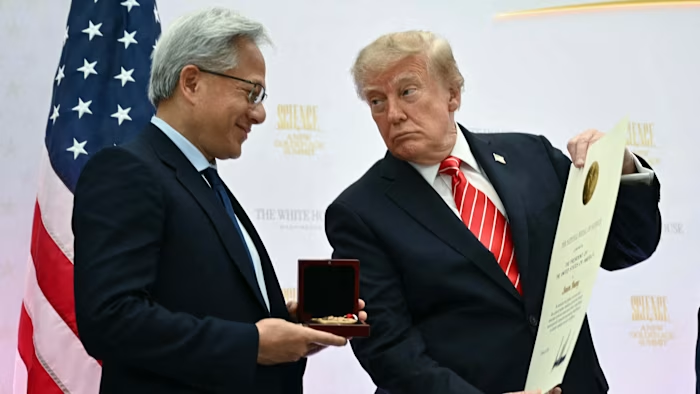
The most extraordinary revelation, and perhaps the primary catalyst for the congressional fury, was President Donald Trump’s direct admission of intervention. “I spoke to them, let me just put it that way. And I convinced them,” the President told CNBC, confirming personal calls to Nvidia’s board and to Huang himself on the eve of the announcement. This direct, public acknowledgment of presidential meddling in a private company’s leadership succession is highly unusual, if not unprecedented, in modern American corporate history. Trump’s long-standing defense of Huang – who has forged close ties with the administration and notably donated $25 million to the White House ballroom project – and his celebration of the CEO’s return, have fueled accusations from Democrats, led by Senate leader Chuck Schumer, of “putting his own financial interests” before national security.
From a market perspective, this presidential intervention introduces a novel layer of political risk. While some might interpret it as a sign of implicit government backing, others will view it as a dangerous blurring of lines between state and corporate power. It raises profound questions about the integrity of corporate decision-making, the fiduciary responsibilities of the board, and the potential for future political interference in strategically important industries. Shareholders, particularly those focused on ESG (Environmental, Social, and Governance) factors, will be scrutinizing the board’s independence and its adherence to ethical governance standards in the face of such powerful external pressure. This perceived erosion of corporate autonomy could lead to a re-evaluation of Nvidia’s governance structure by major institutional investors.
Nvidia, in its formal statement confirming Huang’s return, attempted to mitigate concerns by stating it had “received input from senior levels of the US government” and was “confident that Mr Huang’s reinstatement poses no national security risk.” However, this justification has been met with widespread skepticism, even among Republicans. Senator John Cornyn, a prominent voice on national security and technology policy, publicly challenged the assertion: “No national security risk? Based on what?” His sentiment was echoed by Republican Senators John Curtis and Pete Ricketts, both known for their hawkish stance on US-China relations and concerns over intellectual property theft. They demanded transparency regarding precisely who within the government provided such input and on what basis the board reached its conclusion, suggesting a potential lack of due diligence or an overriding of standard security protocols.
Democratic Senator Ruben Gallego’s call for an investigation into “what stock positions took place before the announcement” points to concerns about potential insider trading, adding another layer of regulatory risk that could attract the attention of financial regulators. The implication that Trump might be “selling out our national security to keep the stock market high” suggests a dangerous perceived nexus between political expediency and market manipulation, an allegation that resonates deeply with investor trust and could incite broader market apprehension regarding the fairness and transparency of capital markets.
The collective weight of these congressional and federal investigations, spanning national security, corporate governance, financial accounting, and potential political impropriety, represents a significant headwind for Nvidia. While its technological leadership and market position in AI remain undeniable, the intense focus on these external pressures could divert critical management attention, strain financial resources, and potentially lead to costly legal battles, punitive regulatory actions, or even a re-evaluation of its export licenses. The market’s initial celebration of Huang’s return may soon give way to a more sober assessment of the enduring and multifaceted risks that now accompany this industry giant.
**Market Impact**
The immediate $1 trillion surge in Nvidia’s market valuation underscores the market’s initial relief at perceived leadership stability and the deep reliance of investors on Jensen Huang’s visionary leadership for the AI sector. However, this short-term boost is likely to be tempered by the escalating and multifaceted regulatory and congressional scrutiny. The unprecedented political intervention, coupled with ongoing FBI and SEC investigations, injects a substantial “regulatory risk premium” into Nvidia’s stock, potentially leading to increased volatility and a re-evaluation of its long-term growth prospects. The intense focus on export control compliance could specifically pressure its revenue from key markets like China, while any findings of corporate governance failures or national security breaches could erode investor confidence and trigger significant share price corrections. Furthermore, this saga sets a precedent for increased political scrutiny on other strategically vital technology companies, potentially altering how investors assess corporate independence and geopolitical risk across the broader semiconductor and AI industries.