
FOX Business’ Grady Trimble reports live from Chicago O’Hare on jet fuel prices, which jumped 10% from Tuesday to Wednesday.
Turbulence Ahead: East Coast Storms, Soaring Fuel Costs Rock Airline Sector
Key Takeaways:
- Operational Strain & Revenue Hit:Over 7,000 flight disruptions (2,000+ cancellations, 5,000+ delays) across the critical Northeast corridor will translate directly into lost revenue, increased operational costs from re-routing and passenger compensation, and a potential hit to Q3 earnings for major carriers.
- Escalating Fuel Prices Compound Pressure:A reported 10% surge in jet fuel prices from Tuesday to Wednesday, as highlighted by Fox Business, adds a significant layer of financial stress. Fuel is a top operating expense for airlines, and such volatility directly erodes profit margins, potentially leading to upward pressure on ticket prices for consumers.
- Investor Sentiment & Stock Volatility:The dual impact of weather-related operational chaos and rising input costs is likely to weigh on investor sentiment, causing short-term volatility in airline stock prices (UAL, JBLU, AAL) as the market assesses the immediate and lingering financial consequences.
NEW YORK – The already complex operational landscape for U.S. airlines has been thrown into disarray this week, as severe thunderstorms swept across the East Coast, causing widespread flight disruptions that threaten to clip the wings of a recovering sector. More than 7,000 flights were affected on Tuesday alone, with over 2,000 cancellations and 5,000 delays, according to FlightAware data, creating a ripple effect across the nation’s busiest air corridors and sparking concerns among investors about the industry’s profitability outlook.
The operational chaos, centered around critical hubs in the New York City area, Boston, Philadelphia, and Washington, D.C., comes at a particularly sensitive time for airlines. Following a robust post-pandemic travel rebound, carriers are navigating high demand coupled with persistent staffing challenges and an ever-present struggle against rising input costs. The Federal Aviation Administration (FAA) issued ground stops for at least eight major U.S. airports, including Baltimore/Washington (BWI), Boston Logan (BOS), Newark Liberty (EWR), LaGuardia (LGA), and Philadelphia (PHL), effectively paralyzing air traffic in a region vital for both business and leisure travel.
Beyond the immediate logistical nightmare for passengers, the financial implications for airlines are substantial. Each canceled flight represents not only lost revenue but also incurs additional costs related to rebooking, accommodating stranded passengers, and repositioning aircraft and crews. These expenses, often categorized as irregular operations (IROPS) costs, can quickly accumulate, eating into an airline’s already tight profit margins. For instance, in the New York City metropolitan area alone, nearly 600 departing flights were canceled and over 500 delayed, indicating a significant hit to revenue for airlines with strong presences in these markets, such as JetBlue (JBLU) and United Airlines (UAL).
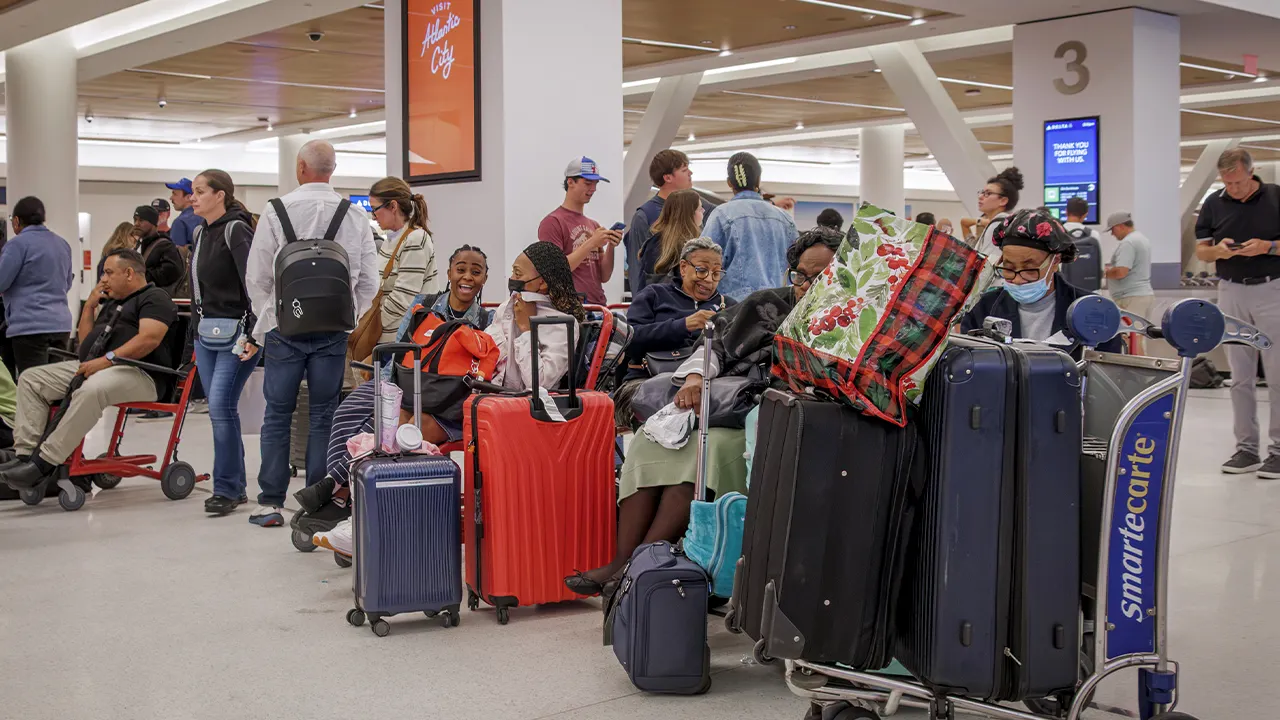
Delta Air Lines passengers wait to retrieve luggage after flight cancellations at La Guardia Airport July 18, 2023. (Erik McGregor/LightRocket / Getty Images)
Adding a formidable headwind to these operational woes is a reported sharp increase in jet fuel prices. Fox Business reported a staggering 10% jump in jet fuel costs from Tuesday to Wednesday. Fuel typically accounts for 25-30% of an airline’s total operating expenses, making it an incredibly sensitive component of their financial health. Such a sudden and significant spike, even if temporary, will immediately pressure profit forecasts, particularly for carriers that haven’t fully hedged their fuel exposure or cannot quickly pass on these costs through higher ticket prices without impacting demand. This surge is likely tied to broader volatility in global energy markets, often influenced by geopolitical events, supply chain issues, or even sudden spikes in demand.
Major carriers like United Airlines, JetBlue, and American Airlines (AAL) have quickly moved to issue travel advisories and offer flexible rebooking options, including waiving change fees and fare differences for affected customers. While these measures are crucial for customer goodwill and operational recovery, they also represent additional financial concessions. For example, United’s policy allowing rebooking between July 20-23, 2023, and JetBlue’s offer for rebooking through Sunday or full refunds, absorb potential revenue and add to the cost burden.
The listed stock performance for these carriers reflects the market’s immediate, albeit complex, reaction. United Airlines Holdings Inc. (UAL) saw a slight uptick (+0.15%), while JetBlue Airways Corp. (JBLU) experienced a dip (-1.83%), and American Airlines Group Inc. (AAL) gained modestly (+0.92%). This mixed bag suggests investors are weighing various factors: the specific exposure of each airline to the affected regions, their financial resilience, and broader market sentiment that might be momentarily overriding sector-specific bad news. However, sustained operational disruptions and upward fuel price trends will undoubtedly pressure these valuations over the medium term.
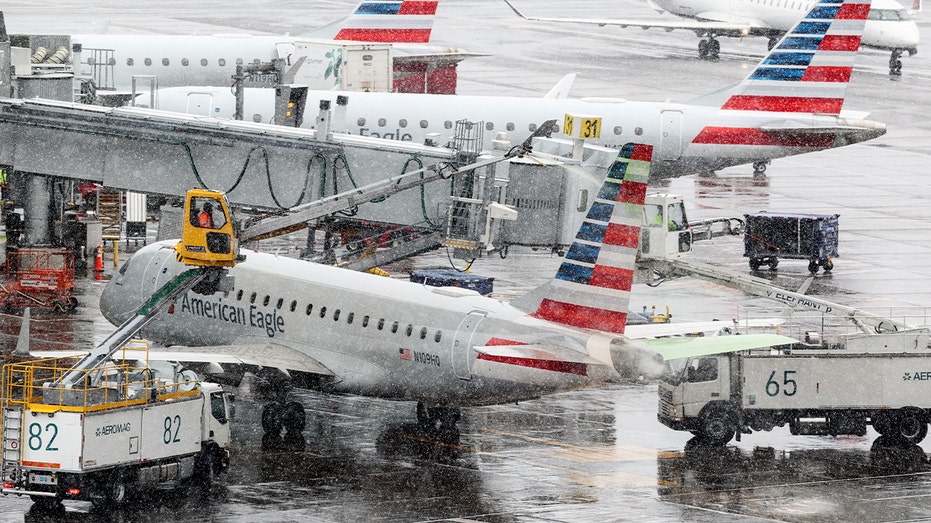
A passenger plane is stationed at a gate during severe weather at LaGuardia Airport in New York Feb. 22, 2023. (Charly Triballeau/AFP / Getty Images)
The cascading effects extend beyond the airlines themselves. The travel and tourism sector, including hotels, car rental agencies, and local businesses in affected cities, will feel the pinch of reduced visitor traffic. Business travelers missing critical meetings can lead to productivity losses. Furthermore, the reliability of air cargo, crucial for just-in-time supply chains, can also be compromised, leading to potential delays and increased shipping costs for businesses relying on air freight.
As the summer travel season progresses, this incident serves as a stark reminder of the airline industry’s vulnerability to external shocks, particularly severe weather events which are becoming more frequent and intense. The ability of airlines to effectively manage these disruptions, mitigate financial fallout, and maintain customer loyalty will be critical to their performance in the coming quarters. Investors will be closely watching Q3 earnings calls for insights into the true cost of these operational challenges and how carriers plan to adapt to an increasingly volatile operating environment.

People walk through the rain along 5th Avenue in Manhattan on June 22, 2023, in New York City. (Spencer Platt / Getty Images)
| Ticker | Security | Last | Change | Change % |
|---|---|---|---|---|
| UAL | UNITED AIRLINES HOLDINGS INC. | 117.70 | +0.18 | +0.15% |
| JBLU | JETBLUE AIRWAYS CORP. | 5.35 | -0.10 | -1.83% |
| AAL | AMERICAN AIRLINES GROUP INC. | 15.28 | +0.14 | +0.92% |
GET FOX BUSINESS ON THE GO BY CLICKING HERE
Market Impact:
The combination of extensive flight disruptions and a sharp rise in jet fuel prices presents a significant near-term headwind for the airline sector. Investor sentiment is likely to remain cautious, with potential for increased volatility in airline stocks as analysts adjust Q3 earnings expectations. While the direct impact on broader market indices might be limited given the sector’s relative size, the ripple effects on travel-dependent industries and consumer spending power could subtly influence economic indicators. Continued vigilance on energy prices and weather patterns will be critical for market participants tracking the airline industry’s trajectory through the peak travel season.