
Utilizing merely six rockets and eight drones, Hizbollah this week propelled Lebanon anew into a conflict fiercely resisted by the majority of the nation’s populace, even segments of the militant faction’s own supporters.
Since its entry into the skirmish involving Israel, the US, and Iran on Monday, the Lebanese organization has unleashed barrages of rockets and explosive-equipped drones towards northern Israel, provoking a formidable retaliation.
Scarcely had the rockets been launched when tens of thousands of Lebanese throughout the nation — already uprooted and beleaguered by over two years of clashes with Israel — evacuated regions probable to be in the firing zone, instigating a fresh humanitarian emergency the country is ill-equipped to handle.
For numerous external commentators, Hizbollah’s choice appeared imprudent, especially given Israel’s publicly declared intention to completely annihilate the organization. “Futile. Rash. Self-destructive,” remarked a western envoy.
The resolve to back its patron Tehran during its most dire period also contradicted a communication Hizbollah lately transmitted to Lebanon’s government, stating it would refrain from participating in such a confrontation.
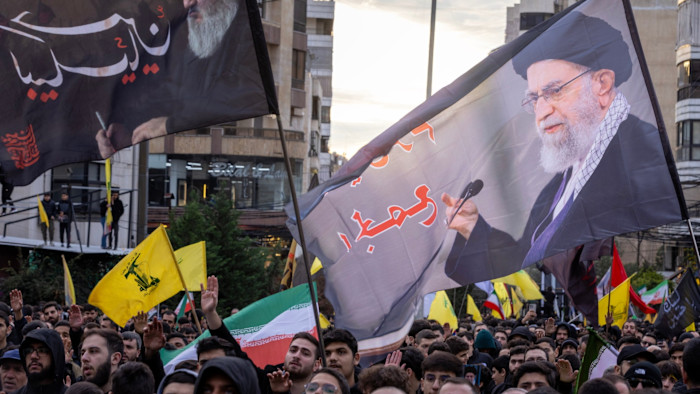
However, for specialists and individuals acquainted with the group’s mindset, it was far from perplexing, particularly as the Shia insurgent faction had consistently affirmed that the assassination of Iran’s supreme leader Ayatollah Ali Khamenei would constitute an “unacceptable boundary.”
“For Hizbollah, this represented an evident decision,” stated Mohanad Hage Ali from the Carnegie Middle East Center in Beirut. “This constitutes a fundamental struggle for its continued existence.
“Their non-participation, should Iran be debilitated or destroyed, would be equally self-destructive. Such a scenario would render them vulnerable to further Israeli actions and devoid of their Iranian supporter.”

Certain members within Hizbollah also harbor aspirations that it might eventually be incorporated into a regional truce, a development that could — in an optimal situation — halt Israeli aggressions against the group within Lebanon.
To date, this appears to be a remote possibility. Israel announced on Tuesday its initiation of ground incursions into Lebanon, aiming to establish “a protective zone,” sparking concerns that this might result in a lasting Israeli foothold within Lebanese land.
Subsequent to the comprehensive 2024 conflict, Israel has sustained its military personnel in no fewer than five locations across southern Lebanon.
Hizbollah has historically been regarded as Lebanon’s most formidable military and political entity, serving as the preeminent asset in Iran’s network of affiliated proxy forces throughout the area. Nevertheless, its power has diminished progressively since the organization began launching projectiles into Israel following Hamas’s October 7, 2023 assault, thereby instigating a conflict with Israel on its home ground.
That conflict devastated its command structure and significantly curtailed its capacities. Even with a US-mediated armistice that ostensibly concluded the comprehensive hostilities in 2024, Israel has persisted in targeting Hizbollah nearly every day, eliminating hundreds of its operatives and endeavoring to suppress any revival.
The 2023 resolution to attack Israel — enacted by seasoned leader Hassan Nasrallah, who was thereafter slain by Israel in 2024 — was primarily driven by a directive requiring joint intervention. Termed the “Unity of Fronts,” this doctrine stipulated that all confederates within Tehran’s alliance were obligated to act against Israel if any single constituent faced aggression.

Numerous individuals, both within and external to the group, now perceive that choice as a grievous strategic blunder. It rendered the organization chaotic and susceptible to internal and global pressures. Advisers from Iran’s Islamic Revolutionary Guard Corps promptly intervened to assist in its recovery.
However, the 2023 choice also introduced fresh leadership for the entity — presently led by Nasrallah’s less engaging second-in-command, Naim Qassem — and ignited intense internal discussions regarding its trajectory. A paramount inquiry: ought local priorities supersede a strategic and ideological allegiance to Iran?
For several months, observers and individuals acquainted with the group’s perspective have discussed internal divisions. One faction, believed to be headed by Qassem, has advocated for prioritizing national concerns with a view towards a political destiny.
The opposing side, comprising hardliners more ideologically devoted to Iran’s cross-border initiative, views the group’s destiny as intrinsically linked to the continued existence of the Iranian regime.
“They are aware that without Iran, their end is certain,” remarked one of the individuals. “They also recognize an obligation to fulfill — they came into being for Iran’s perseverance, and now is the moment to act decisively.”
Comparable discussions have afflicted other factions within Iran’s regional alliance, which likewise contend with the dilemma of relinquishing their own political and economic advantages. They are apprehensive of being perceived as prosecuting a conflict on behalf of Iran.
“These factions operate in a state of self-preservation,” stated Renad Mansour, a specialist on Iraqi paramilitary organizations at Chatham House.
Hizbollah, akin to Iraq’s Shia paramilitary units, found itself mediating opposing requirements, he explained: “Certain individuals within these factions understand that their authority stems from domestic contention, yet others obtain their influence through allegiance to Iran and Khamenei — consequently, they do not uniformly concur on the nature of persistence.”
Following the assassination of the Iranian leader, the genesis of the group’s potency and justification has gained even greater clarity. Khamenei served as a significant Hizbollah benefactor and guaranteed its abundant provisioning even as Iran’s economy severely declined.
“Naim Qassem derives his authority from his ideological representation of Khamenei. Supporters on the ground heed his directives grounded in that principle,” affirmed Hage Ali.

“Given that [Khamenei is] deceased, the current Iranian authorities might conclude that Hizbollah has lost its significance. This prompts inquiries into Naim Qassem’s principles and his capacity to maintain authority without financial backing, personal magnetism, or doctrinal validity.”
Accounts from Lebanese news outlets indicated that certain staunch factions initiated the assault on Israel without seeking counsel from Qassem, thereby compelling his involvement.
In June 2025, following Israel’s assault on Iran, Tehran directed its allied groups in the region, including Hizbollah and Iraq’s militias, to refrain from participation, as per sources privy to that choice. Hizbollah consequently abstained from that confrontation.
No evidence suggests they were instructed to desist on this occasion. A source privy to the organization’s mindset intimated that Hizbollah’s engagement might have been prompted by Iran.
“Irrespective of the process by which the determination occurred, they did not refuse,” Hage Ali stated.
The choice has not only elicited a severe reaction from Israel but also empowered Lebanon’s government to prohibit Hizbollah’s operations, notwithstanding its apprehension of inciting internal conflict.
Hizbollah’s enduring confederate, Nabih Berri, the veteran head of Lebanon’s parliament, endorsed the decision. He allegedly sanctioned the administration’s steps, reportedly incensed by Hizbollah’s reversal on its pledges that they would not engage in the conflict.
However, the organization has intensified its efforts. In less than two days, it proceeded to unleash 14 barrages, thereby challenging certain assessments that its combat strength had been sufficiently diminished to hinder its assaults on Israel, even if so inclined.
Furthermore, the organization has increasingly depended on unmanned aerial vehicles (UAVs), whose deployment sites are more challenging to pinpoint and which possess the capability to circumvent certain aerial protection systems — a vital insight gleaned from the previous major conflict.
Lebanon’s top diplomat had earlier stated that the nation had “obtained indications” that Israel might strike non-military facilities should Hizbollah enter the fray. However, an individual informed about the circumstances asserted that no such designs existed.
“The objective is to strike Hizbollah, not the Lebanese government. The Americans, furthermore, desire Israel to refrain from that,” the individual commented.
Nevertheless, Israeli officials anticipate this conflict might represent Hizbollah’s ultimate struggle. Eyal Zamir, the head of the general staff of Israel’s military, stated recently: “We intend to conclude this operation with not only Iran being targeted but also with Hizbollah enduring a crippling setback.”
Supplementary dispatches by James Shotter in Jerusalem