
Unlock the White House Watch newsletter for free
Your guide to what Trump’s second term means for Washington, business and the world
Key Takeaways:
- **Energy Choke Points & Global Inflation:** Iran’s demonstrated ability to close the Strait of Hormuz has starkly highlighted the vulnerability of global energy supplies, directly fueling inflation, consumer anxiety, and recessionary fears across major economies.
- **Pragmatism Over Principle:** Intense market pressure and the catastrophic economic cost of prolonged conflict have forced the US into a pragmatic, albeit politically unpalatable, negotiation, illustrating how economic imperatives can dictate geopolitical strategy.
- **Shifting Regional Dynamics & Investment Risk:** The emerging deal, while offering short-term energy market relief, portends a long-term recalibration of power in the Middle East, potentially increasing regional investment risk and reshaping energy trade flows as Iran regains financial and strategic leverage.
“The worst thing you can possibly do in a deal is seem desperate to make it. That makes the other guy smell blood, and then you’re dead. The best thing you can do is deal from strength, and leverage is the biggest strength you can have.”
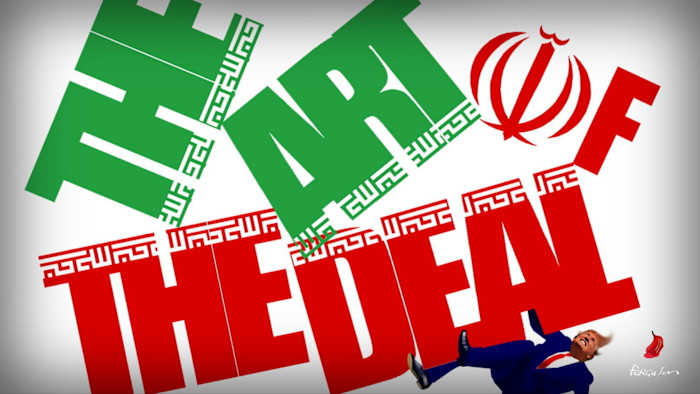
That was the principle Donald Trump (or his ghostwriter) set out inThe Art of the Deal, published in 1987. Perhaps Trump should have re-read his own book before posting on April 5: “Open the Fuckin’ Strait, you crazy bastards, or you’ll be living in Hell.” To the financial markets, that demand sounded not just desperate but economically perilous, particularly when Trump failed to follow through on his threats to unleash hellish violence on Iran, leaving global crude futures exposed to an unprecedented supply shock.
The grim reality, as global commodity traders and shipping insurers can attest, is that in the talks to end the war, it is Tehran that has had the undeniable leverage. Iran’s closure of the Strait of Hormuz, a critical maritime choke point through which roughly one-fifth of the world’s oil supply passes, inflicted immediate and intense pressure on the global economy. As petrol prices have soared in America, creating a painful drag on household budgets and threatening consumer spending, so Trump’s opinion poll ratings have plummeted. This direct correlation between energy costs, inflation, and political capital has been a powerful, inescapable market signal that forced the White House’s hand.
The result is that, at the time of writing, the US seemed poised to agree to a deal that—over the long term—threatens to leave Iran in a stronger financial and strategic position than before this conflict began. For investors, this represents a significant shift in regional risk assessment and potential trade dynamics.
The essence of the emerging deal is that Iran agrees to open the strait without charging a toll. In return, it gets phased relief from sanctions—including the unfreezing of billions of dollars of assets. This influx of capital could be a lifeline for Iran’s beleaguered economy, potentially enabling infrastructure projects, re-engaging with international financial institutions, and providing a boost to domestic consumption. While Iran will make promises to restrict its nuclear programme, the details will be the subject of future negotiations—so that critical issue, laden with geopolitical risk premium, is essentially unresolved.
Trump has insisted that he is in no hurry and would never accept a bad agreement. However, the reaction of hawkish Republicans to the emerging deal was telling, and resonated with market concerns about long-term stability. Senator Ted Cruz suggested that it could be a “disastrous mistake” because it would leave Iran “able to enrich uranium and develop nuclear weapons, and having effective control over the Strait of Hormuz.” Senator Roger Wicker, head of the Senate armed services committee, warned that the emerging deal “would not be worth the paper it is written on.” These warnings, if realized, imply a sustained geopolitical risk premium on oil, increased defense spending in the region, and continued uncertainty for foreign direct investment.
The Israeli government, which played a crucial role in persuading Trump to go to war in the first place, will be polite about any deal in public—not least because Benjamin Netanyahu must soon face the electorate. But the reality is that the Israeli leader sold the war as a unique opportunity to secure regime change in Iran. He is now looking at the conflict ending with the Iranian regime still in place—more confident, more hardline and with new financial resources to rebuild its nuclear programme and its proxy network throughout the Middle East. This outcome complicates regional security for Israeli bond markets and defense stocks, and challenges the investment narrative for countries like Saudi Arabia and the UAE.
Eli Groner, a former director-general of Netanyahu’s office,arguesthat the knowledge that Iran can now close the Strait of Hormuz at any point in the future “is a victory far deeper and more strategic than any point-scoring military achievement.” His one-word summary was: “Disaster.” From a market perspective, this “knowledge” translates into a persistent, unquantifiable risk factor that will likely keep crude oil futures prices elevated and shipping insurance premiums volatile for the foreseeable future.
As well as potentially alleviating the Islamic republic’s dire financial and economic position through sanctions relief and access to previously frozen funds, the agreement is likely to tilt the regional balance of power in Iran’s direction. As Dan Shapiro, a former US ambassador to Israel,observedon X: “Iran has gained significant leverage for the future by demonstrating it can control the strait, by attacking its neighbours and US bases in the region and causing significant damage, and by taking the United States’ and Israel’s best punch and surviving.” This enhanced leverage implies a new baseline for geopolitical risk in the Middle East, influencing everything from sovereign debt ratings to the appetite for private sector investment.
Shapiro believes that, nonetheless, Trump is so boxed in that accepting a bad deal that opens the strait would be a better option than continuing the war. Given the mounting risks of a global energy crunch and a worldwide recession, that is an understandable calculation. America also has recent memories of wars—including Vietnam and Afghanistan—that went on for far too long, as the US struggled in vain to improve a losing position. The economic toll of such conflicts on national treasuries, not to mention their inflationary impact, provided a stark lesson in the opportunity cost of prolonged military engagement. Markets abhor uncertainty, and a swift, albeit imperfect, resolution that prevents a wider energy crisis is often preferred over a protracted, unpredictable conflict.
If and when Trump accepts a bad deal, it will be because he has no viable alternative. Senator Wicker’s proposal was “to allow America’s skilled armed forces to finish the destruction of Iran’s conventional military capabilities and then reopen the strait.” But an effort to secure the strait by military means would probably have required the deployment of ground troops and the acceptance of heavy American casualties, leading to an immediate spike in defense spending and a potential global market sell-off. Even then, the Iranians would have been able to threaten shipping with drones or missiles, maintaining a constant threat to maritime trade and thus global energy security, negating any perceived military victory with persistent economic disruption.
Trump’s occasional threats to unleash “Hell” on the Iranian regime lacked credibility—not just politically, but economically—because of his obvious reluctance to get involved in a ground war and because of the danger of Iranian retaliation against the Gulf states and their energy infrastructure. In the jargon of military analysts, the vulnerability of the Gulf gave Iran “escalation dominance.” In market terms, this translated into an unacceptably high risk to global oil supply, making military options effectively a non-starter from a macro-economic stability perspective.
The US president—who compares himself obsessively with former president Barack Obama—liked to deride the nuclear deal that the Obama administration reached with Iran in 2015. Trump has called it “one of the worst and most one-sided transactions the United States has ever entered into” and claimed: “Never, ever, ever in my life have I seen any transaction so incompetently negotiated as our deal with Iran.” Yet, in a twist of market-driven irony, Trump himself is now negotiating an agreement that looks, in many respects, worse than the one Obama negotiated—partly because of the lurking knowledge that Iran can still close the Strait of Hormuz, any time it wants. This strategic upper hand, cemented by market forces, is some achievement from the master of the art of the deal.
Market Impact:
The immediate market reaction to the anticipated deal would likely be a short-term easing in global crude oil prices, reflecting the reopening of the Strait of Hormuz and the reduction of the acute supply shock risk. Shipping insurance premiums for vessels traversing the Persian Gulf could also see a modest decline. However, the long-term implications are far more complex. The unfreezing of billions in Iranian assets could lead to an eventual increase in Iran’s oil exports, potentially adding supply to a tight market but also creating competition for other OPEC+ producers. Investors will be closely watching for signs of how Iran utilizes these funds—whether for economic development, which could open new trade avenues, or for bolstering its military and proxy networks, which would exacerbate regional instability and maintain a geopolitical risk premium. The unresolved nuclear program details mean that future flare-ups remain a distinct possibility, keeping volatility a constant factor in energy markets and limiting the appetite for sustained long-term investment in the broader Middle East. Furthermore, the demonstrated leverage of energy choke points will likely compel major economies to accelerate diversification of energy sources and supply chain resilience efforts, impacting global investment in renewables and logistics infrastructure.
[email protected]