
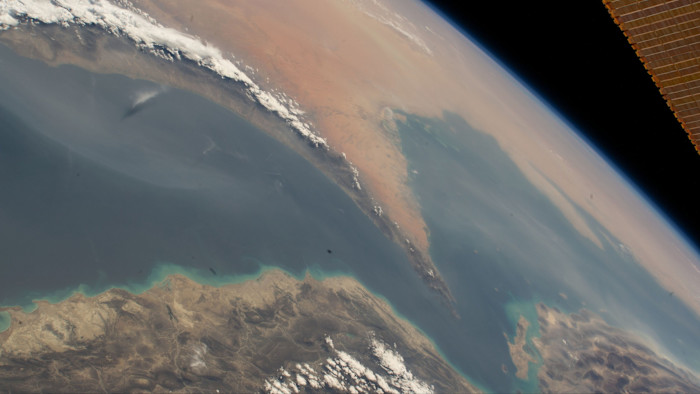
Iran is endeavoring to institute a framework for sanctioned transit for vessels navigating the Strait of Hormuz, indicating an intensification of dominion over this vital maritime channel, which Tehran implies might persist past its ongoing conflict with the United States and Israel.
United States President Donald Trump has consistently insisted that Tehran unblock the constricted passage, a conduit for approximately one-fifth of global petroleum shipments, prior to its closure by Iran to nearly all maritime traffic upon the commencement of hostilities.
This week, Tehran’s diplomatic body declared that “non-antagonistic” ships would gain permission to traverse the strait, subject to “collaboration with the pertinent Iranian agencies” — but conversely, it specified that American, Israeli, or any “entities involved in the assault” would be barred.
Abbas Araghchi, the foreign minister, stated that Iran would implement a novel system of governance in the strait post-conflict, asserting the nation’s dominion over the channel “notwithstanding desires by some to perceive it as global maritime territory”.
“Moving forward, our aim is to institute fresh protocols for secure transit,” Araghchi communicated to national broadcasters on Wednesday.
These pronouncements provoke profound inquiries regarding entry to what stands as a paramount global maritime thoroughfare — and a myriad of logistical challenges for shipping enterprises to contend with.
The Strait of Hormuz, measuring merely 21 nautical miles across at its most constricted stretch, is bisected by the territorial waters of Iran and Oman. However, its sharp curve and the mountainous terrain bordering it on the Iranian flank afford clear vantage points for Iran’s Revolutionary Guard Corps to aim at traversing ships.
“It is, without doubt, the most winding strait,” remarked Tom Sharpe, an erstwhile British naval officer. “During transit, hazards can emerge from any quarter.”
On Thursday, Trump prolonged a crucial date, requiring Iran to render the passage accessible by April 6, otherwise confronting assaults on its power facilities.
Before hostilities, roughly 135 vessels traversed the maritime route daily. Yet, following the initial US-Israeli bombardments on Iran, maritime activity has dwindled considerably. From March 1st to 25th, only 116 passages occurred, a 97 percent decrease from the corresponding timeframe in February, as reported by S&P Global.
Vessels that have completed the transit were primarily associated with proprietors from China, India, or Gulf nations. A number of these were ‘dark fleet’ ships, penalized by occidental authorities for engaging in Iranian petroleum commerce.
Certain vessels have remitted up to $2 million to Iran to guarantee secure transit through the Persian Gulf, as per Lloyd’s List Intelligence and an individual aware of a ship operator whose craft successfully traversed.
Alaeddin Boroujerdi, a prominent figure in Iran’s legislature, informed state television on Sunday that all ships navigating the vital maritime route were incurring a $2 million levy. “A fresh system of governance is taking effect in this channel,” he declared.

The sanctioning procedure entailed intergovernmental discussions with Iran through diplomatic missions in the pertinent nations, explained Martin Kelly, who leads advisory services at EOS Risk Group, a company specializing in crisis resolution.
The vessel subsequently obtained a unique identifier, which it transmitted on radio frequency VHF 16 — the global emergency channel — upon nearing the strait. Concurrently, Iranian officials verified the vessel’s documentation, encompassing the cargo’s destination and the crew’s origins, Kelly added.
No consignments traversing the strait since the commencement of warfare have been bound for the United States and European nations. The majority proceeded to East Asia, with a portion also directed towards East Africa and South America, based on vessel monitoring intelligence.
The passage through the channel lies entirely within Iran’s sovereign maritime domain, instead of employing conventional navigation channels. Experts propose this enables Iran to visually confirm vessel particulars, notwithstanding US attacks on its radar and surveillance stations.
“A clear framework is established, a distinct command is evident,” Kelly remarked.

Two Pakistani nationals engaged in unofficial communications with Iran reported that certain ships from other nations were altering their registration to Pakistani in order to traverse the strait.
“Numerous maritime carriers are modifying their ensigns to operate under Pakistani registration,” stated one, a diplomatic representative. The second individual mentioned the provisions were meant as “a gesture of conciliation towards Trump”.
The Iranian diplomatic mission in Madrid conveyed that Tehran was “amenable” to any petition from Spanish vessels seeking transit through the channel, stating it regarded Spain as “a nation dedicated to global legal norms”.
Pedro Sánchez, the Spanish Premier, became the inaugural European head of government to denounce the US-Israeli bombardments against Iran.
Maritime enterprises requiring to remit for transit would be compelled to circumvent embargoes imposed upon the Iranian administration and its Revolutionary Guard Corps, entities that have been officially labeled as terrorist groups by the United States, the European Union, and other occidental nations.
However, Claire McCleskey, the erstwhile compliance chief at the US Office of Foreign Assets Control, stated Iran had developed covert financial systems.

“They possess a pre-existing ‘clandestine financial system’ to market their petroleum, acquire restricted technology, and finance armament initiatives,” McCleskey observed. “It would prove quite simple for Iran
to utilize shell corporation accounts at financial institutions and currency exchange bureaus globally to receive remuneration.”
Several firms from India and China, whose vessels have traversed the passage since the conflict commenced, failed to reply to inquiries for remarks. India’s external affairs ministry stated that Iran sought no quid pro quo for ensuring secure transit. European and US vessel operators informed the FT they possessed no information regarding a remuneration scheme.
“Information regarding [fees] reached me frequently via numerous vessel proprietors, but frankly, no one could definitively confirm the existence of an opportunity for a few million dollars,” stated SV Anchan, the chief executive of the US-headquartered Safesea Group, whose vessel, the Safesea Vishnu, suffered an impact in the Gulf on March 11.
Individuals in Iran have highlighted past examples where administrations levied charges for traversing vital maritime channels.
For centuries, Denmark imposed levies on vessels, a portion of their consignment’s worth, for passage through the Danish straits at the entrance to the Baltic Sea. That charge, referred to as the Sound Dues, ceased to exist in 1857.

Yahya Ale Es’hagh, the leader of the Tehran Chamber of Commerce, referred to the Suez Canal as an instance of a maritime route requiring payment for vessel transit.
“Iran has, until now, demonstrated excessive leniency by failing to assert its prerogatives while global powers levied punitive measures against us,” he commented. “Such a move might enable Iran to accrue from $70 billion to $80 billion each year.”
But Johanna Hjalmarsson, a senior lecturer at the University of Southampton’s Institute of Maritime Law, stated that the Suez Canal presented a distinct situation, since it comprised Egypt’s domestic waters and was regulated by the 1888 Constantinople Convention.
Under the UN Convention on the Law of the Sea, as a littoral nation, Tehran possessed the authority to “manage maritime movement and temporarily halt transit for safety considerations” but not to “obstruct unthreatening transit” or “exhibit prejudice, whether overtly or covertly, against ships from various nations”, Hjalmarsson noted.
Both Iran and the US are not signatories to Unclos, yet even states not party to it are typically anticipated to adhere to its regulations.
A prolonged endeavor by Tehran to assert dominance over the Strait of Hormuz might, in due course, diminish the channel’s significance.
“Should Iran begin to approve or prohibit maritime traffic via the strait, nations bordering the Gulf will seek other options, for instance, constructing conduits,” commented a regional envoy.
Additional reporting by Andrew England and Jamie John in London, Humza Jilani in Islamabad, Barney Jopson in Madrid and Michael Stott in New Delhi