
The esteemed panel on The Big Money Show examines a troubling recent assessment that highlights Social Security and Medicare swiftly heading for financial collapse, cautioning that pensioners face substantial reductions in their entitlements unless the government intervenes promptly.
Larry Fink, CEO of BlackRock, addressed potential modifications to Social Security, which could enable a greater number of citizens to profit from the expansion of the equity market, concurrently guaranteeing the scheme’s reinforcement to ensure its enduring viability for coming cohorts.
In his recently published yearly chairman’s correspondence, Fink remarked upon how Social Securitystands as “among the most successful historical initiatives for preventing destitution” and that although it offers financial security, it “hinders the majority of Americans from accumulating assets in a manner that contributes to the nation’s economic advancement.”
“Currently, the framework functions predominantly as a ‘pay-as-you-go’ scheme. Contributions from wages fund the payments for present-day pensioners, with the Social Security reserve fund chiefly allocated to U.S. government securities. Essentially, employees provide capital to the state and are guaranteed specified payouts in exchange.”
“This framework, conceived as a collective assurance initiative, prioritizes steadiness and foresight. However, it fails to enable individuals to augment their entitlements in tandem with the wider economic expansion. The core inquiry, Fink stated, is whether the Social Security apparatus could accommodate both objectives.”
RECENT RECOMMENDATION SUGGESTS LIMITING SOCIAL SECURITY ENTITLEMENTS AT $100K FOR AFFLUENT PARTNERS
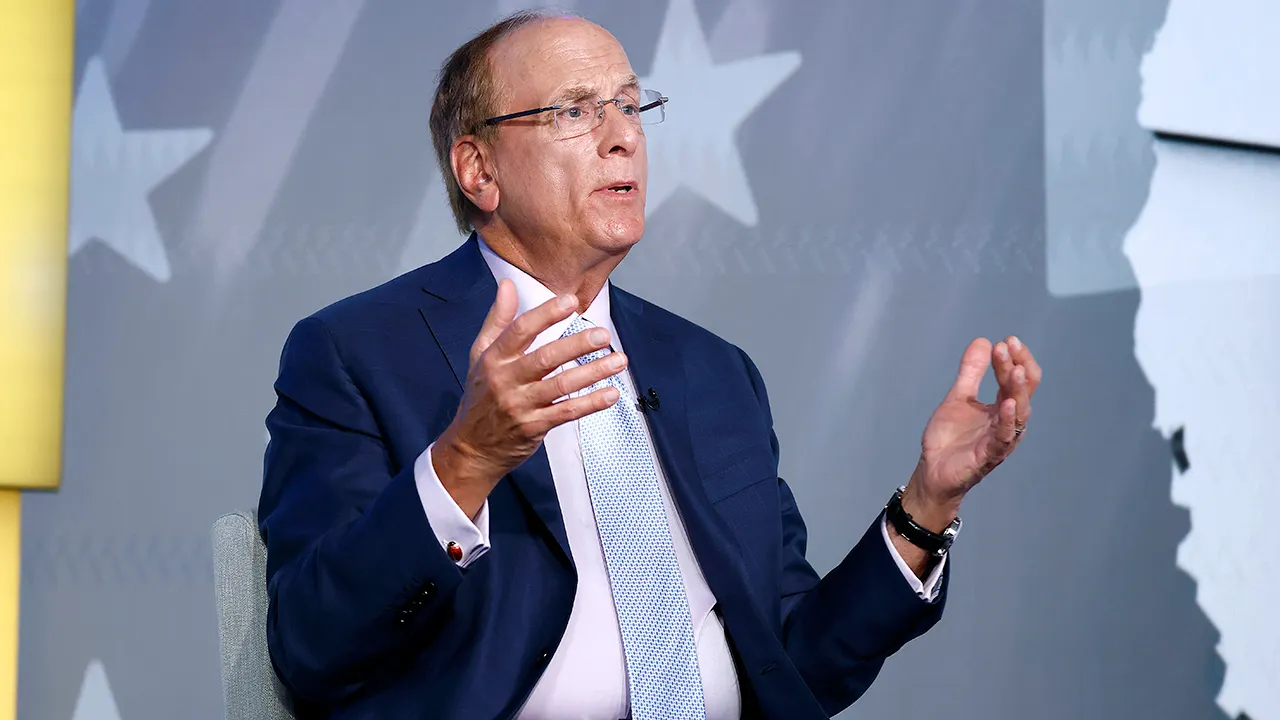
BlackRock CEO Larry Fink stated that citizens must deliberate on methods to restructure Social Security prior to its financial collapse.(Hollie Adams/Bloomberg via Getty Images)
He suggested that this might be achieved by considering if a segment of the program could be allocated “with prudence, widely, and across many years,” in a manner akin to other enduring retirement schemes.
“This would unequivocally not signify the privatization of Social Security, nor would it entail investing the entirety in the equity market,” Fink penned. “Rather, it would involve implementing a degree of variety, conceptually akin to the government’s Thrift Savings Plan, an entity that oversees pension funds for numerous government staff.”
“The objective would be to reinforce the framework progressively, concurrently safeguarding its fundamental assurances,” he appended.
SOCIAL SECURITY’S PRIMARY RESERVE ACCOUNT ANTICIPATES EXHAUSTION IN 2032, PROMPTING ENTITLEMENT REDUCTIONS

Social Security’s principal reserve fund is headed towards financial collapse within a decade, at which point entitlements would be automatically reduced to correspond with income from wage contributions.(Getty Images/iStock)
Fink referenced a cross-party proposition from Sens. Bill Cassidy, R-La., and Tim Kaine, D-Va., which aims to establish a novel investment vehicle that would function alongside the current reserve fund instead of supplanting it, concurrently allocating capital into a varied portfolio of equities and fixed-income securitiesto yield superior profits.
This proposition would necessitate an initial capital injection of roughly $1.5 trillion and would be allotted 75 years for expansion; during which timeframe the Treasury would persist in subsidizing Social Security entitlements.
Upon the fund’s maturation, it would reimburse the Treasury and subsequently augment wage contributions in the future to aid in bridging the disparity between the Social Security system’s receipts and disbursements – ensuring that no current Social Security recipient or individual approaching retirement would experience an alteration to their payouts.
Fink further highlighted that approximately six million U.S. citizens who work for state and municipal administrations do not presently pay into Social Security, instead depending on governmental retirement schemes which allocate funds into varied asset holdings.
FISCAL SHORTFALL REACHES $1 TRILLION DURING THE INITIAL FIVE-MONTH PERIOD OF THE FINANCIAL YEAR: CBO
| Ticker | Security | Last | Change | Change % |
|---|---|---|---|---|
| BLK | BLACKROCK INC. | 968.46 | -12.89 | -1.31% |
Further instances of substitute retirement schemes are discoverable internationally, such as Australia’s superannuation framework, which embodies a method of allocating retirement savings into the capital markets. Fink posited that a “comparable, meticulously designed strategy might be contemplated to bolster Social Security.”
“I comprehend why any discourse regarding alterations to Social Security causes public apprehension. Social Security constitutes a fundamental commitment, and citizens justifiably expect its fulfillment. However, within the existing framework, inaction could indeed nullify that pledge,” he articulated.
“Present forecasts indicate the reserve fund will be incapable of disbursing complete entitlements by 2033. Numerous younger citizens question whether they will ever fully receive their own,” he clarified. “Rectifying that discrepancy will likely necessitate diverse approaches. Nonetheless, judicious, enduring investment strategies could represent one such avenue.”
ACCESS FOX BUSINESS ON THE MOVE VIA THIS LINK
A study conducted by the impartial Committee for a Responsible Federal Budget (CRFB) indicated that once Social Security’s principal reserve fund achieves financial collapse – an event anticipated in 2032 – national legislation mandates a reduction in entitlements to correspond with income generated by wage contributions, equating to an approximate 24% decrease for recipients.
Fink observed that his chairman’s correspondence from two years prior had centered on re-evaluating retirement and had drawn censure for proposing that Social Security required modifications. He conceded that his most recent letter might elicit a similar response, but asserted that such a dialogue is indispensable.
“Throughout my five decades in financial services, a singular lesson I’ve absorbed is that the unaddressed issues are precisely those that ought to concern us the gravest. Consequently, this underscores the urgency of engaging in this discussion immediately – as the penalty for procrastination is continuously escalating,” he concluded.