
Unlock the White House Watch newsletter for free
Your guide to what Trump’s second term means for Washington, business and the world
Key Takeaways:
- Policy Uncertainty Amplified:Intra-party feuds in critical swing states like Michigan exacerbate political instability, contributing to market uncertainty around future fiscal policy, regulatory frameworks, and sector-specific legislation, particularly concerning inflation and energy.
- Senate Control and Economic Direction:The tight race for Michigan’s Senate seat is pivotal for determining congressional control. A shift in power could drastically alter tax policy, federal spending priorities, and the regulatory environment, directly impacting corporate earnings forecasts and overall economic growth projections.
- Geopolitical Narratives & Investor Sentiment:Debates incorporating geopolitical elements, such as the controversial ad linking grocery prices to foreign aid, introduce complex risk factors into domestic policy discussions, potentially unsettling investor confidence and diverting focus from core economic challenges.
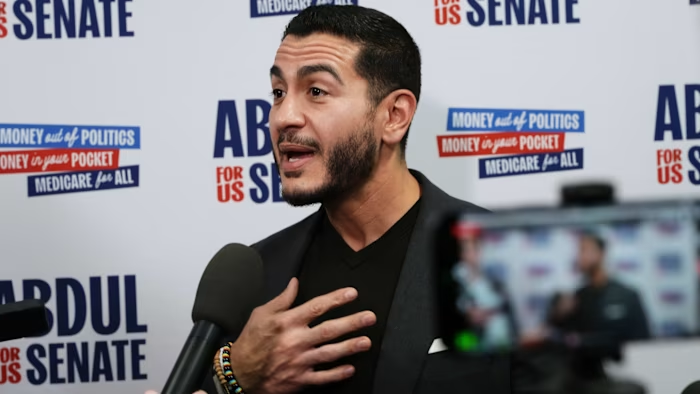
Beyond the immediate political drama, the burgeoning Democratic discord in Michigan’s crucial Senate battleground is sending ripples of concern through financial markets, highlighting the precarious nature of policy consensus ahead of pivotal midterm elections. The escalating feud between progressive candidate Abdul El-Sayed and his moderate former primary rival Haley Stevens underscores the deep ideological fissures within the party, threatening not just electoral success but the very predictability required for stable economic planning and investor confidence.
With just days remaining until Tuesday’s midterms, the intraparty tensions in Michigan have boiled over, casting a shadow over Democratic efforts to present a united front against US President Donald Trump. For markets, this disunity translates directly into increased policy uncertainty. A party unable to maintain solidarity among its factions suggests potential legislative gridlock, even if it achieves a narrow majority. This scenario could impede progress on critical economic issues, from long-term fiscal strategies to immediate inflationary pressures, and delay consensus on vital sectors like energy, healthcare, and technology.
Michigan, an industrial powerhouse and bellwether state, holds significant weight in the battle for control of the upper chamber of Congress. Democrats are defending a seat against Republican challenger Mike Rogers in what polls indicate is an exceedingly tight race. The outcome here will not merely decide a single seat but could be the linchpin for Senate control, profoundly influencing the legislative agenda for the next two years. A Democratic loss in Michigan, compounding other potential setbacks, would force the party to find an even greater number of flips in staunchly conservative states, thereby increasing the market’s perceived risk of a divided government.
El-Sayed, who emerged victorious from a bitter primary against Stevens in August, has struggled to project a common front against Rogers. The planned joint campaign appearance on Sunday was cancelled after El-Sayed asked Stevens not to attend. The catalyst was Stevens’ criticism of El-Sayed for not sufficiently condemning an ad by his supporters that controversially suggested high grocery prices were driven by US military support for Israel. This specific controversy is not just a political gaffe; it introduces a complex geopolitical narrative into domestic economic policy discussions, a dynamic that can unsettle markets by adding layers of unforeseen risk.
“I’ve already been clear that that ad was not made by me and I do not agree with the contents of that ad,” El-Sayed stated, attempting to distance himself. However, his subsequent dismissal of the broader implications for public discourse – “Most people don’t care about this, like, intrigue stuff that you all love to carry. It is not of concern to the vast majority of Michiganders. People here are struggling to afford their gas. They’re struggling to afford their groceries. They’re struggling to see a doctor,” he added – while aiming to resonate with voters, inadvertently highlights the very economic anxieties that markets are closely monitoring. These consumer struggles directly feed into inflation data, consumer confidence indices, and central bank policy decisions, making them top-tier concerns for investors.
Stevens’ sharp retort underscored the deep divisions. She issued a statement on Friday expressing her intent to attend the Sunday event organised by veteran Democratic congressman Jim Clyburn, before launching into a pointed critique of El-Sayed. “A disclaimer is not a condemnation, and everyone in my community knows the difference,” she asserted. Her further comment, “Abdul promises to get money out of politics. He can begin by getting Israel out of his explanation for everything Michigan cannot afford,” directly challenges El-Sayed’s economic framing. This internal disagreement over attributing economic woes, especially when linking domestic issues to foreign policy, creates a volatile environment for investors trying to gauge future legislative priorities and potential shifts in international relations that could impact trade, defense spending, and energy security.
The financial implications extend beyond rhetoric. While Stevens has not withdrawn her endorsement of El-Sayed, the public backing of Rogers by her fiancé, Jason Turkish, signals a severe erosion of party unity. Turkish’s assertion to Fox News that El-Sayed’s stance puts “Jews at risk” amplifies the moral and ethical dimensions of the debate, transforming a local political squabble into a nationally resonant issue with potential long-term impacts on voting blocs and political coalitions. For markets, such deep-seated ideological divisions within a major party can complicate the passage of critical legislation, from annual budgets to debt ceiling negotiations, raising the specter of government shutdowns and increased credit risk for the sovereign.
Many Michigan Democrats, including Mallory McMorrow, who ran against both El-Sayed and Stevens in the primary, have voiced alarm at the discord. McMorrow’s rhetorical question, “First of all, I have no idea what the hell Stevens is doing,” before her endorsement of El-Sayed and her plea to “recognise the stakes,” highlights the anxiety within the party. For investors, these “stakes” are tangible: they represent the potential for a unified legislative agenda capable of addressing critical economic challenges like inflation, supply chain resilience, and workforce development, versus a fragmented government prone to political stalemates.
Democrats already face an uphill battle to win back control of the US Senate, which requires a net gain of four seats. Their strategy hinges on improbable victories in traditionally conservative states such as North Carolina, Texas, Ohio, Alaska, and Iowa. A defeat in Michigan, a state considered far more winnable, would dramatically increase the burden, requiring them to flip five seats instead of four. This higher bar for Senate control translates into a greater perceived likelihood of a divided Congress, a scenario typically associated with slower legislative progress, reduced fiscal stimulus, and heightened regulatory uncertainty—factors that often temper market enthusiasm and can lead to increased volatility.
Market Impact:
The intensifying political friction within the Democratic party in Michigan carries significant ramifications for financial markets. Should this internal strife contribute to a loss of the Senate seat, it would increase the probability of a divided Congress, characterized by potential legislative gridlock on crucial economic policies. Investors could anticipate heightened uncertainty regarding the future trajectory of fiscal spending, taxation (particularly concerning the expiring Trump-era tax cuts), and regulatory reform across key sectors like energy, healthcare, and technology. Defense contractors, consumer staples, and even companies reliant on stable trade relationships could see increased volatility as policy frameworks remain in flux. Moreover, a less predictable political landscape might deter both domestic and foreign direct investment, impacting long-term economic growth projections. The perceived inability of a major party to coalesce around a common economic vision, especially on issues like inflation and consumer affordability, risks eroding overall investor confidence and could lead to a more cautious, risk-averse market environment.