
Stay informed with free updates
Simply sign up to the Oil myFT Digest — delivered directly to your inbox.
Key Takeaways:
- Geopolitical tensions, including Houthi attacks in the Red Sea and heightened US-Iran rhetoric, have propelled Brent crude prices above $100 a barrel, igniting fears of a renewed global inflation shock and significant energy market instability.
- The surge in oil prices, combined with disappointing tech earnings, triggered a broad market sell-off in equities, particularly impacting growth stocks, while bond yields spiked globally as investors priced in higher inflation and accelerated central bank rate hikes.
- The vulnerability of critical maritime chokepoints like the Bab al-Mandab Strait highlights a severe supply-side risk that could drive oil prices to levels seen during the 2008 or 2022 crises, posing a serious threat to economic growth and financial market stability.
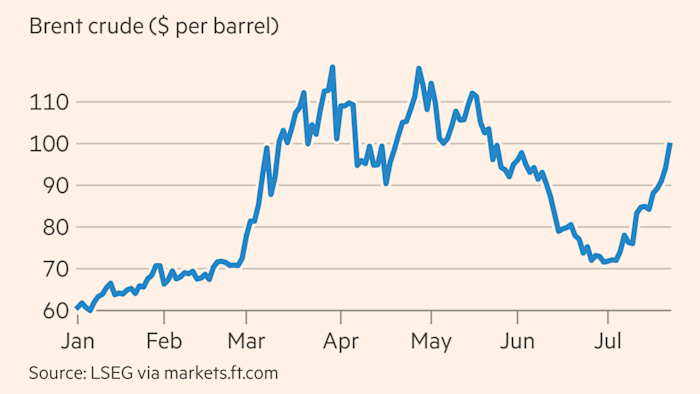
Oil prices have surged past the psychological $100 a barrel mark for the first time since May, sending ripples of anxiety across global financial markets. This sharp ascent was immediately mirrored by a broad sell-off in US stocks and a notable rise in bond yields, as escalating geopolitical tensions in the Middle East—particularly concerning Iran—fueled fears of a renewed inflationary spiral. The catalyst for this market upheaval was a combination of direct attacks by Iranian-backed Houthi militants in the Red Sea and incendiary rhetoric from former President Donald Trump, who indicated he was contemplating a “massive attack” on Iran.
Brent crude, the internationally recognized benchmark, registered a dramatic jump of up to 7.4 per cent, touching $101.01 a barrel. This blistering rebound in crude prices follows reports that Houthi militants, who had earlier attempted to impose a maritime blockade on Saudi Arabia, attacked two Saudi Arabian tankers in the Red Sea. These actions immediately amplified concerns among investors that the US and Iran are perilously close to a full-blown military conflict, threatening to severely disrupt global energy supplies and reignite a global inflation shock.
The geopolitical temperature was further ratcheted up by Trump’s comments in an Axios interview, where he stated, “I am considering a massive attack. Bigger than ever before. I am close to making a decision. We are all set for it.” Such statements, coupled with real-world acts of aggression in vital shipping lanes, create a “perfect hurricane for the market,” as described by Arne Rasmussen, chief analyst at Global Risk Management. He elaborated, “You have an escalation in the rhetoric from both sides [in the Iran war] and now the Red Sea attacks. The market was probably caught on the short side. Everything is moving in the wrong direction.” This confluence of factors has significantly increased the geopolitical risk premium embedded in oil prices, making energy markets highly volatile.
The immediate fallout was evident across asset classes. The Nasdaq Composite, heavily weighted towards technology and growth stocks, plummeted 2.6 per cent by late morning in New York. This decline was a double blow, as the oil market shock coincided with disappointing earnings reports from tech giants Alphabet and Tesla, exacerbating a sector-specific sell-off. Tesla shares tumbled 14 per cent, while Alphabet shed 7.4 per cent, underscoring how macroeconomic headwinds can amplify company-specific disappointments, particularly for high-growth companies whose valuations are sensitive to interest rate expectations.
The broader S&P 500 index was not spared, falling 1.4 per cent, reflecting widespread investor anxiety. The oil surge’s most significant market-wide impact, however, extended to bond markets. Investors quickly began pricing in a more aggressive stance from major central banks, anticipating that interest rates would need to be lifted more swiftly and substantially to contain the resulting inflationary pressures. The European Central Bank’s earlier warning on Thursday that “the full inflationary impact of the energy shock has yet to play out” now appears prescient, setting a hawkish tone for future monetary policy decisions.
In the US, 10-year borrowing costs climbed 0.05 percentage points to 4.71 per cent, marking an 18-month high. Similarly, German 10-year yields, a benchmark for the Eurozone, touched their highest level since 2011 at 3.21 per cent. This sharp increase in yields reflects a recalibration of inflation expectations and a demand for higher compensation from bondholders, signaling a potential end to the era of ultra-low borrowing costs.
The targeting of Saudi ships raises the alarming prospect of the Houthis attempting to close the Bab al-Mandab Strait. This narrow waterway, connecting the Red Sea with the Gulf of Aden and the Indian Ocean, is a critical artery for global trade and, crucially, for Saudi Arabia’s oil exports. Its closure would force ships to take a much longer, more expensive route around Africa, significantly increasing shipping costs and transit times, thereby disrupting global supply chains and further fueling inflation. This strategic choke point has gained even greater importance since Iran seized control of the Strait of Hormuz in the early days of the war, making alternative routes paramount. The recent attacks also threaten to unravel a fragile four-year ceasefire between the Houthis and Saudi Arabia, escalating an already volatile regional conflict.
Brent crude last traded above $100 on May 26 but had subsequently tumbled in June following an agreement between Washington and Tehran to extend their ceasefire and reopen the strait, which had offered fleeting hopes of restored oil supplies. However, the breakdown of this ceasefire, with US and Iranian forces trading fire for almost two weeks, demonstrates the fragility of any peace efforts. Rising US petrol prices, which topped $4 a gallon earlier this week, are also likely to fuel voter frustration, posing a significant challenge for the incumbent administration ahead of November’s midterm elections.
Trump’s warning on Thursday that the Houthis and Iran would face “major military punishment” if the attacks continued underscores the gravity of the situation. The Houthis, a potent member of Iran’s “axis of resistance,” have largely remained on the sidelines of the wider conflict until recently, apart from firing missiles and drones at Israel in March and early April. However, there have been persistent concerns that the Houthis could coordinate with Tehran to close Bab al-Mandab, effectively weaponizing energy markets and global trade to exert maximum pressure.
Given these latest developments, analysts are revising their forecasts. Helima Croft, head of global commodity strategy at RBC Capital Markets, warned that oil prices could exceed the $139 a barrel reached in 2022 following Russia’s invasion of Ukraine, or even surpass the $147 peak of 2008. Such a scenario would have profound implications for global economic stability, potentially pushing major economies into recession.
Market Impact:
The sudden surge in oil prices and the concurrent geopolitical escalation signals a significant shift in market dynamics. Investors should brace for heightened volatility across all asset classes, with a distinct tilt towards a “risk-off” sentiment. Inflation will remain the dominant concern, forcing central banks globally to grapple with a difficult policy dilemma: combating inflation with higher rates while risking economic slowdown. The increased geopolitical risk premium will continue to influence commodity prices, particularly energy. Companies heavily reliant on energy inputs or those with long supply chains face significant margin pressure. Furthermore, a sustained period of elevated oil prices could dampen consumer spending, curb corporate investment, and ultimately lead to a more pronounced global economic deceleration or even stagflation, fundamentally altering investment strategies towards defensive sectors and inflation-hedging assets.