
Key Takeaways:
- Vision 2030 Under Direct Assault:Houthi missile attacks on critical infrastructure, specifically Riyadh’s King Khalid International Airport, directly undermine Saudi Arabia’s multi-billion dollar Vision 2030 economic diversification strategy, jeopardizing ambitious targets for tourism, logistics, and global event hosting.
- Eroding Investor Confidence & Heightened Risk Premium:The disruption of flagship international business conferences and the withdrawal of high-profile global executives signal a significant increase in perceived geopolitical risk, threatening foreign direct investment inflows and potentially raising the cost of capital for the kingdom’s mega-projects.
- Renewed Energy Market Volatility & Supply Chain Concerns:Escalating hostilities in a strategically vital global oil corridor, coupled with threats to key transportation hubs, inject fresh uncertainty into energy markets and pose tangible risks to international supply chains, demanding a re-evaluation of regional stability.
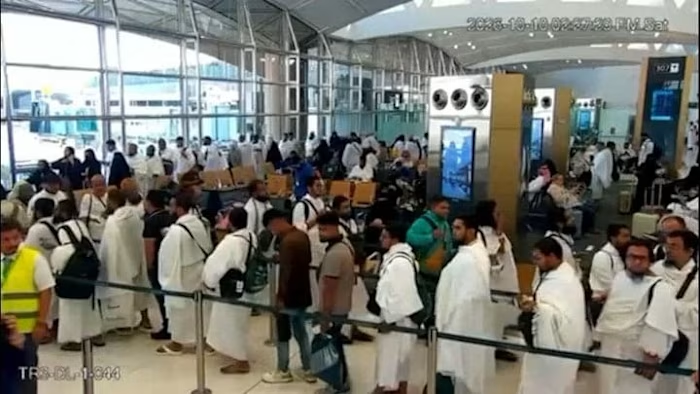
Dozens of passengers stand in line as they prepare to board a flight to Jeddah in western Saudi Arabia, many of them pilgrims en route to Mecca. As one, dressed in simple white garb, leans to pick up his bag from the floor, the camera shakes violently and suddenly. A white flash fills the screen as debris falls from the ceiling, and people run for safety.
The scene, captured in dramatic CCTV footage, marks the moment of a deadly Houthi missile attack on Saturday, one of hundreds launched by the Iran-backed militant group across the kingdom since the years-long conflict reignited in July. Beyond the immediate human tragedy, this incident carries profound implications for Saudi Arabia’s economic ambitions and global market perception.
That it happened in Riyadh’s main international airport — killing 13 people and injuring over 300 — underscores the dramatic escalation of the Iran-backed rebels’ campaign. This is no longer merely a border conflict; it has now hit at the very heart of Crown Prince Mohammed bin Salman’s Vision 2030 programme, a multi-trillion-dollar blueprint to transform Saudi Arabia into a regional finance, tourism, and events centre, diversifying its economy away from oil dependency.
Riyadh’s King Khalid International Airport (RUH) is absolutely central to these ambitions. The government is planning a monumental expansion, a capital expenditure project running into tens of billions, as it prepares to host global events including Expo 2030 and the Fifa World Cup in 2034. It also serves as the home base of Riyadh Air, a new national carrier backed by the kingdom’s Public Investment Fund (PIF), which aims to turn the city into a transport and logistics hub directly competing with established players like Dubai’s Emirates and Qatar Airways. The closure of an airport critical to these strategic initiatives sends a stark message about operational risk to investors and potential partners.
But the airport, which has been hit five times since Wednesday, will now be closed until at least Friday, according to a notice given to airlines. Attacks on other airports including in Dammam and the south-west, as well as disruptions in Jeddah — the largest by traffic — have forced the cancellation of thousands of more flights. This widespread aviation disruption not only impacts passenger revenue for airlines but also cargo logistics, potentially increasing supply chain costs and delivery times for businesses operating in or through the kingdom.
“There is little question that the attacks by the Houthis on Saudi airports . . . were designed to damage the kingdom’s global standing while crippling an essential part of Vision 2030,” said Sean Foley, professor of Middle East history at Middle Tennessee State University. From a market perspective, this “damage” translates directly into a higher geopolitical risk premium for investing in the kingdom, potentially slowing FDI inflows and increasing borrowing costs.
These escalating security threats have emerged during a particularly busy period in Saudi Arabia’s business calendar. The kingdom is preparing to host later this month the Future Investment Initiative (FII) event, its flagship economic conference often dubbed ‘Davos in the Desert,’ which typically attracts Wall Street titans, global investors, and bankers crucial for generating deal flow and showcasing investment opportunities. Concurrently, the World Petroleum Council’s (WPC) energy congress began on Sunday in Riyadh, a pivotal gathering for the global oil and gas industry.
The chief executives of ExxonMobil, TotalEnergies, Shell, and BP were all expected to attend the WPC congress but withdrew following the Houthi attacks, the FT reported on Sunday. The absence of such high-profile figures sends an unmistakable signal to the market, indicating that even short-term security concerns can override long-term strategic interests for global corporate leadership. This exodus limits crucial networking, negotiation, and potential investment announcements that these events are designed to facilitate.
Other events were also affected. The organisers of Misk Global Forum — an annual conference organised by an NGO affiliated with the crown prince — said on Monday they were cancelling their event scheduled for next month, highlighting the immediate operational impact. A private equity firm also cancelled a planned investor day this week in Riyadh after losing most of its speakers. “Even the ones in Saudi have to attend to bigger problems,” the firm’s chief executive said, underscoring a reprioritization away from business development towards crisis management.
Prince Abdulaziz bin Salman, Saudi Arabia’s energy minister, struck a defiant tone at the WPC congress on Monday, telling the audience — which included fewer attendees in western-style clothing than would ordinarily be expected at such an event — that “the word fear in the Saudi dictionary does not exist”. While such rhetoric aims to project confidence, market participants often weigh such statements against tangible security and operational realities.

But with Riyadh’s airport closed for days, many of the energy officials and other business executives currently in the capital could be forced to take a land route to neighbouring Gulf states such as Bahrain or Qatar to catch flights back home. This logistical inconvenience translates into lost productivity, increased travel costs, and a heightened perception of instability, all detrimental to cultivating a thriving international business hub.
And experts say the repeated failure of Saudi air defences to protect airports risks doing longer-term damage to the kingdom’s image and its ability to attract foreign investors and tourists, both vital for the success of the crown prince’s economic plans. The implicit guarantee of safety for international travel and business operations is a fundamental prerequisite for attracting significant foreign direct investment (FDI) and achieving ambitious tourism targets of 100 million visitors by 2030.
Farea al-Muslimi, a research fellow at Chatham House, said the targeting of airports was designed to inflict maximum damage on the kingdom’s economic infrastructure and reputation. “This is a huge part of the Houthis’ calculation,” he said. “Saudi Arabia has something to lose and they do not. It is the economy where they feel they can cause the most harm.” This strategy aims to drive up the kingdom’s security costs, divert funds from development projects, and make international partners think twice before committing capital.
The conflict between Saudi Arabia and the Houthis first began more than a decade ago, after the kingdom intervened in Yemen’s civil war to restore the internationally recognised government against the Iran-backed militants. The intervention came just months before Prince Mohammed unveiled his plan to transform the Saudi economy by diversifying away from oil revenues, removing some social restrictions in the conservative kingdom and developing new sectors such as tourism, logistics and technology.
Riyadh soon became bogged down in a hugely costly campaign in Yemen, before a fragile truce with the Houthis in 2022 seemed to provide the regional stability needed for the kingdom to forge ahead with Prince Mohammed’s plans. But while Saudi Arabia was less hard hit than some neighbours like the United Arab Emirates by Iranian attacks following the start of the US and Israeli war against Tehran earlier this year, the truce with the Houthis ultimately collapsed over the summer, reigniting concerns over regional energy security.
The rebels declared a maritime blockade against Saudi ships passing through strategic Bab al-Mandeb Strait, which had become a vital outlet for Saudi oil after the US-Iran war in effect closed the Strait of Hormuz. These actions have direct implications for global oil prices, potentially increasing the risk premium on crude futures as traders factor in potential supply disruptions from a critical chokepoint. They also fired waves of missiles and drones at energy facilities in Saudi Arabia’s southern provinces, threatening the kingdom’s export revenues and roiling global energy markets.
After the Saudi-backed Yemeni government this month announced a new offensive against the Houthis, the group responded by escalating its targeting of Saudi airports, first in the kingdom’s south-west and then Riyadh itself. This tit-for-tat escalation indicates a deteriorating security landscape that could deter long-term capital commitments.

An adviser to the Saudi government acknowledged that the airport attacks will hurt foreign investment and tourism in what was already a turbulent year. “Tourism is the first thing hit in a big way,” he said. While it won’t stop religious tourism, “it will stop high-income travel. Investments will get hit. It was already slower this year.” The financial impact on the hospitality sector, airlines, and related leisure industries could be substantial, affecting employment and local economies.
“Investors will ask: Is there going to be demand?” the adviser added. “Is the facility safe? If you’re an energy investor, you were already spooked.” These are fundamental questions that directly influence investment decisions, capital allocation, and risk assessment models used by international financial institutions.
Haytham Linjawi, an assistant professor of political science at King Abdulaziz University in Jeddah, argued that Saudi Arabia’s strong global relations and the reforms it implemented as part of Vision 2030 are factors that outweigh the security incidents. “Travel disruptions are an immediate logistical consideration for organisers,” he said, “but so far they do not appear to alter the underlying investment in upcoming conferences,” with Saudi Arabia continuing to build hotels, venues and expand airports. This perspective suggests that the fundamental economic drivers and long-term strategic commitment might absorb short-term shocks, indicating potential resilience in capital markets.
But Kristin Smith Diwan, a senior resident scholar at the Arab Gulf States Institute in Washington, offered a more cautious view. “As long as the airports are under attack and unsafe, people will not come,” she asserted. “You can’t build a globally integrated economy when you can’t protect your airports. If security can be restored, attitudes will change. But today that doesn’t seem fully under Riyadh’s control.” This highlights a critical challenge for the Saudi government: the perception of security directly correlates with the ability to attract and retain the international capital and talent essential for its economic transformation.
Additional reporting by Chloe Cornish and Nicolas Parasie in Dubai
Market Impact
The escalating Houthi attacks on Saudi Arabian airports represent a significant and immediate challenge to the kingdom’s market attractiveness and stability. Investors are now forced to reassess the geopolitical risk premium associated with Saudi assets, potentially leading to increased sovereign bond yields, higher political risk insurance costs for new projects, and a more cautious stance from foreign direct investors eyeing Vision 2030 opportunities. While the Saudi Tadawul stock exchange might show short-term resilience due to robust domestic liquidity and oil revenues, prolonged instability could weigh on key sectors like tourism, aviation, and construction, impacting corporate earnings and valuations. Furthermore, the disruption to global supply chains and the renewed threat to critical energy infrastructure in the Bab al-Mandeb Strait could introduce additional volatility into international oil and gas markets, potentially pushing up prices and contributing to global inflationary pressures. The ultimate market impact will hinge on the Saudi government’s ability to swiftly restore confidence in its security apparatus and demonstrate its capacity to protect vital economic infrastructure, thereby mitigating the erosion of international investor trust and safeguarding its ambitious economic transformation agenda.