
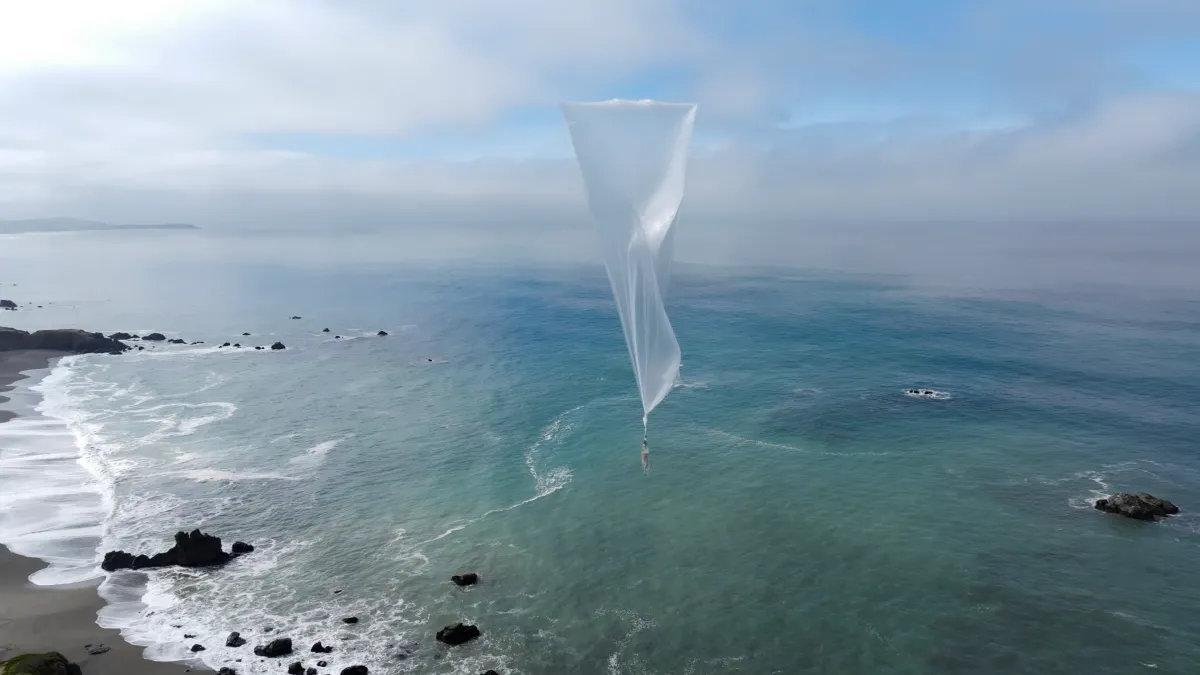
The U.S. Air Force is set to significantly enhance its meteorological capabilities, not through traditional government channels, but by tapping into the cutting-edge innovation of a Silicon Valley startup. WindBorne Systems, a pioneer in autonomous weather balloon technology, has secured a landmark contract that could see the Air Force invest nearly $50 million in the company’s unique data collection and AI forecasting prowess. This move signals a pivotal shift in how critical weather intelligence is gathered and processed, showcasing the growing reliance on agile private sector firms for national defense and operational insights.
Key Takeaways
- Strategic Air Force Partnership:The U.S. Air Force has entered a potential $49 million contract with WindBorne Systems for global weather data, highlighting a significant government investment in private sector meteorological innovation.
- AI-Driven Weather Superiority:WindBorne leverages a global fleet of 700 autonomous balloons to feed empirical data into its proprietary AI forecasting model, WeatherMesh 6, which claims higher accuracy than traditional physics-based models.
- Pioneering Operational Applications:The company demonstrated its advanced capabilities by navigating an unpowered balloon into the eye of a typhoon, showcasing real-world operational decision-making powered by deep learning for the first time.
A New Horizon in Weather Intelligence: Air Force Taps WindBorne Systems
In a groundbreaking move, the U.S. Air Force has initiated a substantial partnership with WindBorne Systems, a Redwood City-based startup specializing in autonomous weather balloons and AI-driven forecasting. This contract, potentially worth up to $49 million, positions WindBorne as a critical data provider for military operations, underscoring a strategic shift towards advanced, privately developed meteorological solutions.
Founded in 2015, WindBorne has rapidly ascended as a leader in atmospheric data collection. The company currently operates an impressive fleet of approximately 700 weather balloons globally, meticulously gathering atmospheric sensor readings. This vast trove of empirical data not only serves its diverse customer base but also fuels its proprietary deep-learning weather forecasting model, WeatherMesh 6.
The Unrivaled Contract: A Testament to Unique Capabilities
While WindBorne Systems has a history of collaborating with U.S. government entities, including the National Weather Service and branches of the military, this new agreement with the Air Force represents their most significant engagement to date. The contract’s structure is notably flexible: it allows the Air Force to place orders for specific regions and times as data is needed, with initial orders totaling $1.7 million already placed. Executives anticipate a continuous flow of future orders, signaling sustained demand for WindBorne’s unique services.
Andrey Sushko, co-founder and CTO of WindBorne Systems, shed light on the contract’s broader implications. “This is largely a vehicle through which continued growth of the constellation can be supported, as well as some work on research and development to continue to improve the hardware and performance of the balloons,” Sushko explained to TechCrunch. He emphasized the non-competitive nature of the award, stating, “It’s a determination by the government that for this capability of collecting global data, we were the only company able to provide it in the way that met their needs for these operations.” This highlights WindBorne’s distinct technological advantage in the market.
WindBorne’s Innovative Edge: Autonomous Balloons and AI Precision
Central to WindBorne’s appeal is its innovative approach to data collection. Unlike traditional weather instruments, WindBorne’s unpowered balloons are masterpieces of controlled autonomy. They are not merely passive data collectors; they are actively maneuvered by adjusting their altitude, bleeding air, or dropping sand as ballast. This allows them to harness prevailing winds, guiding them precisely to where data is most critical.
This sophisticated navigation was put to the ultimate test in August when WindBorne achieved a remarkable feat: becoming the first organization to send an unpowered flight system directly into the eye of a typhoon. Sushko elaborated on this groundbreaking accomplishment: “That’s a pretty novel step, and the two ingredients for that are one, having good wind and weather models, and knowing how to navigate them; and two, having a large enough constellation that you have balloons in the right places.” He further noted the significance for AI application, stating, “It’s one of the first times that a deep-learning model was used for actual operational decisions.”
Beyond data collection, WindBorne’s prowess extends to forecasting. The company’s latest iteration, WeatherMesh 6, is an AI-powered model that directly ingests empirical data from its balloon fleet. WindBorne claims this model offers more accurate forecasts than traditional, physics-based simulations, such as those run by the venerable European Centre for Medium-Range Weather Forecasts (ECMWF). This claim is backed by significant investor confidence, as CEO John Dean previously informed TechCrunch about the company’s successful $37 million Series B funding round, aimed at further scaling its operations and technological advancements.
The Shifting Landscape of Weather Prediction: From Supercomputers to Deep Learning
The rise of companies like WindBorne is symptomatic of a broader revolution in meteorology. For decades, weather forecasting relied on incredibly expensive supercomputers running intricate equations that approximated atmospheric behavior based on the laws of physics. While effective, these methods were computationally intensive and often limited by the sheer complexity of the atmosphere.
The advent of transformer model architectures and the release of massive historical weather datasets by organizations like ECMWF have ushered in a new era. AI weather forecasting, particularly through deep learning, has emerged as one of the most productive applications of this technology. End-to-end learning models can now ingest decades of historical weather data and issue predictions with unprecedented speed and, increasingly, accuracy.
This “jagged frontier” of forecasting, as experts describe it, sees both traditional physics-based models and cutting-edge AI models contributing to a more comprehensive understanding of the weather. Pioneering work from labs like Google DeepMind, whose latest weather models offer important new capabilities—particularly in cyclone forecasting—is becoming increasingly central to how governments, including the U.S., prepare for and respond to severe weather events like hurricane season. WindBorne’s integration of empirical data directly into a deep-learning model offers a unique advantage, bridging the gap between real-time observation and predictive analytics in a way that traditional models struggle to match.
Looking Ahead: A Strategic Advantage for the Air Force and Beyond
The Air Force’s investment in WindBorne Systems is more than just a contract; it’s a strategic embrace of next-generation technology that offers a distinct operational advantage. Accurate, real-time weather data is paramount for military planning, from flight operations and reconnaissance to logistical support and tactical deployments. By leveraging WindBorne’s global constellation and AI-driven insights, the Air Force can gain unparalleled situational awareness, potentially enhancing mission safety and effectiveness across the globe.
This partnership also underscores a growing trend where government agencies are increasingly turning to agile, innovative startups to fulfill critical national security and scientific needs. As WindBorne continues to scale its operations and refine its technology, its impact could extend far beyond military applications, influencing everything from climate research to commercial aviation and disaster preparedness worldwide.
Bottom Line
The U.S. Air Force’s substantial contract with WindBorne Systems marks a significant inflection point in the realm of meteorological intelligence. It unequivocally validates the power of autonomous balloon technology combined with advanced AI for critical data collection and forecasting. This strategic alliance not only provides the Air Force with unparalleled weather insights, but it also solidifies the private sector’s crucial role in driving innovation that directly impacts national defense and our broader understanding of the planet’s ever-changing atmosphere.
When you purchase through links in our articles, we may earn a small commission. This doesn’t affect our editorial independence.
{content}
Source:{feed_title}