
FOX Business correspondent Lauren Simonetti reports on Treasury Secretary Scott Bessent’s remarks regarding Iran’s economy on ‘Varney & Co.’
Key Takeaways for Market Observers:
1.Fiscal Policy Under Scrutiny:The public spat between Treasury Secretary Bessent and Senator Warren highlights deep ideological divisions on fiscal policy, particularly the impact of tax cuts versus government spending on national debt and borrowing costs. This ongoing debate significantly influences long-term bond yields and investor confidence in U.S. fiscal sustainability, driving expectations for future Treasury supply.
2.Monetary-Fiscal Nexus:The exchange underscores the complex interplay between fiscal actions (government spending, taxation) and monetary policy (Federal Reserve interest rates). Bessent’s accusation of “reckless spending” contributing to inflation and Fed rate hikes, versus Warren’s focus on Fed policy and tax cuts, demonstrates a blame game that creates uncertainty for market participants trying to forecast economic direction and interest rate trajectories.
3.Investor Sentiment and Yield Volatility:Such high-profile political confrontations can inject volatility into Treasury markets. While often dismissed as political theater, the underlying policy disagreements – especially concerning deficit financing and debt management – directly impact the supply of government bonds and global demand, thereby influencing the critical 10-year Treasury yield, a benchmark for countless financial products from mortgages to corporate debt.
FOX Business has exclusively obtained Treasury Secretary Scott Bessent’s response to Senator Elizabeth Warren’s latest letter about the rise in the 10-year treasury yield. This contentious exchange not only provides a glimpse into the ongoing partisan battles in Washington but also lays bare fundamental disagreements on economic policy that have significant implications for financial markets, particularly the trajectory of U.S. government bond yields and the national debt.
“Happy Indigenous People’s Day in advance to you and your family,” Bessent handwrote at the end of his scathing letter, mocking her former claim of Native American heritage. This highly unusual and politically charged opening set the tone for a letter that escalated the long-standing animosity between the Trump administration’s Treasury Department and its Democratic critics, with direct repercussions for how investors perceive policy stability and the potential for gridlock on critical fiscal matters.
The senator has sent more than 100 letters to the Treasury Department asking for information in the past 21 months, a volume that Bessent clearly views as an obstruction rather than oversight. This continuous barrage of inquiries itself contributes to a climate of political friction that can distract from substantive policy discussions, potentially clouding the market’s view on the administration’s economic priorities.
Bessent’s Saturday letter, which was snarky at other points as well, accused Warren of having little knowledge about financial markets. This pointed critique from the nation’s chief financial officer to a prominent economic voice in Congress highlights a deep chasm in understanding, or perhaps just a deliberate misrepresentation, of the drivers behind key market indicators like the 10-year Treasury yield, which is a barometer for economic health and future growth expectations.
BESSENT INVOKES ASSASSINATION ATTEMPT ‘2 HOURS AFTER BEING SWORN IN’ IN DRAMATIC BRUSHBACK OF LEFTIST THREAT
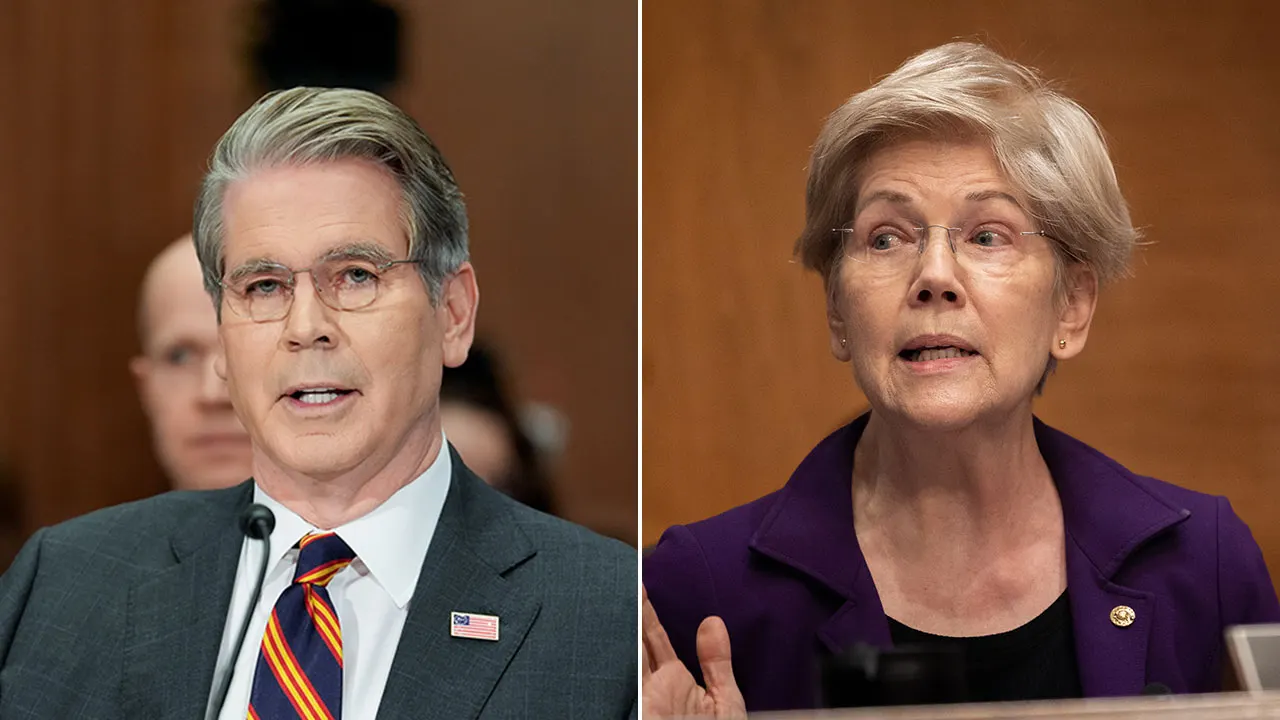
A split graphic showing Treasury Secretary Scott Bessent and Sen. Elizabeth Warren, D-Mass.(Getty Images / Getty Images)
“Rather than take my suggestion of studying introductory economics, you have continued your letter-writing crusade and participation in tabloid fodder about the Treasury Department,” he wrote. This statement underscores Bessent’s frustration and signals a refusal to engage with Warren’s critiques on their terms, instead opting for a confrontational approach that could further polarize economic debates crucial for market stability. For market participants, such public feuds among high-ranking officials can be a source of unease, suggesting a lack of consensus on the nation’s economic path, which translates into increased uncertainty regarding future fiscal policy.
Warren sent a letter on Oct. 7 asking for more information about what the Trump Administration is doing to lower borrowing costs for average Americans. Her focus on “average Americans” and “borrowing costs” reflects a populist approach, connecting macroeconomic indicators like Treasury yields directly to household finances. The 10-year Treasury yield is a critical benchmark, influencing everything from 30-year fixed-rate mortgages to corporate bond yields and consumer loan rates. A sustained rise in this yield effectively raises the cost of capital across the economy, impacting everything from housing affordability to business investment decisions, and ultimately, GDP growth.
WATCH: SEN WARREN UNLOADS ON TRUMP’S FED NOMINEE KEVIN WARSH IN EXPLOSIVE HEARING SHOWDOWN
Warren requested Bessent answer her questions by Oct. 21. Her deadline suggests an urgency to address rising yields, which have been a point of concern for investors and policymakers alike given their broad economic implications and potential to slow down economic activity.
In the letter, the senator accuses the Treasury secretary of increasing costs, saying, “The surge in Treasury yields is self-inflicted and follows the Fed’s decision to raise the federal funds rate by a quarter of a percentage point, driven by concerns about inflation.” This accusation places the blame squarely on the administration’s fiscal policies and the Federal Reserve’s monetary tightening. While the Fed’s rate hikes directly influence short-term rates, they also ripple through to longer-term yields, particularly when coupled with expectations of persistent inflation or increased government borrowing. Warren’s argument suggests a direct causal link between the Fed’s actions and the administration’s policy choices, implying a lack of coordination or a detrimental fiscal stance that forces the Fed’s hand.
GOP FISCAL HAWK SOUNDS ALARM ON ‘OUT OF CONTROL’ FEDERAL SPENDING, SAYING ‘BOTH PARTIES HAVE FAILED US’
Bessent refuted that characterization in his letter, adding, “It is difficult to treat your concern as sincere,” adding, “As the federal funds rate climbed from near zero to its highest level in 22 years, with inflation hitting a 40-year high, you were a cheerleader for the Biden Administration’s reckless spending.” This counter-argument shifts the blame from the current administration to the previous one’s fiscal policies, asserting that excessive spending during the Biden era laid the groundwork for the current inflationary environment, which then necessitated aggressive rate hikes by the Federal Reserve. This is a classic “monetary vs. fiscal policy” debate, where each side blames the other’s domain for economic woes. From a market perspective, understanding which narrative gains traction can influence expectations for future fiscal stimulus, central bank actions, and ultimately, inflation forecasts and bond yields, creating a complex environment for investors.
He claimed she blamed the economic consequences at the time on the Federal Reserve, rather than “your own irresponsible fiscal policies.” This highlights a core ideological divide. Democrats often advocate for government spending to stimulate demand and support social programs, while Republicans frequently emphasize fiscal restraint and tax cuts to spur supply-side growth. The market implications of these divergent philosophies are profound: greater spending without commensurate revenue often leads to higher deficits and increased Treasury issuance, which can put upward pressure on yields. Conversely, tax cuts, if not offset by spending reductions, can also inflate deficits, creating a dilemma for bond investors concerned about sovereign risk and the long-term value of government debt.
ON FILING DEADLINE, GOP BLASTS DEMOCRATS FOR OPPOSING TRUMP TAX CUTS, ‘MAKING LIFE MORE EXPENSIVE’
“While you voted for a $5 trillion tax hike on every day Americans, the Working Families Tax Cuts continue to deliver for families and workers across the country,” he wrote. Bessent’s defense of the “Working Families Tax Cuts” (likely a reference to the previous administration’s tax reform package, often framed as benefiting corporations and the wealthy by Democrats) aims to frame the administration’s fiscal approach as pro-growth and beneficial for the middle class. The debate around tax policy’s impact on economic growth, income inequality, and the national debt is central to market sentiment. Investors constantly weigh the potential for future tax reforms and their effects on corporate earnings, consumer spending, and government borrowing needs, all of which directly feed into market valuations and economic forecasts.
Warren claimed in her letter that the tax cuts in the One Big Beautiful Bill will add $4.7 trillion to the national debt over a decade and only benefit the “ultra-wealthy and large corporations — while cutting health care and food assistance for families. Meanwhile, the Iran war has cost taxpayers an estimated $43.6 billion to date, according to the Pentagon.” Warren’s assessment directly links the tax cuts to an increase in the national debt and frames them as regressive. The national debt, now exceeding $34 trillion, is a significant concern for bond investors. A rapidly expanding debt supply, especially without clear plans for fiscal consolidation, can lead to higher term premiums on U.S. Treasuries, pushing yields upward as investors demand greater compensation for holding longer-dated government bonds. The added cost of the Iran war further exacerbates these fiscal challenges, contributing to the overall deficit and the demand for Treasury issuance, raising questions about fiscal sustainability.
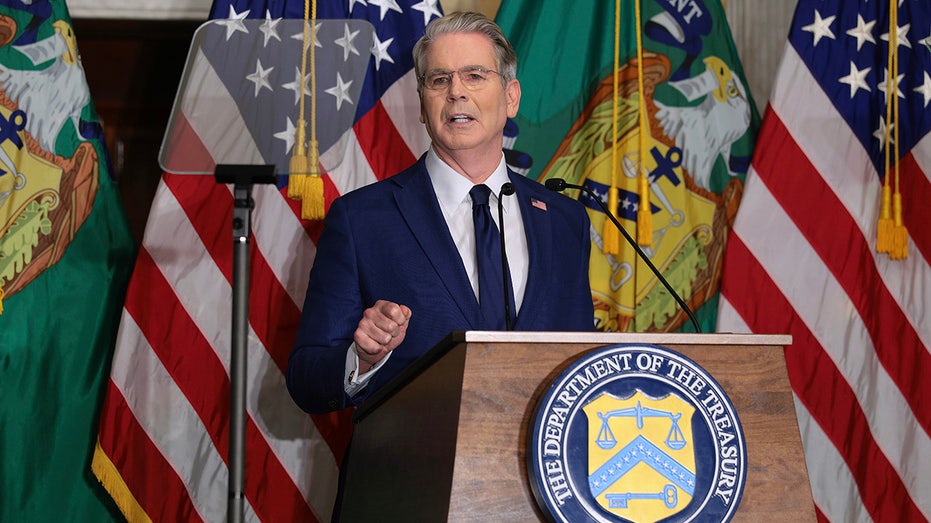
Treasury Secretary Scott Bessent announces a new set of sanctions against Iran, describing them as “an economic D-Day,” in the Cash Room at the Treasury Department on August 24.(Chip Somodevilla/Getty Images / Getty Images)
BESSENT HOSTS FINANCIAL LITERACY FAIR, TOUTS EDUCATION AS KEY TO AMERICAN DREAM
The secretary concluded his letter by jokingly offering “a Foreign Exchange for Dummies tutorial,” adding, “if you receive a passing grade to the Yale metric, not the Harvard curve, I would be happy to also include a Fixed Income for Dummies.” This sarcastic offer, while personal, underscores the technical knowledge required to navigate and understand global financial markets. Foreign exchange (FX) markets, which determine currency values, are crucial for international trade and investment flows, directly impacting the competitiveness of U.S. exports and the attractiveness of U.S. assets to foreign buyers. Fixed income markets, where government bonds like Treasuries are traded, are the bedrock of global finance, providing benchmarks for all other interest rates. The Treasury Secretary’s role involves managing the nation’s debt and currency, making a deep understanding of these markets fundamental. Bessent’s jab implicitly argues that Warren’s criticisms are uninformed by the realities of these complex systems, which require a nuanced approach rather than broad political accusations.
Warren is a former Harvard Law professor and Bessent previously taught economic history at Yale. The academic rivalry embedded in Bessent’s “Yale metric, not the Harvard curve” comment adds another layer to the personal animosity, but also highlights the theoretical underpinnings that often inform policy debates in Washington, though sometimes divorced from market realities and investor sentiment.
CLICK HERE TO DOWNLOAD THE FOX NEWS APP
Warren drew criticism from tribal leaders in 2018 when she took a DNA test to prove distant Indigenous heritage after President Donald Trump had repeatedly mocked her as “Pocahontas” for previously listing herself as an “American Indian” or a minority on professional documents before she was a senator. Warren said that her belief of her ancestry had been passed down to her through family stories, but later apologized to several tribes for taking the DNA test, which they said is not how Native American identity is decided. While seemingly extraneous to market concerns, this historical context reveals the depth of the political bad blood, where personal attacks often overshadow substantive policy discussions that ultimately impact the economic landscape and investor confidence in political stability.
Market Impact:
The escalating rhetoric between the Treasury Secretary and a senior Senator, particularly concerning fiscal policy, national debt, and the drivers of interest rates, introduces an element of political risk into financial markets. Investors are keenly watching the U.S. fiscal trajectory, as sustained large deficits necessitate increased Treasury issuance, potentially pushing benchmark yields higher and increasing the government’s borrowing costs. This environment can lead to higher mortgage rates, dampen corporate investment, and slow economic growth. Furthermore, the public display of deep ideological divisions within Washington on core economic principles can erode investor confidence in long-term policy predictability. While the immediate market reaction to such political spats may be muted, the underlying policy disagreements, if left unresolved, contribute to a higher risk premium for U.S. government debt, affecting everything from the dollar’s strength to global capital flows and the broader equity market outlook. The lack of bipartisan consensus on fiscal matters signals ongoing volatility for fixed-income markets and economic growth projections.