
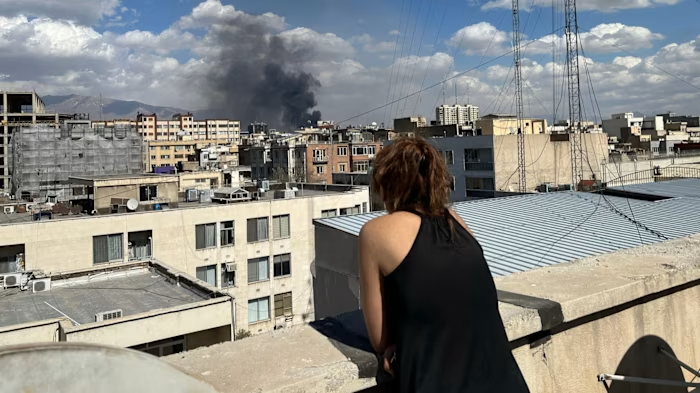
On Sunday, for many hours after the deafening sound of warplanes and huge explosions ripped through an otherwise exceptionally tranquil Tehran, the pungent aroma of volatile compounds still hung in the atmosphere.
Aside from the wisps of ash-grey and charcoal-black smoke spiraling upwards, Tehran’s cityscape — ordinarily concealed by haze and contaminants — was exceptionally lucid, revealing the clearly defined mountain range embracing the metropolis in the distance.
In districts surrounding Vanak Square in central Tehran, where a towering bronze monument portrays the mythical Persian hero Arash the Archer releasing his arrow, residents were diligently sweeping glass fragments from blast-shattered windows into the street.
However, other individuals, emerging from a night devoid of sleep, were abandoning the urban center. Major departure routes leading to northern cities were transformed into unidirectional thoroughfares teeming with outgoing vehicles after the government urged inhabitants to leave Tehran if feasible. Families who stayed mostly remained indoors. Amidst the sounds of detonations, a typically bustling city had become eerily hushed.
Shirin, a Tehran resident who had initially planned to stay put, promptly gathered her belongings to depart for Damavand, east of Tehran, following a nearby bombing on central Sohrevardi Street.
“I cannot remain here and endure this apprehension,” she asserted.
Israel and the US initiated a vast aerial assault against Tehran on Saturday morning, targeting crucial security and military installations. The attacks, which claimed the lives of Ayatollah Ali Khamenei and several high-ranking military commanders, persisted into Sunday.
Maryam, residing in the Jordan district in central Tehran, articulated profound despair after Sunday’s intense shelling.
As an adversary of the government, she had initially endorsed US-Israeli assaults on Iran, but now tearfully declared: “I cannot endure this. My greatest concern is for my children . . . It feels as though this regime is holding us captive.”
The bombardments revived distressing recollections of Israel’s 12-day conflict against Iran last year, in which the US briefly participated.
Iranians were also still grappling with the authorities’ severe suppression of anti-regime demonstrators in January, which resulted in thousands of fatalities.
Around Tehran, plainclothed officers redirected vehicular flow away from the impacted zones. Along the Niayesh highway in northwestern Tehran, municipal workers in orange uniforms cleared demolition debris, while security personnel instructed drivers to proceed cautiously. Ambulances and fire engines were positioned along the highway.
A formidable security presence was conspicuous throughout the city. Security forces on motorcycles and armored vehicles were deployed on the principal arteries. In Vanak, an armed serviceman stood atop a pickup truck surveying the surroundings. Security checkpoints scrutinized vehicles on some roads.
Only a small contingent of inhabitants ventured out to acquire essential provisions on Sunday. All public venues were shuttered, with the exception of food stores and supermarkets, as authorities proclaimed a seven-day national observance to honor Iran’s supreme leader.
Several members of the Ayatollah’s lineage, including his daughter-in-law, son-in-law, and a grandchild, were also verified as fatalities in the assault.
Outside a sizable mosque in Sa’adat Abad’s Kaj Square in western Tehran, which was undergoing refurbishment after being damaged during January’s anti-regime demonstrations, prominent images of Khamenei were erected.
In the square, one of the designated mourning locations, temporary facilities were arranged to distribute sustenance and beverages for the Ramadan iftar meal.
At a municipal fresh produce market in northern Tehran, only a handful of customers quietly moved between vendor stalls. Extensive queues had formed outside fuel stations.
In the otherwise quiet metropolis, pro-government rallies constituted some of the sole activities. Thousands of regime adherents assembled at the emblematic Enghelab Square for a memorial procession, brandishing national banners and holding aloft portraits of Khamenei. Further ceremonies were slated for Sunday evening in several of Tehran’s principal plazas.
Officials endeavored to reassure the populace that vital commodities — ranging from foodstuffs to fuel, medication, and even infant formula — would remain obtainable. They stated that mobile fuel delivery services would be deployed along inter-city routes.
Accounts of civilian casualties augmented residents’ anxieties. In the southern settlement of Minab, within Hormuzgan province, over 150 schoolgirls perished in a Saturday strike, authorities reported. On Sunday, Iran’s Red Crescent indicated that 57 individuals had been killed by midday in Tehran province, without detailing how many were non-combatants.
Currency was accessible at some cash dispensers, but many others were inoperable. The central bank asserted its continued provision of funds to financial institutions, adding that the daily cap for digital banking transfers had been doubled.

New assaults impacted eastern, southeastern, and central Tehran on Sunday evening, as reported by the IRNA news agency.
Throughout the city, a predominant feeling of astonishment prevailed. Zohreh, an inhabitant of Tehran’s Shariati street, where an attack occurred on Sunday, described the detonation as “immense.” “The concussion from the explosion was so potent that it felt as though we were propelled from the ground and flung toward the ceiling,” she recounted.