
Unlock the Editor’s Digest for free
Roula Khalaf, Editor of the FT, selects her favourite stories in this weekly newsletter.
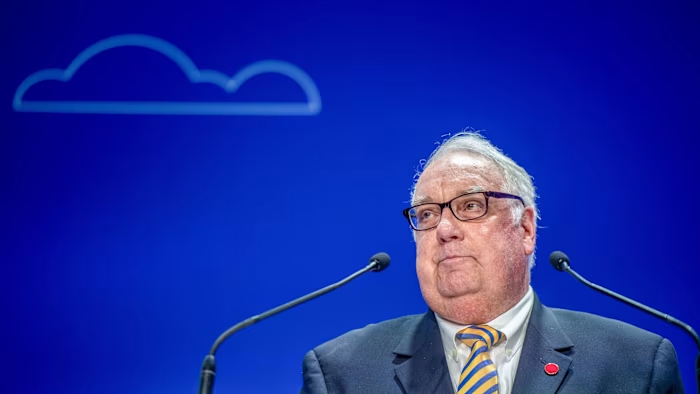
Berkshire Hathaway, the venerable $1.1 trillion conglomerate that has long been a bellwether for value investing, has officially named Howard Buffett as its new chair. This pivotal appointment sees him replace his father, the legendary Warren Buffett, who will transition to the role of chair emeritus. The move marks a definitive moment in the company’s carefully orchestrated succession plan, solidifying the leadership structure that will guide Berkshire into its next chapter.
The elevation of the 71-year-old Howard, the second of Warren’s three children and a Berkshire board director since 1993, comes less than a year after Greg Abel assumed the chief executive role. Together, these appointments cap the most significant leadership shake-up at the company since Warren Buffett took the reins of a struggling New England textile mill in 1965, transforming it into America’s most iconic investment vehicle.
For investors, this transition carries immense weight. The elder Buffett, along with his late business partner Charlie Munger, built Berkshire into a sprawling empire encompassing railways, utilities, and a formidable insurance operation. The “Buffett premium”—the market’s willingness to assign a higher valuation to Berkshire shares due to Warren’s unparalleled leadership and capital allocation acumen—has been a cornerstone of its market identity. The challenge now is to maintain this premium, or at least investor confidence, as the architect steps back.
In a letter to shareholders published on Friday, Warren Buffett articulated the distinct roles within the new leadership paradigm: “Greg runs the company; Howard will guard its culture and values — both worth more than anything on our balance sheet.” This statement is critical, signaling a clear division of labor that seeks to assuage market concerns about continuity. Howard’s non-executive role is not about operational oversight, but rather the preservation of the unique ethos that has defined Berkshire’s long-term success – a culture of integrity, long-term thinking, and disciplined capital allocation that has often run counter to Wall Street’s short-term focus.
While the 96-year-old Warren Buffett will remain on the board and provide “valued judgment and perspective,” his relinquishing of the chair marks a further, albeit gradual, loosening of his grip. In July, he had already outlined final plans for his remaining Berkshire shares, indicating they would be handed to four family-linked foundations within the next eight years. His words to shareholders, “Serving as your chairman has been the privilege of a lifetime, and I have never taken your trust for granted,” alongside the poignant acknowledgment that “Father Time always wins,” underscore the inevitability of this transition.
Christopher Rossbach, chief investment officer of J Stern & Co, a long-term Berkshire shareholder, encapsulated the market sentiment: “This is obviously a really significant moment for investors. The transition is now complete in the way that he’s prepared it for so many years.” This preparedness has been a consistent theme, with Warren Buffett meticulously planning for this day for decades, aiming to minimize any potential market shock or governance vacuum.
Howard’s background, while not traditionally corporate finance, aligns with his designated role. He runs his own charitable foundation and has managed agricultural operations in Nebraska and Illinois. His past experience includes serving on the boards of Coca-Cola and ConAgra Foods, as well as authoring several books and even a stint as a county sheriff. While some analysts might question the lack of a deep corporate finance background for a chair of a $1.1 trillion entity, his role is clearly defined as a cultural custodian rather than an investment strategist or operational head. This was hinted at during a 2011 interview with60 Minutes, where he discussed the potential transition, though at that time, it was suggested his father would remain chair until his death. The earlier-than-expected formal shift reflects a proactive approach to succession.
Kevin Chen, the chief economist of Horizon Financial, a veteran attendee of Berkshire’s annual meetings, reiterated the long-term vision: “The succession has long been planned. Buffett always wanted a family member” to help preserve the company’s culture. This continuity of values, particularly in a company so intertwined with its founder’s personality, is paramount for many investors who hold Berkshire for its stability and ethical approach.
Under Greg Abel’s relatively short tenure as CEO, Berkshire shares have risen approximately 2 per cent since the start of the year. While this represents steady growth, it notably lags behind the robust 11 per cent gain for the benchmark S&P 500 over the same period. This divergence highlights a key market dynamic: Berkshire, often seen as a value play and a defensive holding, typically underperforms during periods of strong market rallies driven by growth stocks. The modest gain also reflects the challenge of deploying its immense cash pile effectively without diluting returns or overpaying in a frothy market. Indeed, the shares saw a slight dip of 0.4 per cent in early trading on Wall Street following the announcement, suggesting a cautious initial market reaction as investors fully digest the implications.
However, Abel has begun to put some of Berkshire’s prodigious $365bn cash pile to work, indicating a more active stance. Recent investments include ploughing $10bn into shares of Alphabet and the agreement in May to acquire US homebuilder Taylor Morrison for $8.5bn. These moves are crucial for market observers, as they offer early glimpses into Abel’s strategic priorities and capital allocation philosophy – an area where he is expected to gradually stamp his own authority while adhering to the core tenets of value investing.
Abel’s statement on Friday acknowledged the significance of Howard’s new role: “We are grateful to Howard for the care, discipline and deep understanding of Berkshire he will bring to his new role.” This mutual endorsement underscores the collaborative nature of the new leadership team. Meanwhile, Susan Decker will continue in her role as the company’s lead independent director, providing an additional layer of corporate governance oversight.
Market Impact
The formalization of Berkshire Hathaway’s succession plan, particularly the naming of Howard Buffett as Chair, is expected to provide long-term stability rather than trigger immediate dramatic shifts in its stock performance. While the shares saw a minor dip post-announcement, this is likely a momentary recalibration as the market processes the finality of the transition. Investors, particularly institutional holders who value predictable governance, will likely view this as a positive step, removing lingering uncertainties about leadership. The clear delineation of roles between Howard Buffett (culture and values) and Greg Abel (operations and investments) helps to preserve the “Buffett premium” of trust and long-term vision, even as the direct influence of Warren Buffett gradually recedes. Moving forward, market attention will increasingly focus on Greg Abel’s capital allocation decisions, especially how he deploys Berkshire’s massive cash reserves in the current economic climate, and whether his strategies can close the performance gap with broader market indices. This completed succession positions Berkshire for a future where its strength will increasingly depend on the robust framework established, rather than solely on the charisma of its founder.