
Gain access to the Editorial Summary at no cost
Roula Khalaf, the FT’s Editor, curates her top pieces in this periodic bulletin.
Fixed-income and stock markets plummeted this past Thursday, with market participants cautioning that the area confronted an “extended energy crisis” subsequent to assaults on energy facilities in Qatar and Iran.
Sovereign debt instruments across the Atlantic suffered setbacks, given that market players anticipated monetary authorities would be compelled to address the escalation in inflation provoked by conflict in the Middle East through raising interest expenses.
Europe’s Stoxx 600 index declined by 2.8 percent that day amidst a widespread downturn, where all segments apart from the energy industry experienced divestment, meanwhile, Wall Street’s S&P 500 slipped 0.9 percent during initial market hours, exacerbating the prior day’s market retreat.
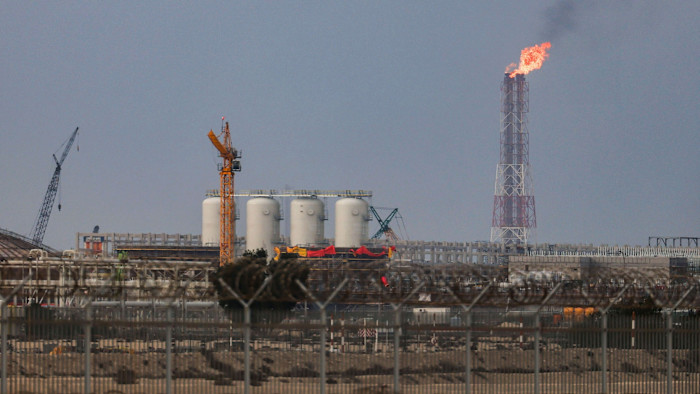
These downturns transpired following Iran’s attack on Qatar’s Ras Laffan natural gas facility, a site that typically supplies 20 percent of global LNG, leading to an additional escalation in the cost of energy.
“Financial markets are beginning to incorporate a sustained energy crisis,” stated Roger Hallam, worldwide director of interest rates at Vanguard.
The trends intensified once the Bank of England indicated its readiness to intervene regarding inflation given the conflict’s effect on fuel costs, mirroring remarks made on Wednesday by Federal Reserve chairman Jay Powell that “elevated energy costs will elevate general inflation” and that a potential increase in interest rates had been broached during the Fed’s deliberations. As anticipated, both monetary authorities maintained their current interest rates.
Yields on two-year US Treasury notes, indicating anticipations for the Fed’s interest rate policy, jumped by 0.12 percentage points to 3.86 per cent.
British sovereign debt suffered the most severe impact from the fixed-income divestment, as the yield for 10-year gilts climbed 0.15 percentage points to 4.89 per cent, its peak since hostilities commenced.
This divestment has propelled Britain’s lending expenses near their peak since 2008.
David Rees, director of worldwide economic research at Schroders, commented: “The present crude oil and natural gas price points are already sufficient to contribute around 1 per cent to overall inflation in the forthcoming period, while a scarcity of agricultural nutrients might elevate food price inflation towards the end of the year.”
As hostilities intensified, a distinct possibility emerged for inflation to surpass the BoE’s 2 per cent objective “for the immediate outlook”, Rees further noted.
Within Germany, yields on 10-year German Bunds increased 0.05 percentage points to around 3 per cent, concurrently, two-year yields climbed 0.13 percentage points to 2.58 per cent. The European Central Bank likewise maintained its interest rates that Thursday.
Economies across Europe are significantly dependent upon petroleum and natural gas originating from the Middle East, rendering the area’s markets particularly susceptible to an interruption in provision.

The TTF, Europe’s gas standard, surged by up to 35 per cent, reaching €74 per MWh that Thursday, a peak not seen since hostilities commenced, prior to a partial rebound to €65 per MWh. Brent crude, the global oil standard, momentarily climbed to $119 per barrel.
The most recent assaults “elevate the potential for market downturns” for financial markets, said Emmanuel Cau, director of European stock strategy at Barclays. “A more prolonged and severe energy crisis will lead to further declines in stock markets.”
The downturns witnessed on Wall Street were less pronounced, owing to the US’s position as a net energy supplier, which aided Wall Street shares in surpassing their European counterparts.
“The US continues to experience the strain of elevated costs and prices, however, its material infrastructure is simply not as dependent [as Europe’s] on the Middle East or on imports whatsoever,” said Peter Schaffrik, worldwide macroeconomic analyst at RBC Capital Markets.